25 Best Things To Do in Mérida, Mexico: 2026 Full Guide

Things to do in Mérida, Mexico range from Mayan museum visits to rooftop restaurant dinners on streets that look unchanged since the 1920s. This is the cultural capital of the Yucatán Peninsula, and it earns that reputation specifically.
The Yucatán State Tourism Board (Turismo Yucatán) identifies Mérida as consistently one of Mexico’s top destinations for cultural and culinary travel. It has held the title of American Capital of Culture twice, a distinction no other Mexican city has matched.
This guide covers the city’s best neighborhoods, top activities, honest seasonal warnings, practical logistics, and a one-day itinerary framework. It also tells you what to skip and what the tourism boards won’t say about the summer heat.
Things To Do in Mérida Mexico: What Makes This City Different
Mérida, Mexico, offers a type of travel experience that resorts in Cancún and Los Cabos cannot replicate: slow, walkable, deeply rooted in Yucatecan identity.
The city’s historic center contains one of the densest concentrations of colonial-era architecture in the Americas. Streets are narrow, painted in warm ochres, creams, and dusty reds.
What separates Mérida from other Mexican colonial cities is how local it remains. San Miguel de Allende has been heavily colonized by foreign retirees. Mérida has not.
The population is predominantly Mexican, the markets are working markets, and the Sunday street events are attended primarily by Meridanos. That local character is the city’s real asset.
Turismo Yucatán notes that Mérida’s metropolitan area population exceeds one million, making it the largest city on the Yucatán Peninsula. Its scale means infrastructure is strong while its character remains intact.
Insider Tip:
- Arrive on a Thursday or Friday to experience the full Sunday event cycle at Plaza Grande.
- The Monday and Wednesday evening shows at Parque Santiago are free and nearly tourist-free.
- Solo travelers find the city especially navigable because pedestrian zones on Calle 60 are active and well-lit every evening.
Mérida Yucatán Things To Do: Overview for First-Time Visitors
The best starting point for Mérida, Yucatán, things to do is the historic centro, which can occupy a full day on its own before you begin day trips.
Plan at minimum three days to experience the city’s core without rushing. Four to five days allows for one or two archaeological site day trips and a cenote visit.
| Activity Type | Time Required | Cost Range | Best For |
|---|---|---|---|
| Historic Centro walk | 2 to 3 hours | Free to low cost | All profiles |
| Gran Museo del Mundo Maya | 2 to 3 hours | Approx. $5 to $10 USD | Culture travelers, families |
| Mercado Lucas de Gálvez | 1 to 2 hours | Low (food purchases) | Budget travelers, foodies |
| Cenote Cuzamá day trip | Full day | $30 to $60 per person | Active travelers, couples |
| Chichen Itza day trip | Full day | $25 to $70 per person | History travelers |
| Hacienda Xcanatún lunch | 2 to 3 hours | $40 to $80 per person | Couples, seniors |
| Celestún flamingo tour | Full day | $50 to $100 per person | Nature travelers, families |
| Sunday Plaza Grande events | 2 to 4 hours | Free | All profiles |
Families with children should prioritize the Gran Museo del Mundo Maya, Parque Centenario (a free zoo and park), and Sunday events at Plaza Grande. The cenotes are excellent for children who can swim but require adult supervision at all times.
Seniors and accessibility travelers will find the historic centro’s flat streets manageable. The Gran Museo del Mundo Maya has full wheelchair access. Cenote visits involve uneven terrain and ladder descents at most sites. Cenote Xlacah at Dzibilchaltún is the most accessible option, with a gentle entry path.
Key Takeaway: Three days minimum in Mérida covers the historic center, one day trip, and the Sunday events cycle. Four days is the sweet spot.
Mérida Colonial Architecture and Historic Center
Mérida’s colonial historic center, known as the Centro Histórico, is the single most concentrated area of Spanish colonial architecture in southeastern Mexico.
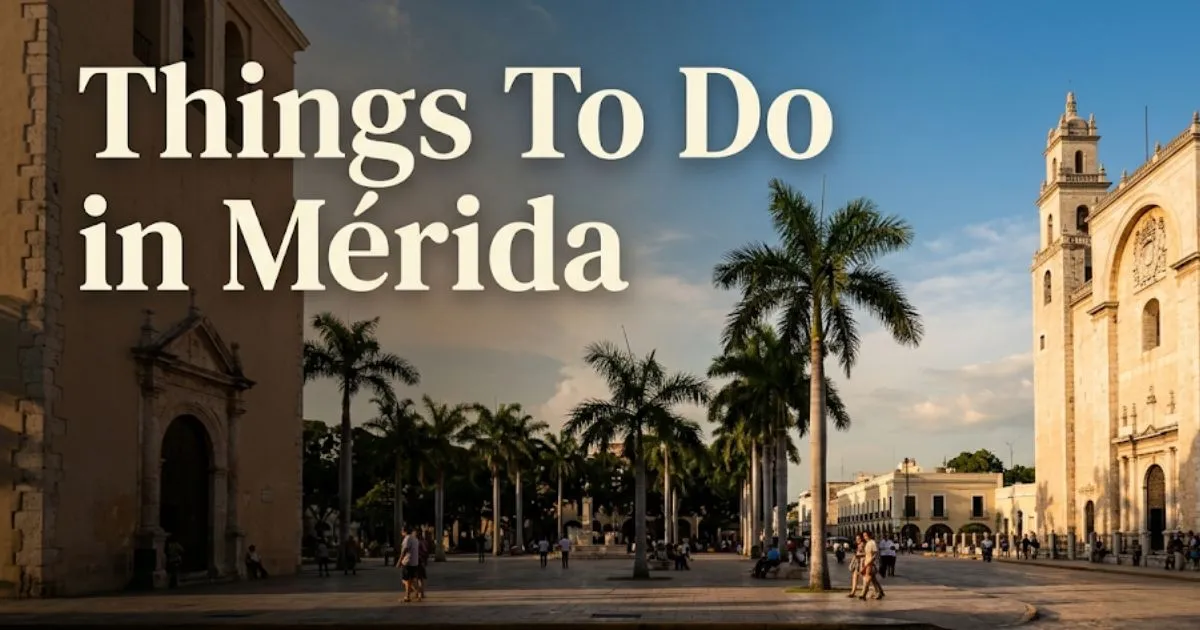
The core is Plaza Grande, the main square framed by the Catedral de San Ildefonso (begun in 1561, making it one of the oldest cathedrals on the American mainland), the Palacio Municipal, and the Casa de Montejo.
Casa de Montejo deserves specific attention. Built in 1549 by the conquistador Francisco de Montejo, its facade features carved stone figures of conquistadors standing on the heads of Mayan warriors. It is a stark, unambiguous colonial document in stone. Entry to the ground floor (now a Banamex cultural space) is typically free.
Calle 60 runs north from Plaza Grande and is the city’s main pedestrian corridor. It connects Plaza Grande to Parque Santa Lucía to Parque Santa Ana, a sequence of plazas and parks that takes about 45 minutes to walk at a casual pace.
Paseo de Montejo is the city’s grand boulevard, lined with Beaux-Arts mansions built by henequen-wealthy Yucatecan families in the late 19th and early 20th centuries. It is Mérida’s answer to Mexico City’s Reforma, at a smaller and more human scale.
The Palacio Cantón on Paseo de Montejo now houses the Regional Anthropology Museum. Admission runs approximately $3 to $5 USD as of recent years. Verify current fees with INAH before visiting.
Insider Tip:
- Walk Paseo de Montejo before 9 a.m. for the best light and no crowds.
- The mansions are most photogenic from the opposite side of the boulevard, not standing directly in front.
- Couples will find the boulevard particularly atmospheric on Sunday evenings when it is closed to vehicles.
Best Neighborhoods in Mérida Mexico
The best neighborhoods in Mérida, Mexico for travelers extend well beyond the historic center, and each rewards different interests.
Barrio de Santiago sits immediately west of the centro and contains some of the city’s best local taco stands, mezcal bars aimed at residents rather than tourists, and the Parque de Santiago, where Monday evening events feature traditional Yucatecan music. It is less polished than the centro and more genuinely inhabited.
Santa Ana is north of the centro along Calle 60. It contains the Parque Santa Ana and a cluster of art galleries, design shops, and restaurants that cater to Mérida’s creative and expat community without being overrun by tourism.
Barrio de Mejorada is east of the centro and contains the Ex-Convento de la Mejorada, a 17th-century convent complex now partly used as an architecture school. The neighborhood is quieter and more residential than Santiago.
García Ginebrés (also spelled García Gineres) is the mid-century residential neighborhood north of the centro where many of Mérida’s wealthiest families live. It contains the best concentration of boutique restaurants and wine bars in the city.
For solo travelers, Barrio de Santiago and Santa Ana are the best bases. Both are walkable from the centro and have the social density needed for a solo traveler to feel comfortably active at night.
For couples, García Ginebrés restaurants offer the most intimate dining atmosphere in the city, away from the tourist foot traffic of Calle 60.
Insider Tip:
- Barrio de Santiago’s best tacos are sold from stands on and around Calle 59. Arrive between 7 p.m. and 9 p.m.
- The Ex-Convento de la Mejorada is free to enter on most weekday mornings. Check current access with local sources before visiting.
Mérida Food Scene and Markets
Mérida’s food scene is one of the strongest arguments for visiting the city. Yucatecan cuisine is distinct from the rest of Mexico’s culinary traditions.
Cochinita pibil is the defining dish: slow-roasted pork marinated in achiote and bitter orange, wrapped in banana leaves, and cooked underground. The version at Mercado Lucas de Gálvez on Sunday mornings, from vendors who have been operating the same stall for decades, is the benchmark by which every other version is judged.
Mercado Lucas de Gálvez (Calle 56 between Calles 67 and 69) is the city’s main working market. It is not a curated food hall. It is a loud, crowded, functional market where locals buy produce, meat, spices, and prepared food. Budget travelers can eat a full breakfast here for the equivalent of two to three US dollars.
Mercado San Benito is the secondary market and is often less crowded at midday. It covers a similar range of products with a slightly calmer atmosphere.
For sit-down Yucatecan food, La Chaya Maya on Calle 62 has served traditional dishes for decades and remains the most consistent introduction to sopa de lima, papadzules, and poc chuc for first-time visitors. It is popular with both locals and visitors, which is a genuine signal of quality rather than a compromise.
For a more local experience, Restaurante Apoala on Parque Santa Lucía focuses on Oaxacan-Yucatecan fusion and is frequented primarily by Meridanos rather than tourists.
Budget travelers can eat extraordinarily well in Mérida without spending more than $10 to $15 USD per day on food if they prioritize markets and street stalls over sit-down restaurants.
Families with children should note that Mercado Lucas de Gálvez involves tight spaces, strong smells, and no air conditioning. Children who are easily overwhelmed by sensory environments may find it stressful. The Sunday outdoor food vendors around Plaza Grande are a more manageable alternative.
Key Takeaway: Eat cochinita pibil from Mercado Lucas de Gálvez on a Sunday morning before 10 a.m. Every other version is a variation on that standard.
Mérida Museums and Cultural Sites
The best museums in Mérida anchor one of Mexico’s strongest concentrations of Mayan cultural interpretation outside Mexico City.
The Gran Museo del Mundo Maya (Calle 60 Norte, north of the centro) is the primary museum. It covers the entire scope of Mayan civilization across four permanent galleries. The architecture alone, a building designed to evoke a ceiba tree in form, justifies the visit. Admission runs approximately $5 to $10 USD per adult as of recent years. Verify current fees before visiting.
The Regional Anthropology Museum in the Palacio Cantón on Paseo de Montejo is the more intimate option. It focuses specifically on Yucatán’s pre-Hispanic and colonial history. Admission typically runs $3 to $5 USD. INAH manages the site.
The Fundación Macay (Museo de Arte Contemporáneo Ateneo de Yucatán) on Plaza Grande is the city’s contemporary art institution. Entry is typically free or low-cost. It focuses on regional and Latin American contemporary work. It is significantly undervisited relative to its quality.
The Olimpo Cultural Center on Plaza Grande hosts rotating exhibitions, concerts, and cultural events. Most programming is free. The rooftop terrace offers a view of the plaza that few visitors find.
Cultural travelers and solo travelers will find Mérida’s museum circuit genuinely rewarding. Budget travelers will appreciate that multiple strong cultural institutions are free or nearly free.
Seniors and accessibility travelers should note that Gran Museo del Mundo Maya has elevators and accessible paths throughout. Regional Anthropology Museum has some stair-heavy sections. Verify accessibility details directly with each venue before visiting.
According to INAH, the Regional Anthropology Museum’s Palacio Cantón collection includes artifacts from the 2,000-year span of Mayan civilization in Yucatán. It is one of the most complete regional collections in Mexico.
Cenotes Near Mérida
The best cenotes near Mérida offer a type of swimming experience that has no equivalent in the Caribbean resort zone: ancient, cathedral-quiet, underground chambers filled with cool, clear freshwater.
Cenote Cuzamá is the most visually dramatic option near Mérida. It involves a horse-drawn cart (a cenote train on narrow rails) through henequen fields to access three connected cenotes. The experience is genuinely unique and takes two to three hours. Located approximately 50 miles southeast of Mérida. Plan for an early start. The cenote trains become crowded by midmorning.
Cenote Xlacah at the Dzibilchaltún archaeological site is the most accessible option. It sits within the archaeological zone, requires no additional logistics beyond entry to the site, and has a relatively gentle entry. INAH manages Dzibilchaltún, located approximately 10 miles north of Mérida.
Cenote Homún is a less-visited alternative in the Homún area (approximately 45 miles from Mérida). The route passes through small villages and the cenote itself is open-air with a partial cave structure. It is significantly less crowded than Cuzamá on weekends.
Active travelers and couples will find Cuzamá the most memorable experience. Seniors and accessibility travelers should prioritize Xlacah, which involves less physical demand. Families with young children need to assess swimming ability carefully. Most cenotes require at least basic swimming competence and do not have lifeguards.
Budget travelers should note that Dzibilchaltún combines the cenote with an archaeological site visit for a single entry fee, making it the highest-value cenote option near Mérida.
Insider Tip:
- Arrive at Cenote Cuzamá before 9 a.m. The experience degrades significantly as tour groups arrive mid-morning.
- Bring water shoes. Cenote floors and entry ladders are often slippery.
- Sunscreen is prohibited at many cenotes to protect the water ecosystem. Verify the specific rules before arriving.
Day Trips From Mérida Yucatán
Day trips from Mérida, Yucatán, reach some of the most significant archaeological and natural sites in the Americas within two hours of the city.
Chichen Itza is approximately 75 miles east of Mérida, a 90-minute drive or bus ride via the ADO first-class bus line. The UNESCO World Heritage Site requires advance timed-entry booking through INAH, particularly for visits between November and March when crowds peak. Budget visitors can take the ADO bus for a fraction of the cost of a guided tour. The site is best entered at opening time (typically 8 a.m.) before the heat and crowds build.
Uxmal is approximately 50 miles south of Mérida. It receives significantly fewer visitors than Chichen Itza and rewards them with arguably better-preserved architecture. The Pyramid of the Magician and the Governor’s Palace are among the finest examples of Puuc-style Mayan architecture in existence. INAH manages the site. Evening sound-and-light shows run seasonally; verify current schedule before visiting.
Izamal is a small Pueblo Mágico town approximately 45 miles east of Mérida. The entire town center is painted a uniform deep yellow. The 16th-century Franciscan convent sits atop a Mayan pyramid base. It is a half-day trip rather than a full day, easily combined with an afternoon return to Mérida.
Progreso is the Gulf Coast beach town 22 miles north of Mérida. It is a functional working port with a long pier. The beach is modest. It is where Meridanos go on hot Sundays, not a resort destination. Bring realistic expectations.
Celestún Biosphere Reserve is approximately 60 miles west of Mérida. Flamingo boat tours depart from the town of Celestún. The reserve holds one of the largest flamingo populations in the world. Tours run approximately $40 to $80 USD depending on boat size. Arrive early; afternoon tours are hot and less productive for wildlife viewing.
Key Takeaway: Uxmal beats Chichen Itza for architecture and atmosphere. Choose Chichen Itza if iconic recognition matters. Choose Uxmal if genuine experience is the priority.
Mérida Sunday Market and Plaza Grande
The Sunday experience at Plaza Grande is the single best free activity in Mérida and one of the best urban cultural events in Mexico.
Every Sunday, the Mérida city government closes Paseo de Montejo and the streets around Plaza Grande to vehicles. The city fills the space with food vendors, artisan markets, live music, and dance performances. The event is called the Sunday Tianguis (market) and is attended overwhelmingly by locals rather than tourists.
The specific highlight is the traditional Yucatecan dance performances held on the Plaza Grande stage. Performers wear traditional white Yucatecan dress. The dances, including the Jarana Yucateca, are a genuine cultural performance rather than a staged tourist show.
Calle 60 becomes a pedestrian promenade from Plaza Grande north to Parque Santa Ana every Sunday. Street food vendors, hammock sellers, and musicians occupy the full length of the street. The atmosphere is closest to what Mérida felt like before tourism arrived.
The city also hosts the Noche Mexicana event most Saturday evenings on Paseo de Montejo. It is a free outdoor cultural event with food, music, and craft vendors. It is less well-known than the Sunday events and correspondingly less crowded.
All traveler profiles benefit from the Sunday events, but families with children and solo travelers gain the most. The events are free, safe, and accessible. The food vendor concentration means budget travelers can eat well for minimal cost.
Seniors and accessibility travelers should note that the Sunday street events involve standing and walking on cobblestone surfaces. Bring supportive footwear. Early afternoon is more comfortable than late morning due to shade patterns around the plaza.
Insider Tip:
- The Saturday Noche Mexicana is a stronger practical choice for travelers who want the same cultural content with smaller crowds.
- Arrive at Plaza Grande by 9 a.m. on Sunday to see the market at its fullest before the midday heat reduces attendance.
Haciendas Near Mérida Mexico
The best haciendas near Mérida, Mexico offer a version of Yucatecan history that no museum can replicate.
Yucatán’s henequen boom in the late 19th and early 20th centuries produced extraordinary private wealth. That wealth built haciendas of staggering scale and ambition. When henequen collapsed as a global commodity, many haciendas fell into ruin. Several have since been converted into hotels and restaurants of exceptional quality.
Hacienda Xcanatún (approximately 9 miles north of Mérida on the road toward Progreso) is the most acclaimed converted hacienda restaurant in the Mérida area. Lunch here costs approximately $40 to $80 USD per person and is worth the investment for the setting, the quality of Yucatecan and French-influenced cuisine, and the property itself. Reservations are strongly recommended.
Hacienda San Antonio Ochil (approximately 25 miles south of Mérida near Abala) combines a functioning agave and henequen exhibition with a restaurant and small cenote on the property. It is a more educational experience than Xcanatún and suits families and cultural travelers more than pure luxury seekers.
Hacienda Sotuta de Peón (approximately 45 miles southeast of Mérida) is the only working henequen hacienda in Yucatán that offers guided tours of the full production process alongside a cenote swim. It is the most complete hacienda experience available as a day trip from Mérida.
Couples will find Hacienda Xcanatún the most romantic option. The restored main building, gardens, and pool area make it a viable overnight choice. Rates run approximately $200 to $400 per night as of recent years.
Budget travelers should note that hacienda restaurants serve lunch as their primary service and often close or limit service in the evening. A hacienda lunch is a better value entry point than a hacienda overnight for budget-conscious visitors.
Best Time To Visit Mérida Mexico
The best time to visit Mérida, Mexico is November through February, when temperatures are manageable, rain is rare, and the city’s calendar is at its most active.
November through February brings daytime highs typically in the mid-80s°F with low humidity. Evenings cool to the 60s°F and 70s°F. Walking the historic center at noon in February is entirely comfortable. Walking it at noon in June is not.
March sees the beginning of warming. Mérida’s Carnaval, held in February or early March depending on the calendar year, is the largest Carnaval celebration in the region and draws significant crowds. Book accommodation four to six weeks in advance for Carnaval dates. Verify 2026 specific dates with Turismo Yucatán.
April and May see temperatures regularly reaching 100°F to 104°F. This is when the heat becomes a practical constraint on outdoor activity. If visiting in these months, structure outdoor sightseeing before 10 a.m. and after 5 p.m. Cenote swimming becomes especially appealing as a midday option.
June through October is rainy season. Afternoon downpours of 30 to 90 minutes are typical. The rain cools the air temporarily but resumes the humidity immediately after. Hurricane season peaks in August through October and can affect coastal day trips to Celestún and Progreso. Monitor forecasts daily during this period.
Budget travelers should note that April through June offers the lowest hotel rates of the year. The heat is a trade-off that budget travelers may be willing to accept.
Seniors and travelers with heat sensitivity should avoid April through August without careful planning. Heat exhaustion risk is genuine and not to be minimized.
Key Takeaway: Visit November through February for the best outdoor experience. If you must visit in summer, build your entire day around the heat: outdoors at 7 a.m., indoors from 11 a.m. to 5 p.m., outdoors again at dusk.
How To Get Around Mérida
Getting around Mérida does not require a rental car for city activities. It does require one for almost every day trip.
The city’s historic center is walkable. Plaza Grande to Parque Santa Lucía is a 10-minute walk. Plaza Grande to the Gran Museo del Mundo Maya (on Calle 60 Norte) is a 20-minute walk or a short taxi ride. Paseo de Montejo is 15 minutes by foot from Plaza Grande.
Colectivo taxis are the primary local transit for distances beyond walking range. They run fixed routes for a flat fare of approximately 10 to 15 Mexican pesos as of recent years. They are efficient, used by locals, and require knowing the general route. For first-time visitors, app-based taxis are easier.
Indriver and Uber both operate in Mérida and are the practical choice for non-Spanish-speaking travelers. Fares within the centro run approximately $2 to $5 USD. Fares to the Gran Museo or Parque Centenario run $3 to $7 USD.
For day trips: ADO bus lines connect Mérida to Chichen Itza, Uxmal, and Progreso with first-class buses at reasonable fares. The Chichen Itza route runs approximately $10 to $20 USD each way as of recent years. Verify current fares at the Mérida ADO terminal (located near the centro on Calle 71).
Car rental is available at Mérida International Airport (MID) through major agencies. A rental car is essential for Cenote Cuzamá, Hacienda Sotuta de Peón, Río Lagartos, and Celestún. Traffic in the centro is congested. Parking in the historic center is limited and often on narrow streets.
Mérida International Airport (MID) (Manuel Crescencio Rejón International Airport) is approximately 6 miles southwest of the historic center. Taxis from the airport to centro run approximately $10 to $20 USD. App-based taxis are available on arrival.
Mérida Mexico Safety for Tourists
Mérida is among the safest cities in Mexico for international tourists. The US State Department assigned Yucatán state a Level 1 travel advisory (Exercise Normal Precaution) as of recent reporting. Verify the current advisory status at travel.state.gov before departure.
Practical safety context: Mérida is a city of one million people. It has the infrastructure, police presence, and civic culture of a functioning regional capital. The standard urban precautions that apply anywhere apply here.
Key safety and practical facts every visitor to Mérida should know:
- Petty theft is the primary risk in crowded areas. Keep bags closed and phones out of sight at Mercado Lucas de Gálvez and Sunday market events.
- Heat exhaustion is a genuine health risk from April through August. Drink water constantly. Plan shade breaks. Avoid midday outdoor exertion.
- Traffic in the historic center is chaotic by US standards. Cross streets carefully. Sidewalks are narrow in many areas.
- Road conditions on routes to cenotes and archaeological sites outside the main highways can be rough. Drive defensively.
- Water: Drink bottled or filtered water only. Tap water is not safe to drink. This applies universally in Mérida.
- Pharmacies are abundant in the centro. For serious medical needs, Mérida has quality private hospitals, including Star Médica and Clínica de Mérida.
Solo travelers, particularly solo women, consistently report Mérida as one of the most comfortable cities in Mexico for independent travel. Street harassment is low by regional standards. Nighttime walking in the centro and on Calle 60 is standard among locals.
Bold instruction: Do not drink tap water, even in good hotels. Use bottled water for brushing teeth if you have a sensitive stomach.
One-Day Mérida Itinerary
A single well-structured day in Mérida can cover the historic center, a market breakfast, a museum, and an evening cultural event without rushing.
This itinerary assumes arrival the night before or an early morning start. It works best Tuesday through Sunday, as some sites have reduced Monday access.
One-Day Mérida Itinerary:
- 7:00 a.m. Walk Paseo de Montejo. The boulevard is quiet, the light is excellent, and the mansion facades are at their most photogenic before the heat builds. Allow 45 to 60 minutes.
- 8:30 a.m. Breakfast at Mercado Lucas de Gálvez. Order panuchos or a full cochinita pibil plate. Budget approximately $3 to $6 USD. The market vendors typically begin full service by 7:30 a.m.
- 10:00 a.m. Walk Calle 60 from Plaza Grande to Parque Santa Lucía. Stop at the Catedral de San Ildefonso and the exterior of Casa de Montejo. Enter the Olimpo Cultural Center if current exhibitions interest you. Entry is typically free.
- 11:30 a.m. Visit the Gran Museo del Mundo Maya. This is the correct midday activity because it is fully air-conditioned. Allow two to three hours. Admission runs approximately $5 to $10 USD.
- 2:00 p.m. Lunch near the museum at a mid-range Yucatecan restaurant. La Chaya Maya on Calle 62 is the most reliable option for traditional cuisine at a fair price.
- 3:30 p.m. Rest, read, or explore a neighborhood during the hottest part of the afternoon. Barrio de Santiago is walkable from the centro and shows the city’s less-polished, more authentic residential character.
- 6:00 p.m. Return to Plaza Grande as the evening cools. The plaza animates at dusk with locals, musicians, and vendors. If it is a Sunday, stay for the cultural dance performances.
- 8:00 p.m. Dinner in Santa Ana or García Ginebrés. Restaurante Apoala near Parque Santa Lucía is a strong choice. Budget $20 to $40 USD per person for a sit-down dinner with drinks.
Key Takeaway: The Gran Museo del Mundo Maya is non-negotiable on a one-day Mérida itinerary. Do it during the midday heat. Do the outdoor walking before 10 a.m. and after 5 p.m.
Mérida Mexico Budget Travel Tips
Mérida is one of the best-value cities in Mexico for budget travelers. You can experience a full day of culture, history, and excellent food for $20 to $35 USD total.
The city’s free and low-cost offerings are genuinely strong, not budget-traveler compromises. The Sunday events at Plaza Grande, the Olimpo Cultural Center exhibitions, the Noche Mexicana on Saturday evenings, and the Catedral de San Ildefonso are all free. The Paseo de Montejo walk costs nothing.
Free and low-cost activities in Mérida:
- Plaza Grande Sunday events and Noche Mexicana Saturday events (free)
- Catedral de San Ildefonso entry (free, donations accepted)
- Olimpo Cultural Center exhibitions (typically free)
- Parque Centenario (free zoo and botanical garden, west of the centro)
- Calle 60 pedestrian promenade (free; market stalls are optional purchases)
- Barrio de Santiago neighborhood walk (free)
- Palacio Municipal interior (free to enter during business hours)
- Monday evening Yucatecan music at Parque de Santiago (free)
Budget travelers should stay in guesthouses or budget boutique hotels in or near Barrio de Santiago. Rates run approximately $25 to $55 USD per night for basic but clean private rooms. Hostel dormitory beds are available from approximately $12 to $20 USD per night.
The ADO bus to Chichen Itza is significantly cheaper than a guided tour. The trade-off is no guide context. Many budget travelers supplement the bus trip with a Spanish-language audio guide app or purchase a guide book at the site entrance.
Insider Tip:
- The INAH national sites (Uxmal, Dzibilchaltún, Chichen Itza) are free for Mexican citizens on Sundays. As an international visitor, you pay the standard fee. Budget for $15 to $30 USD per site for entry.
- Eating comida corrida (the set lunch menu) at local restaurants in Barrio de Santiago typically runs $4 to $7 USD for three courses, including water or a soft drink.
Mérida Mexico for Different Traveler Types
Mérida suits specific traveler profiles extremely well and others less so. Understanding which applies to you changes how you plan the trip.
Profile 1: Solo Travelers. Mérida is one of the most solo-traveler-friendly cities in Mexico. The historic center is compact and navigable on foot. The evening social scene on Calle 60 and Plaza Grande provides natural opportunities for interaction without requiring nightlife. Spanish-speaking solo travelers gain significantly more access to local culture, but non-Spanish speakers navigate fine. Budget solo travelers can operate comfortably on $40 to $60 USD per day including accommodation, food, and entry fees.
Profile 2: Couples and Romantic Travelers. Mérida works exceptionally well for couples who prioritize atmosphere over activity quantity. Hacienda dinners, rooftop restaurants in the centro, evening walks on Paseo de Montejo, and boutique hotel stays in converted colonial mansions make the city genuinely romantic. The Sunday market is an excellent shared experience. Couples who want beach-and-pool romance should add a Riviera Maya extension to the trip.
Profile 3: Families with Children. Mérida works best for families with children aged 8 and up. The Gran Museo del Mundo Maya holds children’s interest well. The Parque Centenario has a free zoo and open space. Cenote swimming is thrilling for older kids. Families with toddlers or infants face practical challenges: cobblestone streets, heat, and the general pace of a culture-focused city that does not have dedicated children’s infrastructure at resort levels.
Profile 4: Budget Travelers. Mérida is possibly the best-value cultural city in Mexico for budget travelers. The combination of free cultural events, low-cost markets, affordable local transit, and modestly priced accommodation makes $40 to $60 USD per day genuinely achievable.
Profile 5: Seniors and Accessibility Travelers. November through February is the critical timing recommendation for this profile. The heat between April and August is a genuine health risk, not an inconvenience. In cooler months, the flat historic center is manageable for most seniors. The Gran Museo del Mundo Maya is fully accessible. Cenote visits are generally not recommended for travelers with significant mobility limitations.
| Traveler Profile | Best Activities | Suggested Budget/Day | Best Season | One Thing to Know |
|---|---|---|---|---|
| Solo Travelers | Calle 60 evenings, markets, museums, neighborhoods | $40 to $60 USD | Nov to Feb | Safety is high; Spanish helps but isn’t required |
| Couples | Hacienda Xcanatún, Paseo de Montejo, boutique hotels | $120 to $250 USD | Nov to March | Avoid mid-summer heat for romantic atmosphere |
| Families | Gran Museo, Parque Centenario, Sunday events, cenotes | $80 to $150 USD | Dec to Feb | Heat is the biggest challenge; plan midday rest |
| Budget Travelers | Sunday events, Lucas de Gálvez, free museums, ADO bus | $35 to $55 USD | April to June | Rates drop in hot months; heat is the trade-off |
| Seniors | Centro walks, Hacienda Xcanatún, Dzibilchaltún | $80 to $200 USD | Nov to Feb | Avoid April to August entirely if heat-sensitive |
The honest note for families: Chichen Itza with children under 8 sounds compelling but rarely delivers. The site is large (more than a mile of walking in sun), has no shade on the central plaza, and the main pyramid cannot be climbed. Children lose interest quickly. Save Chichen Itza for when they’re old enough to appreciate the context.
Safety and Practical Warnings for Mérida, Mexico
The primary safety concern for travelers in Mérida is not crime. It is heat.
Between April and August, temperatures regularly reach 100°F to 104°F with high humidity. This is not “warm.” It is a heat-stress environment that requires active management.
Key safety and practical facts every visitor should know:
- Heat management: Schedule outdoor activity before 10 a.m. and after 5 p.m. from April through August. The midday window is for air-conditioned museums, restaurants, and hotel rooms.
- Hydration: Carry 1 to 2 liters of bottled water at all times in warm months. Dehydration in tropical heat comes on faster than most travelers expect.
- Sun protection: SPF 50 sunscreen, a hat with full brim, and UV-protective clothing are practical necessities in summer, not optional accessories.
- Water safety: Drink only bottled or filtered water. This applies to ice in drinks at restaurants. Choose bottled beverages or restaurants you have confirmed use filtered ice.
- Petty theft: Mérida’s crime rate is low by regional standards, but markets and crowded Sunday events attract the opportunistic theft that exists in any populated public space. Use a cross-body bag. Keep phone inside your bag, not in your hand.
- Traffic: Mérida’s historic center streets are narrow and traffic does not slow for pedestrians by instinct. Cross carefully. Do not assume right-of-way.
- Medical access: Mérida has quality private hospitals including Star Médica and Clínica de Mérida. Travel insurance with medical evacuation coverage is strongly recommended for any international trip.
For emergencies in Mexico, dial 911. The number operates nationally.
Frequently Asked Questions About Things To Do in Mérida
What is Mérida, Mexico best known for?
Mérida is best known for its well-preserved colonial architecture, Yucatecan cuisine (particularly cochinita pibil), and its position as the gateway city for Mayan archaeological sites including Chichen Itza and Uxmal.
The city also holds a strong reputation for safety, cultural events, and a quality of life that has attracted both Mexican nationals and international residents.
It is the cultural and economic capital of Yucatán state and has been designated American Capital of Culture twice by the Organization of American States.
Is Mérida, Mexico safe for tourists?
Mérida is considered one of the safest cities in Mexico for international tourists.
The US State Department assigned Yucatán state a Level 1 travel advisory (Exercise Normal Precaution) as of recent reporting, the same level applied to many European destinations.
Verify the current advisory status at travel.state.gov before departure, as advisories are subject to change.
What is the best time of year to visit Mérida?
The best time to visit Mérida is November through February, when temperatures range from the low 70s°F to the low 90s°F with low humidity.
February or early March brings Carnaval, the largest street festival in the region, which adds significant energy to the city but also increases accommodation demand.
Avoid May through August if heat sensitivity is a concern; temperatures regularly exceed 100°F during those months, which constrains outdoor activity to early morning and evening hours.
How many days do you need in Mérida?
Three to four days is the ideal length for a first visit to Mérida.
Three days covers the historic center, one day trip (either Chichen Itza or a cenote), and the Sunday events at Plaza Grande.
Four to five days allows for two day trips, deeper neighborhood exploration, and a hacienda lunch or dinner without rushing any single experience.
What are the best cenotes near Mérida?
The best cenotes near Mérida for most travelers are Cenote Cuzamá (for visual drama and a unique horse-drawn cart approach, approximately 50 miles away) and Cenote Xlacah at Dzibilchaltún (for accessibility and proximity, approximately 10 miles from the city center).
Cenote Homún near the town of Homún is the best option for travelers seeking a less-crowded alternative, approximately 45 miles from Mérida.
Arrive at any cenote before 9 a.m. to experience it before tour groups arrive; all three sites become significantly more crowded by late morning.
Can you do a day trip to Chichen Itza from Mérida?
Yes, Chichen Itza is a standard day trip from Mérida, located approximately 75 miles east and reachable in 90 minutes by car or ADO first-class bus.
Book timed-entry tickets in advance through INAH, particularly between November and March when visitor volume is highest. The site opens typically at 8 a.m. and the first two hours are significantly less crowded than midday.
Budget travelers should take the ADO bus (approximately $10 to $20 USD each way as of recent years) rather than a guided tour, which typically costs $60 to $120 USD per person, and use the savings for a guide book or audio guide at the entrance.
Mérida rewards travelers who arrive with a plan and flexible expectations about pace. Book the Gran Museo del Mundo Maya early in your stay. Schedule your Chichen Itza or Uxmal day trip with advance INAH timed-entry tickets.
If you visit between November and February, you will find the city at its most comfortable and its most active. That is the practical decision that matters most.
Travel conditions, operating hours, admission prices, and US State Department advisory levels change. Verify all key logistics directly with Turismo Yucatán, INAH, and the US State Department at travel.state.gov before departure. The specific information in this guide reflects general conditions and recent reporting. Your pre-trip verification is the final step.