
Best Things To Do in Rome, Italy: 2026 Travel Guide

The best things to do in Rome, Italy span 2,700 years of history in a walkable city center that remains one of the most concentrated collections of landmark sites in the world. Rome is not just a checklist. It is a place where an afternoon wander through Trastevere or a morning espresso at a neighborhood bar earns as much as any museum visit.
Rome draws more than 7 million international tourists annually, according to the Italian National Tourist Board (ENIT). Most of them make the same planning mistakes. This guide is built to help you avoid every one of them.
You will find here specific named venues, booking requirements, neighborhood-by-neighborhood guidance, and honest seasonal context. Everything is organized so you can build an actual itinerary, not just read a list of famous places.
Things To Do in Rome: What Makes the Eternal City Worth Your Time
Rome rewards travelers who arrive knowing the city is genuinely layered: ancient, medieval, Renaissance, and Baroque coexist within blocks of each other.
The Pantheon sits alongside a medieval church. A Roman Forum column rises between a cafe and a souvenir shop. This physical density of history is not replicated anywhere else in Europe at this scale.
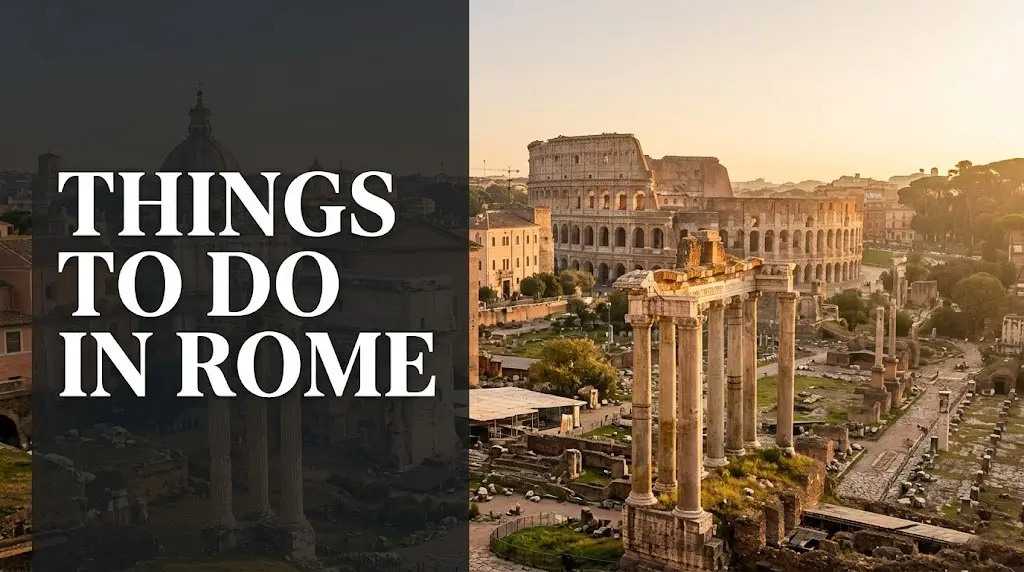
Rome’s centro storico (historic center) is compact enough to walk across in 40 minutes. Yet it packs more UNESCO-listed heritage into those kilometers than most countries contain in total.
The city operates on a different time logic than Northern European cities. Lunch runs from 1 pm to 3 pm. Dinner rarely starts before 8 pm. Plan your sightseeing schedule around this reality, not against it.
For solo travelers: Rome’s piazza culture makes solo exploration natural and social. Piazza Navona and Campo de’ Fiori are excellent evening gathering points that never feel isolating.
For families: The sheer visual drama of the Colosseum works on children of all ages. The cobblestone terrain does not work with strollers.
The honest starting point: Rome is extraordinary and exhausting in equal measure. Heat, crowds, and uneven terrain are real. The payoff is proportional.
- Best for: History-motivated travelers, food-focused couples, culturally curious solo visitors, art and architecture enthusiasts.
- Genuinely challenging for: Families with toddlers, travelers with significant mobility limitations, anyone expecting predictable schedules and air-conditioned comfort throughout.
Top Things To Do in Rome for First-Time Visitors
The top things to do in Rome for first-time visitors are the Colosseum, Roman Forum, Vatican Museums, and Trastevere on foot, booked in advance and sequenced to minimize backtracking.
Every first-time visitor should understand one structural fact. The Vatican and the Colosseum are on opposite sides of the historic center. Trying to visit both in the same morning means crossing the city during the hottest, most crowded midday hours.
Insider Tip:
- Book the Vatican for your first or second morning. Lines build after 10 am and become brutal by noon.
- Book the Colosseum for a late afternoon slot. The golden light in the arena after 4 pm is exceptional. Crowds thin noticeably compared to midday.
- Spend your first evening in Trastevere rather than near the Trevi Fountain. The neighborhood is walkable, genuinely residential, and the restaurant quality is higher.
For couples: Book a sunset viewing slot at Castel Sant’Angelo. The terrace view over the Tiber River at dusk is among Rome’s most genuinely romantic experiences.
For budget travelers: The Roman Forum and Palatine Hill are included in the Colosseum ticket. That combined ticket covers Rome’s most significant archaeological site for the price of one entry.
According to Comune di Roma Capitale, the Colosseum area receives over 7 million visitors per year, making advance booking not a convenience but a practical necessity from March through October.
| Attraction | Best Time to Visit | Book in Advance? | Approx. Entry Cost |
|---|---|---|---|
| Colosseum | Late afternoon (4 pm+) | Yes, weeks ahead in peak season | 18-25 euros per adult |
| Vatican Museums | First morning slot, 8 am | Yes, weeks ahead | 20-28 euros per adult |
| Borghese Gallery | Any timed slot | Yes, mandatory | 15-20 euros per adult |
| Pantheon | Weekday mornings | Timed entry required | Verify current fee |
| Roman Forum | Same ticket as Colosseum | With Colosseum booking | Included in combo |
Verify all current pricing and booking requirements directly with official venue websites before your visit.
Things To Do in Rome, Italy: The Colosseum, Forum, and Ancient Core
The Colosseum is the single most visited site in Italy and genuinely earns its reputation, though the experience depends entirely on how you approach it.
The building held 50,000 to 80,000 spectators in its operational era. Standing on the arena floor level, which is accessible on certain ticket tiers, makes that scale viscerally real in a way that the exterior view alone does not.
The Roman Forum is attached to the Colosseum ticket and covers the civic heart of ancient Rome. Walk the Via Sacra from the Arch of Titus toward the Temple of Saturn. This sequence tells the story of imperial Rome more efficiently than any museum display.
Palatine Hill, included in the same combined ticket, sits above the Forum and offers the best elevated view of the Forum ruins below. Most visitors skip it because they are tired after the Colosseum. This is the single biggest tactical mistake in Rome sightseeing.
For seniors and accessibility travelers: The Colosseum’s lower levels are accessible via elevator. The Roman Forum terrain is uneven stone and unpaved paths. The full Forum and Palatine Hill circuit involves significant walking on difficult terrain. Plan accordingly.
For families: The underground Colosseum tour, available at a premium ticket tier, is genuinely engaging for older children. The standard arena level tour is enough for younger visitors.
Local alternative: The Circus Maximus, two kilometers south, held 250,000 spectators and is free to enter. It is entirely unroofed green space now, but its scale is astonishing. Experienced repeat visitors rate it as the better place to understand ancient Roman public life at its most democratic.
Insider Tip:
- Arrive at the Colosseum from the Palatine Hill/Via Sacra entrance rather than the main front entrance on Via dei Fori Imperiali. The queue is shorter almost every time.
- The Arena Floor access requires a specific ticket tier. Book this tier in advance, not as an upgrade on arrival.
- Wear closed-toe shoes. The Forum terrain is ankle-twist territory in sandals.
Best Things To Do in Rome Beyond the Obvious Tourist Circuit
The best things to do in Rome beyond the obvious tourist circuit start in Testaccio, the neighborhood where Roman culinary identity is most honestly preserved.
Testaccio is built on a former slaughterhouse district. Its food culture reflects that working-class history. The Mercato di Testaccio on Via Beniamino Franklin is a covered market where locals shop daily. Stall 15 inside serves supplì (fried rice balls with mozzarella) that are more representative of authentic Roman street food than anything near the Trevi Fountain.
The Aventine Hill is two kilometers from Testaccio and almost entirely ignored by first-time visitors. The Orange Garden (Giardino degli Aranci) on the hill’s southern edge offers one of Rome’s best views over the Tiber River and St. Peter’s Basilica. Entry is free. There is almost never a crowd.
The Knights of Malta Keyhole on the Aventine, a small metal door at Piazza dei Cavalieri di Malta, frames a perfectly composed view of St. Peter’s dome through a carefully aligned garden path. It is genuinely one of Rome’s most distinctive visual experiences and costs nothing.
For solo travelers: The Testaccio market in the morning, followed by the Aventine Hill walk, makes a full half-day that feels entirely local. Almost no tour groups.
For budget travelers: This entire route costs nothing beyond the market food you buy. Budget 8 to 12 euros for a full market lunch.
Overrated honest note: The Trevi Fountain is genuinely beautiful. It is also almost always surrounded by shoulder-to-shoulder crowds, making quiet appreciation difficult. Visit at 6 am or 7 am if you want it to yourself. Experienced repeat visitors rank it low on the return-visit priority list for exactly this reason.
Fun Things To Do in Rome, Italy That Go Beyond the Guidebook
Fun things to do in Rome, Italy beyond the standard sights include the Porta Portese flea market, the Appian Way by bike, and a traditional aperitivo circuit through the Pigneto neighborhood.
Porta Portese runs every Sunday morning from dawn to approximately 2 pm on Viale Trastevere. It is Rome’s largest and oldest flea market, mixing antique furniture, vintage clothing, old books, and the kind of chaotic browsing that rewards patience. Arrive by 8 am for the best selection before the crowds arrive.
The Via Appia Antica (Appian Way) is Rome’s oldest road, built in 312 BC. Renting a bicycle from one of the shops near the Parco della Caffarella entrance and riding south along the ancient road through tombs and countryside is unlike anything else you can do in a European capital. Traffic is restricted on Sunday mornings along the most scenic stretch.
For couples: The Sunday Via Appia ride, followed by a late lunch in Testaccio, is one of Rome’s best date experiences. It requires comfortable shoes, a sense of adventure, and about four hours total.
For families: The Bioparco di Roma in Villa Borghese park is a well-maintained zoo directly accessible from the Borghese Gallery area. It works well for younger children who have reached their museum limit.
According to ENIT, Rome’s Appian Way Regional Park encompasses over 3,400 hectares of protected land within the city limits. That scale is remarkable for a European capital and largely unknown to first-time visitors.
- Porta Portese: Sunday mornings only, Viale Trastevere, free entry, bring cash
- Appian Way by bike: Sunday morning for traffic-free riding, bike rental approximately 10 to 15 euros per day
- Aperitivo in Pigneto: Thursday through Saturday evenings, Via del Pigneto, budget 8 to 12 euros per drink with included food
- Janiculum Hill (Gianicolo): Daily, free, best views at sunset, cannons fired at noon daily
Cool Things To Do in Rome for Culturally Curious Travelers
The coolest things to do in Rome for culturally curious travelers start at the Borghese Gallery, which houses one of the most important collections of Baroque sculpture in the world in a setting that is itself a work of art.
Galleria Borghese limits entry to 360 visitors per two-hour session. This is mandatory. It cannot be entered without an advance reservation. The benefit is that you experience Bernini’s sculptures of Daphne and Apollo, the Rape of Proserpina, and David in rooms that feel like private viewing rather than crowded museum halls.
Book Borghese Gallery a minimum of two weeks in advance during spring and fall. During July and August, book a month out. This is the most undersupported practical fact in all Rome travel content.
Castel Sant’Angelo is the most underrated paid site in Rome. Built as the mausoleum of Emperor Hadrian, converted to a papal fortress, connected to the Vatican by the elevated passageway called the Passetto di Borgo, it contains six floors of Roman, medieval, and Renaissance history. The rooftop terrace view is Rome’s best 360-degree panorama.
For solo travelers: The Castel Sant’Angelo audio guide is among Rome’s best. It provides context that transforms a walking tour into a genuine narrative about papal power, imprisonment, and survival. Benvenuto Cellini escaped from here. Pope Clement VII hid here during the 1527 Sack of Rome.
For seniors: Castel Sant’Angelo has elevator access. The Borghese Gallery is a single-level experience with minimal physical demand. Both are significantly more accessible than the Forum terrain.
Local alternative: The MAXXI (National Museum of 21st Century Arts) in the Flaminio neighborhood is designed by Zaha Hadid and is genuinely one of the most architecturally significant contemporary museum buildings in Europe. Experienced visitors rank it among Rome’s best museum experiences and it is rarely crowded.
Key Takeaway: Book the Borghese Gallery at least two weeks ahead. Walk-ins are not accepted. Ever.
Top 10 Things To Do in Rome, Italy: The Essential Hit List
The top 10 things to do in Rome, Italy cover ancient history, Renaissance art, Baroque architecture, local food culture, and neighborhood walking in a sequence that can be distributed across three to five days.
| Activity | Best For | Cost Range | Time to Allow | Insider Note |
|---|---|---|---|---|
| Colosseum + Forum + Palatine | All profiles | 18-25 euros | Half day | Late afternoon slot for light and smaller crowds |
| Vatican Museums + Sistine Chapel | Art lovers, first timers | 20-28 euros | 3-4 hours minimum | Book 8 am first slot |
| Borghese Gallery | Culture-focused travelers | 15-20 euros | 2 hours (mandatory limit) | Reserve minimum 2 weeks ahead |
| Trastevere walking | Couples, solo travelers | Free | 2-3 hours | Best on weekday evenings |
| Testaccio food market | Food-focused, budget travelers | 0 entry, 8-15 euros food | 2 hours | Tuesday through Saturday mornings |
| Castel Sant’Angelo | History lovers, seniors | 15-20 euros | 2-3 hours | Sunset on the terrace is exceptional |
| Pantheon | All profiles | Verify current entry fee | 45-60 minutes | Timed entry now required |
| Appian Way by bike | Active travelers, couples | 10-15 euros bike rental | 3-4 hours | Sunday mornings for traffic-free riding |
| Piazza Navona at dusk | Couples, families | Free | 1 hour | Skip the tourist restaurants immediately around the piazza |
| Aventine Hill + Knights Keyhole | Repeat visitors, solo travelers | Free | 1-2 hours | Best in morning before heat builds |
Verify current pricing and booking requirements for all venues before your visit. Prices and systems change seasonally.
Things To Do Near Rome: The Best Day Trips from the Eternal City
The best day trips near Rome are Ostia Antica, Tivoli with Hadrian’s Villa and Villa d’Este, and the Castelli Romani hill towns, each reachable within 30 to 60 minutes by train or bus.
Ostia Antica is Rome’s version of Pompeii, without Pompeii’s crowds or entrance fees at that scale. The ancient port city of Rome is 30 kilometers southwest, reachable by a 30-minute train ride from Roma Ostiense station. The site’s preserved mosaics, apartment buildings, and baths give a more complete picture of everyday Roman life than the Forum does. Entry costs a fraction of the Colosseum price. Verify current fees before visiting.
Tivoli is 30 kilometers east of Rome, reachable in 50 minutes from Roma Tiburtina station. It holds two UNESCO World Heritage Sites within a few kilometers of each other. Hadrian’s Villa (Villa Adriana) was the emperor’s personal retreat complex, larger than many small cities. Villa d’Este is a 16th-century Renaissance garden with more than 500 fountains that is among the most dramatically beautiful formal gardens in Europe.
For families: Ostia Antica has wide open spaces and far less walking pressure than the Roman Forum. Children can explore more freely. There are food concessions on site.
For budget travelers: Ostia Antica gives a full Roman archaeological experience for significantly less than the major central Rome sites. It is one of the best value-to-experience ratios in the region.
| Day Trip | Distance | Travel Time | Best For | Cost Range | Insider Note |
|---|---|---|---|---|---|
| Ostia Antica | 30 km | 30 min by train | Families, budget travelers | Low entry fee | Combine with a beach day at Lido di Ostia nearby |
| Hadrian’s Villa, Tivoli | 30 km | 50 min by train | History lovers | Moderate entry | Combine with Villa d’Este on same day |
| Villa d’Este, Tivoli | 30 km | 50 min by train | Couples, garden lovers | Moderate entry | Book entrance in advance for peak weekends |
| Castelli Romani | 25 km | 40 min by regional train | Food travelers, wine focused | Low cost | Frascati wine tasting is the main draw |
| Orvieto | 120 km | 75 min by train | Art history lovers | Moderate | Full day trip minimum |
Top 5 Things To Do in Rome If You Only Have 48 Hours
The top 5 things to do in Rome if you only have 48 hours are the Colosseum, the Vatican, a Trastevere evening walk, a morning in the Testaccio market, and a sunset at the Janiculum Hill.
This is not about doing the most. It is about doing the right five things in the right sequence without losing hours to queues, poor restaurant choices, or midday heat.
To get the most from 48 hours in Rome:
- Book the Vatican Museums for Day 1 at the 8 am opening. Arrive 15 minutes early. You will be done by noon before the worst crowds arrive.
- Spend Day 1 afternoon at the Pantheon (timed entry now required, verify current booking) and walk to Piazza Navona. Dinner in Trastevere at da Enzo al 29 on Via dei Vascellari or at any trattoria away from the main Piazza di Santa Maria in Trastevere strip.
- Book the Colosseum for Day 2 at a 4 pm or 5 pm slot. Buy the combined ticket that includes the Forum and Palatine Hill.
- Spend Day 2 morning at the Testaccio market for breakfast and a walking tour of the Aventine Hill, including the Orange Garden and the Knights of Malta Keyhole.
- Close Day 2 at sunset on the Janiculum Hill (Gianicolo). This is Rome’s highest point. The panoramic view is free and the crowd level is a fraction of the Pincian Hill viewpoint in Villa Borghese.
For solo travelers: This 48-hour sequence works perfectly alone. Every venue on the list is safe, walkable, and solo-friendly. Dinner at a trattoria counter in Trastevere is a particularly good solo experience in Rome.
Key Takeaway: Book Vatican at 8 am and Colosseum at 4 pm. These two slots cut your total queue time by hours compared to midday visits.
Things To Do in Rome, Italy by Neighborhood
Rome’s best neighborhoods for visitors are Trastevere, Monti, Prati, Testaccio, and Pigneto, each with a distinct character and best suited to a different traveler type.
| Neighborhood | Character | Best For | Key Streets | Evening Scene |
|---|---|---|---|---|
| Trastevere | Medieval, residential, romantic | Couples, first timers | Via della Lungaretta, Via dei Vascellari | Lively restaurant scene, piazza gatherings |
| Monti | Bohemian, artisan, central | Solo travelers, repeat visitors | Via del Boschetto, Via dei Serpenti | Aperitivo bars, independent shops |
| Prati | Upscale, Vatican-adjacent | Families, seniors | Via Cola di Rienzo, Piazza Risorgimento | Quieter, good restaurants |
| Testaccio | Working-class, food-focused | Food travelers, budget travelers | Via Galvani, Via Beniamino Franklin | Local bars, less tourist-facing |
| Pigneto | East Rome, alternative | Solo travelers, younger visitors | Via del Pigneto | Rome’s best aperitivo street scene |
Trastevere is Rome’s most visited residential neighborhood. Weekday evenings feel genuinely local. Weekend nights bring significant tourist and party crowds that change the atmosphere considerably.
Monti, immediately northeast of the Colosseum, is the neighborhood most experienced Rome visitors recommend for a base. Via del Boschetto has independent boutiques and wine bars. The terrain is hilly but walkable.
For seniors and accessibility travelers: Prati is the most practical base for seniors. It is flat, well-served by transit, and its main shopping street, Via Cola di Rienzo, has a wide pedestrian-friendly layout. The neighborhood is 10 minutes’ walk from the Vatican.
For budget travelers: Testaccio has Rome’s best ratio of quality to price in casual dining. The neighborhood pizza spots and trattorie cater to locals, not tourists, and price accordingly.
Free Things To Do in Rome That Are Worth Your Time
The best free things to do in Rome include the Pantheon exterior, Piazza Navona, the Campo de’ Fiori morning market, the Trevi Fountain (free to view), the Orange Garden on the Aventine, and walking the Via Sacra route through the forums zone.
Rome’s free experiences are genuinely strong. This is not a consolation prize for budget travelers. Several of the best experiences in the city cost nothing.
- Pantheon exterior and surrounding piazza: Free to view externally, with a paid timed entry for interior access. Verify current entry fees and requirements before visiting.
- Campo de’ Fiori morning market: Tuesday through Saturday, free to browse. Rome’s most lively open-air produce market. The bronze statue of Giordano Bruno at the center marks where he was burned at the stake in 1600.
- Orange Garden (Giardino degli Aranci), Aventine Hill: Free, open daily. Best panoramic view over Rome that most tourists never find.
- Knights of Malta Keyhole, Aventine Hill: Free. A framed view of St. Peter’s dome through a garden path. A 30-second experience that is quietly one of Rome’s most distinctive.
- Nasoni drinking fountains: Rome has over 2,500 free public drinking fountains. The water is safe, cold, and continuous. Carrying a refillable bottle eliminates any need to buy bottled water.
- St. Peter’s Basilica: Entry to the Basilica is free. The Vatican Museums and Sistine Chapel are separate paid venues. The Basilica’s interior, including Michelangelo’s Pieta, costs nothing.
- Piazza Navona at dusk: Free. The Baroque fountains of Bernini are Rome’s finest outdoor public sculpture. The surrounding cafes charge significantly more than neighborhood alternatives.
- Villa Borghese park: Free to enter, walk, and picnic. The Gallery inside requires a paid and pre-booked ticket.
For budget travelers: A full day built around these free experiences, with meals from the Testaccio market or pizza al taglio spots, can deliver an exceptional Rome day for under 20 euros total.
Romantic Things To Do in Rome for Couples
The most romantic things to do in Rome for couples are a sunset on the Janiculum Hill, dinner in Trastevere on a weekday evening, a morning at the Borghese Gallery, and a walk along the Tiber River between Ponte Sisto and Tiber Island.
Rome’s romantic reputation is earned but requires specific choices. The most photographed spots, including the Trevi Fountain and the Spanish Steps, are often too crowded to feel intimate. The genuinely romantic Rome is quieter and more specific.
Janiculum Hill (Gianicolo) is Rome’s highest publicly accessible point. There is no charge, no ticket queue, and no organized tour group circuit. A terrace bar operates at the summit near the Garibaldi monument. Arriving 30 minutes before sunset and staying through the first 15 minutes of dusk gives one of Europe’s most compelling city panoramas.
Trastevere on a Tuesday or Wednesday evening is a different neighborhood than it is on weekends. Locals eat at the trattorie, the piazzas have a genuine neighborhood feel, and a dinner at a white-tablecloth spot on Via dei Vascellari costs significantly less than the same quality meal near Piazza Navona.
For couples on a budget: The Tiber River walk between Ponte Sisto (near Trastevere) and Tiber Island (Isola Tiberina) is free, scenic, and consistently underused by tourists. Tiber Island itself is Rome’s oldest continuously inhabited island and has a calm, almost village-like atmosphere.
Honest note: Rome’s most photographed romantic moment, tossing a coin at the Trevi Fountain, is a genuinely beautiful fountain surrounded by genuinely overwhelming crowds at almost every hour. Experience it if you want to. Just know that 3,000 euros’ worth of coins are tossed in daily, and the atmosphere is closer to a stadium than a Roman evening.
Key Takeaway: Trastevere on a weeknight beats Trastevere on a Saturday by every measure: fewer people, lower prices, more local atmosphere.
Things To Do in Rome With Kids
The best things to do in Rome with kids are the Colosseum, the Circus Maximus, the Villa Borghese park, Ostia Antica, and the Bioparco di Roma zoo, chosen because each combines genuine engagement with manageable logistics for children.
Rome with children is genuinely workable when the planning accounts for pacing, terrain, and heat. The city’s history is visual and dramatic enough to capture older children’s attention. The cobblestone terrain and summer heat are the two factors that derail family trips most consistently.
The Colosseum works for children aged 8 and older because its scale is viscerally impressive. The arena floor level access, available at a premium ticket tier, is worth booking for families. Children aged 5 to 7 often find the standard exterior walk-around underwhelming after the initial impact.
Circus Maximus is the better choice for younger children. It is a large open grass space, free to enter, with no queues or crowds. Children can run. The scale of the ancient chariot racing track is explained on the interpretive signs at the entrance.
Villa Borghese park is Rome’s central park and is genuinely family-friendly. Paddleboats on the small lake, bicycle rentals, a puppet theater, and the Bioparco zoo are all within the park’s boundaries. The park is free to enter.
For families with toddlers: The cobblestone terrain throughout the historic center is the main obstacle. The sampietrini stones are uneven, wet in rain, and difficult with strollers. Consider a carrier for young children in the most historic zones.
Practical note: Rome in July and August with young children is genuinely difficult. Heat regularly exceeds 35 degrees Celsius. Midday is not manageable outdoors. Plan sightseeing before 11 am and after 5 pm, with a long rest during the middle of the day.
Things To Do in Rome at Night
The best things to do in Rome at night are aperitivo on Via del Pigneto, a late dinner in Trastevere, a night walk through the illuminated Piazza Navona, and watching the city’s fountains lit against the summer darkness.
Rome transforms significantly after 8 pm. The light is extraordinary. The crowds at tourist sites thin. The restaurants come alive. This is when the city shows its best face, particularly in summer when the evening heat is more manageable than the afternoon sun.
Via del Pigneto in the Pigneto neighborhood east of the center is Rome’s best aperitivo street. Thursday through Saturday evenings, the street fills with Romans of every age for drinks and small plates at bars including Bar Necci dal 1924 on Via Fanfulla da Lodi, a bar that has operated since the early 20th century and was frequented by filmmaker Pier Paolo Pasolini.
Piazza Navona at night is among Rome’s most genuinely beautiful public spaces after dark. Bernini’s Fountain of the Four Rivers is illuminated. Street performers and artists set up in the evening. The atmosphere is lively without being overwhelming until midnight, when it shifts toward a party crowd.
For solo travelers: Rome at night in the historic center is generally safe and walkable. The main caution is the area around Roma Termini station after midnight, which has a higher concentration of petty crime. Stick to the centro storico and Trastevere for evening walks.
For couples: A gelato walk from Fatamorgana on Via Laurina (Rome’s most respected artisan gelateria for unusual flavors) through the Spanish Steps area and down to the Trevi Fountain at midnight is genuinely worth the effort. At midnight the Trevi crowd is smaller, though still present.
Honest note: Rome’s nightclub scene is not the city’s strength. For evening entertainment, Roman outdoor food and drink culture consistently outperforms indoor nightlife for most visitor profiles.
Things To Do in Rome on a Budget
The best way to do Rome on a budget is to base yourself in Testaccio or Pigneto, eat at food markets and pizza al taglio spots, use the ATAC metro and walking for transit, and prioritize the free attraction circuit alongside one or two paid sites per day.
Budget travel in Rome requires knowing where the price breaks are and where the tourist premium is non-negotiable. The Vatican and Colosseum carry their entry costs honestly. The restaurants around them charge 40 to 60 percent more than equivalent quality elsewhere.
Pizza al taglio (pizza by the slice, sold by weight) is Rome’s best budget meal. Pizzarium Bonci on Via della Meloria near the Vatican is the most respected pizza al taglio bakery in Rome. A meal of three or four slices costs approximately 8 to 12 euros. Gabriele Bonci’s technique involves long-fermented dough that produces a flavor and texture entirely different from tourist-zone pizza.
Suppli from the Testaccio market run approximately 2 to 3 euros each. One suppli and a coffee at a neighborhood bar is a complete Roman breakfast for under 5 euros.
The Roma Pass covers unlimited ATAC transit and provides discounted or free entry to certain museums. It is worth calculating against your specific planned visits. Verify current inclusions and pricing before purchase, as the card’s benefits and pricing update regularly.
- Free to see: St. Peter’s Basilica interior, all piazzas, Campo de’ Fiori market, Nasoni water, Orange Garden, Knights Keyhole, Villa Borghese park, Circus Maximus
- Under 5 euros: Suppli at Testaccio market, espresso at a neighborhood bar, pizza al taglio slice
- Best value paid sites: Castel Sant’Angelo (view justifies cost), Ostia Antica (full Roman archaeology for low entry fee)
- Tourist-zone premium to avoid: Any restaurant with photos on the menu near the Colosseum, Vatican, or Trevi Fountain. Quality-to-price ratio drops sharply in these zones.
For budget solo travelers: Staying in Testaccio or Pigneto reduces accommodation costs compared to the centro storico and puts you within walking distance of Rome’s best-value food culture.
Rome Itinerary for First Timers: How To Build Your Days
A well-structured Rome itinerary for first-time visitors runs across three full days and separates the Vatican, the ancient core, and the neighborhood experience into distinct geographic zones to minimize transit time and maximize energy.
The single most common first-timer mistake is grouping Vatican and Colosseum into the same day. They are on opposite sides of the historic center. Doing both well requires two separate days.
Day 1: Vatican and the West Bank
- Begin at the Vatican Museums at the 8 am opening slot, booked in advance. Allow three hours minimum for the museums and Sistine Chapel.
- Walk to St. Peter’s Basilica immediately after. Entry is free. The Pieta is inside. Allow one hour.
- Walk south along the Tiber River toward Castel Sant’Angelo. Afternoon light on the fortress is excellent. Allow two hours inside.
- Dinner in Prati neighborhood. Via Cola di Rienzo has genuine neighborhood restaurants without tourist pricing.
Day 2: Ancient Rome and the Aventine
- Morning: Testaccio market for breakfast. Arrive by 9 am. Allow 90 minutes.
- Walk to the Aventine Hill, Orange Garden, and Knights of Malta Keyhole by 11 am. Free. Allow 45 minutes.
- Afternoon: Colosseum at 4 pm (pre-booked). Combined ticket includes Forum and Palatine Hill.
- Evening: Walk through the Forum to the Arch of Titus and back to Monti neighborhood for dinner on Via dei Serpenti.
Day 3: Borghese and Trastevere
- Morning: Borghese Gallery at first available timed slot (pre-booked weeks in advance). Allow two hours.
- Walk through Villa Borghese park to the Pincian Hill terrace view over Piazza del Popolo. Free.
- Afternoon: Walk or take metro to Trastevere. Browse Via della Lungaretta. Visit Santa Maria in Trastevere basilica. Free.
- Sunset on the Janiculum Hill. Free. Walk or take bus 23 from Trastevere.
- Dinner in Trastevere. Weekday dinner gives the most local atmosphere.
For seniors: Replace Day 3’s Borghese to Trastevere walk with ATAC bus connections. The distances are manageable by transit. The Borghese Gallery itself involves minimal physical demand.
For families: On Day 2, replace the Colosseum afternoon with the Circus Maximus open space for younger children. The Colosseum in the late afternoon heat is demanding for young children even at the best slot times.
Key Takeaway: The Borghese Gallery requires reservations made weeks in advance. Building your Rome itinerary backward from that booking date is the most practical planning approach.
Safety and Practical Warnings for Rome
Rome’s primary safety concern for visitors is petty theft, concentrated around the Colosseum, Trevi Fountain, and on bus routes 40 and 64 between Roma Termini and the Vatican.
Key safety and practical facts every visitor should know:
- Pickpocket risk is real and specific. The Trevi Fountain area, the Colosseum exterior, and crowded bus routes are the highest-risk zones. Keep wallets in front pockets. Wear bags across the body with the clasp facing inward.
- Unofficial “gladiators” near the Colosseum are aggressive. They offer to pose for photographs without stating a price. Agreeing to a photo without a prior agreed price leads to demands of 20 to 40 euros or more. Walk past them without engaging.
- Taxi scams operate near major tourist sites. Use only official white taxis taken from marked taxi ranks. Confirm the meter is running before the journey begins. The legal fare from Fiumicino airport to the historic center is a set rate. Verify the current fixed fare with official sources before your trip.
- Rome’s cobblestone terrain (sampietrini) is genuinely uneven. Wheeled luggage is difficult. Strollers are very difficult. Mobility aids face serious challenges throughout the centro storico.
- Summer heat above 35 degrees Celsius is a real health risk. The Colosseum, Forum, and Vatican queues involve extended standing in direct sun. Carry water. Use the Nasoni street fountains. Plan outdoor activity before 11 am and after 5 pm in July and August.
- The tap water is safe to drink throughout Rome. Refill at Nasoni fountains. Do not buy bottled water when street fountains are within 200 meters of any point in the historic center.
- Dress codes apply at the Vatican and many Rome churches. Shoulders and knees must be covered. Carry a light scarf or layer. Entry is refused without appropriate clothing.
For emergency assistance in Italy, contact 112 (general emergency), 113 (police), or the US Embassy Rome if you are an American citizen requiring consular assistance.
Frequently Asked Questions About Things To Do in Rome
What are the top things to do in Rome for first-time visitors?
The top things to do in Rome for first-time visitors are the Colosseum, Roman Forum, Vatican Museums, Borghese Gallery, and an evening walk through Trastevere.
Book the Vatican and Borghese Gallery weeks in advance. The Colosseum should be booked at minimum several days ahead, and a late afternoon slot delivers better light and smaller crowds.
Spending one evening in Trastevere rather than near the Trevi Fountain gives a more genuine sense of Roman neighborhood life and better restaurant value.
How many days do you need to see Rome properly?
Three full days cover Rome’s essential sites and one neighborhood experience. Five days allows you to add a day trip to Ostia Antica or Tivoli and explore Testaccio and Monti at a more relaxed pace.
Seven days is the most rewarding for first-time visitors who want depth rather than checklist completion.
If you genuinely have only two days, prioritize Vatican on Day 1 and the Colosseum area on Day 2, and fill evenings with Trastevere and the free sites.
What should you book in advance before visiting Rome?
Book the Vatican Museums, Colosseum, and Borghese Gallery before your trip, ideally as soon as your travel dates are confirmed.
The Borghese Gallery is the most critical. It has mandatory timed entry with a maximum of 360 visitors per session and no walk-in access at any time. During spring and fall, slots fill weeks in advance.
The Vatican and Colosseum can sometimes be booked a few days ahead outside peak season, but summer visitors should book both four to six weeks in advance.
Is Rome safe for solo travelers?
Rome is generally safe for solo travelers, including solo women, when you stay within the well-lit historic center and exercise standard urban awareness.
The main practical risks are pickpocketing in crowded tourist zones and taxi scams near major sites. Use official white taxis from marked ranks, keep valuables secure, and avoid the area around Roma Termini station late at night.
Solo travelers consistently rank Rome as one of Europe’s most manageable and rewarding solo destinations for its walkability, cafe culture, and piazza social life.
What are the best free things to do in Rome?
The best free things to do in Rome include visiting St. Peter’s Basilica, exploring the Orange Garden on the Aventine Hill, browsing the Campo de’ Fiori morning market, walking the Tiber River path, and viewing the Knights of Malta Keyhole.
Piazza Navona and its Bernini fountains cost nothing to experience. Villa Borghese park is free to enter. The Nasoni drinking fountains throughout the city are free and provide safe drinking water.
A full Rome day built on these free experiences, with meals from the Testaccio market and pizza al taglio spots, runs under 20 euros total.
When is the best time to visit Rome to avoid crowds?
The best time to visit Rome to avoid crowds is late September through October or the last two weeks of April.
These shoulder season windows deliver mild temperatures, fully operational tourist infrastructure, and crowd levels that are noticeably lower than June through August. October in particular combines excellent weather with the full harvest season for Roman markets.
July and August bring Rome’s highest visitor volumes alongside temperatures that regularly exceed 35 degrees Celsius. August is also when many local restaurants and neighborhood businesses close as Romans leave the city for summer vacation.
Plan Your Rome Trip Before Summer Slots Disappear
Book the Borghese Gallery first. Everything else in Rome can be adjusted. That one venue has a genuinely hard cap on visitor numbers, and the slots go before any other Rome booking fills.
Once the Borghese is locked, build your Vatican and Colosseum bookings around it. The itinerary structure in this guide places those three bookings across three separate days deliberately.
Travel conditions, entry fees, transit pass inclusions, opening hours, and booking systems all change. Verify every logistics detail directly with official venue websites and Rome’s official tourism sources before departure. The ENIT website and individual venue booking portals are your most reliable current sources.
You now have the specific information to plan Rome with confidence. The landmarks are genuinely extraordinary. The neighborhood experiences are what turn a good trip into one you will actually want to repeat.