26 Best Things to Do in Santa Barbara California 2026

Santa Barbara delivers a genuinely rare combination: Pacific beaches, urban wine tasting, front-country mountain trails, and one of California’s most distinctive local neighborhoods — all within a 15-minute radius of downtown. If you plan your time well, things to do in Santa Barbara will fill a long weekend with almost no overlap between activities.
Visit Santa Barbara estimates the city draws more than 6 million visitors annually, yet most of them spend 80% of their time in the two most tourist-oriented zones and miss the neighborhoods where locals actually spend theirs.
This guide covers every major experience by traveler type, neighborhood by neighborhood, with specific named venues, honest seasonal context, and a two-day itinerary framework you can use immediately.
Things to Do in Santa Barbara: A Destination Overview
Santa Barbara is not simply a California beach town. It sits at the exact point where the Santa Ynez Mountains meet the Pacific, giving the city a layout unlike any other California coastal destination.
The mountains run east-west here rather than north-south. That geometry means the beach faces south, not west, which produces calmer surf and longer afternoon sun exposure than most California beaches offer.
The Spanish Colonial Revival architecture is not a theme park construct. It reflects genuine city policy dating to the 1925 earthquake reconstruction, giving Santa Barbara a visual consistency that sets it apart from every other California city its size.
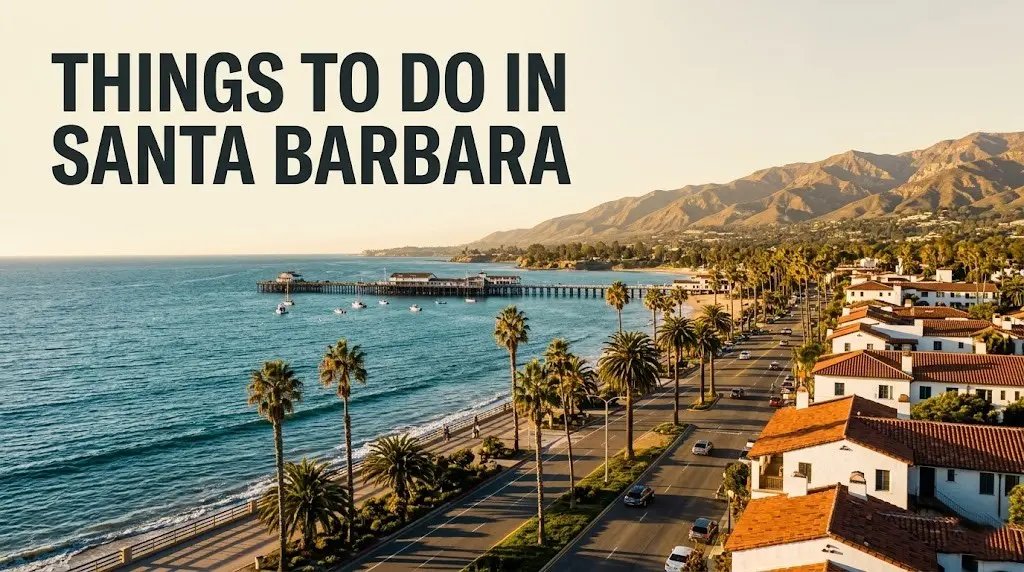
For planning purposes, think of the city in four distinct zones: the waterfront and harbor district; State Street and the Paseo Nuevo commercial corridor; the Funk Zone (between State Street and the train tracks, roughly along Helena Avenue and Anacapa Street); and the mountain-facing residential neighborhoods with trail access.
According to Visit Santa Barbara, the city’s Mediterranean climate produces approximately 300 sunny days per year — but June through mid-July carries consistent marine layer through midday, which changes the beach experience significantly.
Budget roughly two to three full days to cover the city properly. A fourth day works well if you add a Channel Islands trip or a drive to the Santa Ynez Valley wine country.
| Zone | Best For | Primary Draw | Walking Distance from State Street |
|---|---|---|---|
| Waterfront / Cabrillo Blvd | Families, couples | Beach, cycling, sunset | 10 minutes |
| State Street / Paseo Nuevo | Shoppers, casual visitors | Shopping, dining, cafes | Central |
| Funk Zone | Wine lovers, locals | Wine tasting, galleries, restaurants | 8 minutes |
| Upper Trails (Los Padres) | Hikers, active travelers | Inspiration Point, Cold Spring | 20-minute drive |
Best Things to Do in Santa Barbara for Every Traveler Type
The best version of Santa Barbara looks very different depending on who is visiting. Planning without accounting for your travel type is the single most common Santa Barbara planning mistake.
Solo travelers get the most out of the Funk Zone’s communal wine tasting rooms and the Farmers Market on Tuesday and Saturday mornings on the 500 to 800 block of State Street. Both environments are inherently social without requiring a group.
Couples should anchor their itinerary around a sunset at Leadbetter Beach followed by dinner in the Funk Zone. The combination of the coastal walk on Cabrillo Boulevard and evening wine tasting at Carr Winery or Municipal Winemakers is the genuinely romantic version of Santa Barbara that travel brochures promise.
Families with children should prioritize East Beach (the city’s widest and most family-friendly beach), the Santa Barbara Zoo directly adjacent to it, and the Santa Barbara Museum of Natural History in Mission Canyon. All three are within a 20-minute drive of each other.
Budget travelers have more legitimate free options here than most California coastal cities: the entire Cabrillo Boulevard beachfront, the Courthouse Sunken Gardens, the Farmers Market, and the front-country hiking trails cost nothing.
Seniors and accessibility travelers will find Cabrillo Boulevard’s flat paved path from Chase Palm Park to the harbor fully wheelchair accessible. East Beach has beach wheelchair rentals available through Santa Barbara County Parks — verify availability before visiting.
Insider Tip:
- The Saturday Farmers Market (500 to 800 block of State Street) runs 8:30am to 1pm and is where local chefs shop. Arrive before 10am for the best selection.
- The Tuesday afternoon Farmers Market (same location, typically 3pm to 6:30pm) is less crowded and more local-feeling than the weekend version.
- Solo travelers specifically: the communal tasting tables at Municipal Winemakers are designed for single visitors and consistently generate conversation.
Santa Barbara Beaches and Waterfront Activities
Santa Barbara’s best beaches are East Beach, Leadbetter Beach, and Arroyo Burro Beach (known locally as Hendry’s Beach). Each serves a genuinely different purpose, and choosing the right one for your situation matters.
East Beach is the city’s largest and most accessible stretch, running from Stearns Wharf eastward along Cabrillo Boulevard. It has lifeguards in summer, restrooms, volleyball courts, and direct access to the Santa Barbara Zoo and Chase Palm Park. It handles high crowds without feeling overwhelming.
Leadbetter Beach, west of the harbor, draws a more local crowd and is where serious paddleboarders and kayakers launch. It’s significantly quieter than East Beach in summer and has better afternoon sun angles for swimming.
Arroyo Burro Beach (Hendry’s) is the local’s choice, period. It sits at the end of Las Positas Road about 3 miles west of downtown. The adjacent Boathouse at Hendry’s Beach restaurant is the best beachside dining option in the city.
For families, East Beach is the correct choice because of lifeguard coverage and the Zoo proximity. Couples seeking a quieter sunset experience should head to Leadbetter or Hendry’s. Budget travelers note: all Santa Barbara beaches are free to access, though parking lots charge a fee.
Ocean conditions vary significantly with season. July and August bring the calmest water and warmest temperatures. Winter swells make swimming inadvisable at most city beaches from November through February.
Key safety note: rip currents are a genuine hazard at all Santa Barbara beaches. Always swim near a flagged lifeguard station during staffed hours. Check current conditions through Santa Barbara County Parks before visiting in shoulder seasons.
| Beach | Best For | Parking | Crowd Level (Summer) | Local Tip |
|---|---|---|---|---|
| East Beach | Families, first-timers | Cabrillo Blvd lots (paid) | High | Arrive before 9am on weekends |
| Leadbetter Beach | SUP, kayakers, couples | Free lot adjacent | Moderate | Best afternoon wind for sailing |
| Arroyo Burro (Hendry’s) | Locals, dogs, quiet | Free lot | Low-moderate | Dogs allowed west of the lifeguard tower |
| West Beach | Sailboat watching | Street parking only | Moderate | Best views of the harbor anchorage |
The Funk Zone: Santa Barbara’s Best Local Neighborhood
The Funk Zone is the single most underrated area in Santa Barbara for visitors who spend their time on State Street instead. It occupies roughly 12 square blocks between the train tracks and the harbor, centered on Helena Avenue and Anacapa Street.
What makes it distinct: it converted from a light-industrial district into Santa Barbara’s densest concentration of wine tasting rooms, art galleries, and food vendors without becoming artificial. The warehouse aesthetic remains genuine.
Carr Winery on Anacapa Street was among the first to open in the Funk Zone and remains one of the best in terms of wine quality and atmosphere. Municipal Winemakers on Yanonali Street operates out of a working production space; you taste the wine literally where it is made.
Lama Dog Tap Room is the beer alternative for travelers who do not drink wine. Its patio is one of the better outdoor social spaces in the neighborhood. The Santa Barbara Public Market on Helena Avenue anchors the food side of the Funk Zone with multiple independent vendors under one roof.
For solo travelers, the Funk Zone’s open-format tasting rooms are far better than formal winery environments. You can move between three or four spots within walking distance without a reservation at most. For couples, the evening atmosphere after 5pm is the correct time to visit — the crowd thins from tourist-heavy afternoon traffic to a genuinely local crowd.
Budget travelers should note that Funk Zone tastings typically run $15 to $30 per person for a flight. Some tasting rooms waive the fee with a bottle purchase — ask directly.
Insider Tip:
- The most tourist-oriented part of the Funk Zone is the section closest to Stearns Wharf. Walk two blocks deeper toward the train tracks for the genuinely local section.
- Helena Avenue on a weekday afternoon has significantly lower crowds than weekend afternoons between 1pm and 4pm.
- Art galleries on Helena Avenue are mostly free to enter and change exhibitions monthly.
Key Takeaway: The Funk Zone, not State Street, is where Santa Barbara’s genuinely local food and wine scene concentrates. Arrive after 5pm on weekdays to experience it without the tour-group crowds.
Santa Barbara Wine Tasting and the Urban Wine Trail
The Santa Barbara Urban Wine Trail connects more than 30 tasting rooms within the city limits, most concentrated in the Funk Zone. This makes Santa Barbara one of the only California cities where serious wine tasting does not require a car rental or designated driver.
The trail connects downtown tasting rooms with a self-guided walking route. The wines here draw primarily from the Santa Ynez Valley and Santa Rita Hills appellations to the north, meaning you access some of California’s most acclaimed Pinot Noir and Chardonnay without leaving the city.
For context: the Santa Rita Hills appellation gained national attention after the film “Sideways” focused heavily on the region in 2004, and wine production here has expanded significantly since. According to Visit Santa Barbara, more than 50 wineries operate within Santa Barbara County, with the urban tasting room network making the city itself a viable wine destination.
Carr Winery specializes in Grenache and Pinot Noir. Municipal Winemakers is known for skin-contact whites and natural wine production. Lieu Dit (also in the Funk Zone area) produces Loire Valley-style whites from Santa Barbara County grapes and is one of the more distinctive production philosophies in the trail.
Wine enthusiasts can realistically visit four to six tasting rooms in a half-day on the Urban Wine Trail without a car. This is the strongest case for the trail over a winery drive to the Santa Ynez Valley — the Santa Ynez trip is excellent but requires a designated driver or Uber for the 45-minute drive each way.
Budget travelers should target weekday afternoon visits when tasting rooms are less crowded and staff have more time to explain pours. Some rooms offer complimentary pours during slower periods — this is not guaranteed, but it does happen regularly.
Seasonal note: harvest season (late August through October) is the most active time in the tasting rooms. Many host harvest events and release new vintages in this window. Verify specific events with individual tasting rooms before visiting.
Santa Barbara Mission and Historic Downtown
Mission Santa Barbara, formally known as the Queen of the Missions, has operated continuously since its founding in 1786 and remains the only California mission still staffed by the original Franciscan order. This gives it a living institutional character that distinguishes it from preserved historical sites.
The Mission sits on elevated ground at the end of Laguna Street, about a mile north of State Street. The views of the city and the coast from its garden terrace are among the best in Santa Barbara. Admission runs approximately $15 to $20 for adults as of recent years — verify current pricing before visiting.
Directly below the Mission, the Presidio de Santa Barbara State Historic Park on East Canon Perdido Street preserves the original Spanish military fort site. It is less visited than the Mission and offers more depth on the city’s pre-American history. Entry is low-cost or free for California State Parks annual pass holders.
The Santa Barbara County Courthouse on Anacapa Street deserves specific attention. Its Sunken Gardens are free to enter and used daily by locals. The clock tower observation deck offers 360-degree views of the city, the mountains, and the coast — no admission charge as of recent years, though verify current access policies.
For families, the Mission’s museum and garden are appropriate for children 8 and older who have some interest in history. Younger children will engage better with the garden and the koi pond than the museum exhibits. Plan 45 to 75 minutes.
Seniors and accessibility travelers should note that the Mission grounds involve some uneven stone paths, but the main church and museum are accessible. The Courthouse grounds are fully flat and paved.
Insider Tip:
- Most visitors photograph the Mission facade and leave. The cemetery and the garden behind the main church are where the Mission’s real historical depth lives.
- Visit the Mission before 10am on any day to avoid tour buses. By 11am in summer, it is substantially more crowded.
Stearns Wharf and the Harbor District
Stearns Wharf is the most photographed structure in Santa Barbara and also its most tourist-concentrated experience. It is genuinely worth walking for the harbor views and the sense of the city’s maritime character — but do not base your Santa Barbara visit around it.
The wharf extends into the harbor from the foot of State Street. It has seafood restaurants, a wine tasting room (Stearns Wharf Vintners), a small nature museum, and the typical tourist retail mix. The views back toward the mountains are legitimately good.
The honest assessment: an hour here is right. Two hours is too long. The seafood restaurants on the wharf are overpriced relative to quality; Santa Barbara Shellfish Company at the very end of the wharf is the best value option and regularly has lines worth waiting in for the lobster bisque.
The Santa Barbara Harbor west of the wharf is where the local experience begins. The working harbor has fishing boats, sailing charters, whale-watching vessels, and kayak rentals operating from the waterfront. Santa Barbara Sailing Center offers both sailing lessons and sunset cruises from the harbor.
Families should know that the harbor area has a flat, easily walkable promenade that works well for strollers and young children. The small shark exhibit at the wharf’s Sea Center (operated by the Santa Barbara Museum of Natural History) is consistently popular with kids 4 to 10 years old.
Budget travelers: walking Stearns Wharf is free. The Sea Center charges a modest admission — verify current pricing directly. The harbor promenade west of the wharf is entirely free and arguably more interesting for its working maritime atmosphere.
Key Takeaway: Stearns Wharf earns one hour of your Santa Barbara time. The working harbor and harbor promenade to its west are more genuinely interesting and require zero admission.
Outdoor Activities and Hiking Near Santa Barbara
Santa Barbara has direct access to some of Southern California’s most accessible front-country hiking, with trailheads reachable in 15 to 25 minutes from downtown. Los Padres National Forest forms the backdrop of the city.
Inspiration Point via the Tunnel Trail is the benchmark Santa Barbara hike. The trailhead starts at the end of Tunnel Road, roughly 3 miles from downtown. The round trip runs approximately 3.5 miles with about 800 feet of elevation gain. The views of the city, the Channel Islands, and the Pacific from the ridgeline are among the clearest in the region on low-humidity days.
Rattlesnake Canyon Trail off Las Canoas Road is the city’s most popular local trail and for good reason. It follows a year-round creek through sandstone canyon formations and reaches a flat meadow plateau in roughly 3.5 miles round trip. The creek crossings make it especially good in winter and spring.
Cold Spring Trail, accessible from East Mountain Drive, offers the most dramatic exposure of the front-country trails. The east fork reaches Gibraltar Rock with views across the entire Santa Barbara basin. This trail is for experienced hikers; it gains approximately 2,500 feet in its upper sections.
Active travelers and solo hikers should note that all three trails are well-marked and heavily used, which makes them generally safe for solo hiking. Cell service drops significantly above the first ridgeline on all trails. Download offline maps before leaving your car.
Families with children: Rattlesnake Canyon’s lower 1.5 miles (to the first creek crossing) is appropriate for children 5 and older. Inspiration Point is achievable for fit children 8 and older. Cold Spring is not appropriate for children under 12.
Heat warning: July and August temperatures on south-facing trail sections regularly exceed 90 degrees Fahrenheit. Carry at least 2 liters of water per person. Start before 8am in summer.
Channel Islands National Park Day Trips from Santa Barbara
Channel Islands National Park is 25 miles offshore from Santa Barbara and consistently underpromoted relative to California’s more famous national parks. It is the closest thing to an undeveloped Pacific island ecosystem accessible from the continental United States.
The park encompasses five islands. Santa Cruz Island is the largest and most visited, with sea cave kayaking, hiking, snorkeling, and tide pool exploration. Anacapa Island is closer and smaller, best for lighthouse visits and seabird watching. Both are accessible via Island Packers Conservancy, the park’s authorized ferry operator from Ventura and Oxnard harbors.
A typical Santa Cruz Island day trip runs approximately 9 to 10 hours including transit time. The ferry takes about one hour each way. Most visitors spend 4 to 5 hours on the island. Prices run approximately $50 to $80 per adult for the ferry as of recent years — verify current pricing with Island Packers directly.
Advance booking is essential. Summer trips sell out 3 to 4 weeks ahead. Spring and fall trips book 1 to 2 weeks ahead. Do not plan a Channel Islands day without a reservation confirmed in advance.
Active travelers and couples get the most from a sea cave kayaking excursion on Santa Cruz Island. The painted cave sea cave at the island’s western end is one of the largest accessible sea caves in the world. Guided kayak tours are available through Channel Islands Adventure Company — book separately from the ferry.
Families with children should note the island has no shade structures, no food vendors, and no fresh water available. Pack everything. Bring sun protection appropriate for full-day Pacific exposure. Children under 8 may find the hiking terrain challenging.
According to the National Park Service, Channel Islands supports one of California’s most intact island ecosystems, including populations of island foxes found nowhere else on Earth.
Key Takeaway: Channel Islands requires advance booking, often 3 to 4 weeks ahead in summer. It is the single most underused day trip from Santa Barbara and genuinely worth an entire day.
Santa Barbara Museums, Arts, and Cultural Attractions
Santa Barbara’s cultural institutions are consistently stronger than a city of its size typically produces, largely because of the philanthropic culture tied to the city’s significant resident wealth base.
The Santa Barbara Museum of Natural History in Mission Canyon is the city’s most substantive museum experience. Its planetarium, Chumash cultural collections, and extensive natural history exhibits make it worthwhile for 2 to 3 hours. Admission runs approximately $15 to $20 for adults as of recent years. The adjacent Santa Barbara Museum of Natural History Sea Center on Stearns Wharf operates as a satellite with ocean science exhibits.
The Santa Barbara Botanical Garden on Mission Canyon Road covers 78 acres of native California plant communities including coastal redwoods, chaparral, and Channel Islands plantings. The creek walk section through the mission dam area is particularly worth the full circuit. Admission runs approximately $12 to $18 for adults — verify current pricing.
The Santa Barbara Museum of Art on State Street has a permanent collection that includes Impressionist works, Asian art, and a photography gallery. Admission is low relative to comparable California art museums. First Sundays of the month are typically free — verify this policy before visiting.
The Granada Theatre and Lobero Theatre anchor the city’s performing arts calendar. The Lobero is the oldest continuously operating theater in California and has an intimate scale that makes it worth experiencing for any performance that fits your schedule during a visit.
Families: the Museum of Natural History is the correct choice. The planetarium shows are specifically programmed for families. The Sea Center on the wharf supplements this if time allows.
Seniors and accessibility travelers: the Museum of Natural History and Museum of Art are both fully accessible. The Botanical Garden’s creek walk involves some uneven terrain; verify accessibility needs directly with the garden before visiting.
Best Restaurants and Food Experiences in Santa Barbara
Santa Barbara’s dining scene is stronger than its tourism-board reputation suggests, but it requires knowing which neighborhoods to prioritize. State Street’s restaurant corridor skews heavily toward tourist-oriented dining; the Funk Zone and the neighborhoods around Milpas Street serve a genuinely different, more local experience.
Loquita on State Street is the honest exception to the State Street tourist trap generalization. It serves wood-fired Spanish-influenced dishes with Santa Barbara County ingredients and is consistently named among the city’s best restaurants by local media. Expect a wait for walk-in dinner service; reservations are strongly recommended.
The Boathouse at Hendry’s Beach at Arroyo Burro Beach serves elevated coastal California cuisine with direct ocean frontage. Brunch here is the better value than dinner. The grilled fish tacos and the burger are reliable across visits.
Los Agaves on North Milpas Street is the city’s best Mexican restaurant by the consistent judgment of the local food community. It is a 15-minute walk from the main tourist corridor, which keeps it off most visitor itineraries — which is exactly why it is better.
Santa Barbara Public Market on Helena Avenue in the Funk Zone is the best option for solo travelers or groups with varied tastes. Multiple independent vendors operate under one roof: oysters, pizza, charcuterie, coffee, and wine by the glass.
For the city’s most celebrated fine dining, Stonehouse Restaurant at San Ysidro Ranch in Montecito operates at a genuinely premium level and requires both a reservation and a budget of approximately $150 to $250 per person for dinner. Worth noting for couples on a splurge visit.
Budget travelers should know Milpas Street between the 100 and 600 blocks hosts the city’s best concentration of affordable dining: taquerias, Vietnamese restaurants, and a farmers market overflow that local chefs genuinely use as a sourcing walk.
Free and Budget-Friendly Things to Do in Santa Barbara
Santa Barbara is an expensive destination, but the list of genuinely free or low-cost experiences is longer than most visitors realize. Knowing them makes the difference between a draining premium trip and a manageable one.
Free and low-cost options in Santa Barbara:
- Cabrillo Boulevard beachfront walk: the full stretch from East Beach to the harbor is free, paved, flat, and one of the best urban oceanfront walks in California
- Santa Barbara County Courthouse Sunken Gardens: free entry, open daily, with free clock tower access (verify current policy)
- Saturday Farmers Market (500-800 State Street, 8:30am to 1pm): free to walk; affordable to graze
- Funk Zone gallery circuit on Helena Avenue: all galleries are free to enter
- Rattlesnake Canyon Trail: no entry fee; free parking limited, arrive by 8am on weekends
- Inspiration Point Trail: no entry fee; trailhead parking is free
- Stearns Wharf walk: walking the wharf is free
Budget travelers should also note that the Santa Barbara MTD transit system is inexpensive and connects the major visitor areas. The waterfront electric shuttle runs a flat fare that is far less than any parking fee.
The Santa Barbara Museum of Art operates free admission periods that are worth timing a visit around — verify current free days directly with the museum.
Solo travelers on a budget can assemble an excellent Santa Barbara day for under $50 by combining free beach time, the Farmers Market, the Courthouse gardens, a Funk Zone walk, and one glass of wine at a tasting room that allows single-glass purchases.
According to Visit Santa Barbara, the city’s free public events calendar includes the Summer Solstice Parade in June, the weekly Farmers Markets, and various outdoor concert series throughout summer — check their events calendar for 2026 dates before visiting.
Key Takeaway: Santa Barbara’s best free experiences — the Cabrillo beachfront, the Courthouse gardens, the hiking trails, and the Farmers Market — are genuinely excellent and not consolation prizes for budget-constrained travelers.
Things to Do in Santa Barbara With Kids
Santa Barbara with children works best when the itinerary is built around a 200-meter radius from the East Beach parking area, then expanded outward from there.
East Beach itself gives children the widest open space in the city: a flat, sandy beach with gentle summer surf (by California standards), volleyball courts they can watch or join at age-appropriate pickup games, and the Chase Palm Park playground directly adjacent.
Santa Barbara Zoo, immediately adjacent to East Beach on Ninos Drive, is genuinely excellent for families with children 2 through 12. The zoo sits on a bluff above the ocean; giraffes with Pacific Ocean backdrops are a specific photographic situation most other zoos cannot offer. Plan 2.5 to 3.5 hours. Admission runs approximately $20 to $30 per adult, less for children — verify current pricing.
Santa Barbara Museum of Natural History Sea Center on Stearns Wharf (the satellite of the main Museum of Natural History) runs touch-tank programs and ocean science exhibits specifically designed for children 5 and older. It is smaller than the main museum but more immediately interactive.
The Mission works best for children 8 and older who have some school-level exposure to California history. Younger children engage for about 20 minutes maximum; budget accordingly.
For a full day with children, consider this sequence:
- East Beach arrival by 9am (before crowds and heat peak)
- Beach and Chase Palm Park playground until 11am
- Santa Barbara Zoo from 11am to 2pm
- Lunch at the zoo or pack a beach lunch
- Sea Center on Stearns Wharf from 2:30pm to 4pm
- Cabrillo Boulevard walk or cycling rental for late afternoon
Seniors accompanying families should know the flat Cabrillo Boulevard path accommodates wheelchairs, walkers, and slower pacing while keeping pace with the family itinerary. The Zoo has a tram for mobility-limited visitors — verify availability before visiting.
Romantic Things to Do in Santa Barbara for Couples
Santa Barbara performs better as a romantic destination than almost any California city its size, primarily because of the physical environment rather than manufactured romantic infrastructure.
The genuinely romantic itinerary for couples centers on three experiences: sunset at Leadbetter Beach followed by the Funk Zone wine trail, a morning hike to Inspiration Point for private views before the trail crowds arrive, and a dinner reservation at Loquita or the Stonehouse at San Ysidro Ranch in Montecito.
Leadbetter Beach at sunset is specifically better than East Beach for couples because it is quieter, less crowded, and has a direct view of the harbor light and the Channel Islands silhouette on clear evenings. Arrive 45 minutes before sunset for a good position.
A Santa Barbara Sailing Center sunset cruise from the harbor is one of the genuinely romantic experiences in the city that earns the description. Most cruises run approximately 2 hours, with wine options included or available. Book at least a week ahead in summer.
For a full romantic day, consider:
- Morning Inspiration Point hike (early start, arrive at Tunnel Road trailhead by 7:30am)
- Late breakfast at a State Street cafe (Pierre Lafond or Renaud’s Patisserie on Brinkerhoff)
- Funk Zone afternoon — Carr Winery or Lieu Dit tasting, gallery walk
- Sunset at Leadbetter Beach
- Dinner reservation at Loquita (State Street) or The Hungry Cat (Santa Barbara)
Couples on a premium budget should book San Ysidro Ranch in Montecito for accommodation. It is the single most celebrated romantic property in the region and genuinely earns its reputation — though rates reflect this, running well over $800 per night in peak season.
Couples on a mid-range budget will find that boutique properties in the Funk Zone area and the Upper State Street corridor provide a comfortable base without the premium, with walking access to the best of the city.
Best Time to Visit Santa Barbara and Seasonal Guide
The best time to visit Santa Barbara is October through November or March through early May. Both windows offer clear skies, mild temperatures, and significantly lower hotel rates and crowd levels than summer.
| Month | Weather | Crowds | Hotel Rates | Highlights |
|---|---|---|---|---|
| Jan-Feb | Cool (55-65°F), some rain | Low | Lowest | Wine country, museum focus |
| Mar-May | Warming, clear skies | Low-moderate | Moderate | Whale watching peak, wildflowers |
| June | Marine layer mornings | Increasing | High | June Gloom: overcast until midday |
| July-Aug | Warmest (70-85°F) | Peak | Highest | Best beach weather; Old Spanish Days Fiesta (early Aug) |
| Sept-Oct | Clear, 65-80°F | Declining | Moderate-high | Best overall conditions |
| Nov-Dec | Mild, occasional rain | Low | Moderate | Quietest month; wine harvest releases |
June requires specific planning awareness. The marine layer from the Pacific typically keeps skies overcast through noon or 1pm from early June through mid-July. Visitors expecting beach sun in June mornings are regularly disappointed. Afternoon clearing is common, but it is not guaranteed.
Old Spanish Days Fiesta in early August is Santa Barbara’s largest annual event, drawing significant crowds and causing hotel rates to spike. The event is genuinely worth experiencing if you plan around it, but it is not the right week for a quiet coastal vacation.
Whale watching season peaks from January through March (gray whale migration) and again from June through October (blue and humpback whales feeding offshore). Condor Express and other Santa Barbara Harbor operators run whale watching tours — verify current operators and schedules before visiting.
Budget travelers note that January and February are the lowest-rate months by a significant margin and still offer excellent wine tasting, hiking, and cultural access — the only genuine sacrifice is beach swimming.
Families planning beach-focused trips should target late July through September for the most reliable beach weather and warmest water.
Key Takeaway: October is Santa Barbara’s best-kept seasonal secret — clear skies, warm ocean, low crowds, falling hotel rates, and active wine harvest events converge in a single month.
Getting Around Santa Barbara: Logistics and Practical Tips
Getting around Santa Barbara without a car is genuinely feasible, which sets it apart from most California cities. The city is small enough that downtown, the waterfront, and the Funk Zone are all within a 10 to 15-minute walk of each other.
By transit: The Santa Barbara Metropolitan Transit District (MTD) operates the city’s bus network and the waterfront electric shuttle. The shuttle runs along Cabrillo Boulevard between the zoo and the harbor and costs a very low flat fare — verify current fare on the MTD website. It is the correct tool for moving between East Beach and the harbor without driving.
Amtrak Pacific Surfliner connects Santa Barbara directly to Los Angeles Union Station (approximately 2.5 hours) and to the Bay Area via a connecting train. It stops at the Santa Barbara Amtrak station on State Street, within walking distance of the Funk Zone and downtown.
By car: Driving is the most practical option for reaching the hiking trailheads, the Santa Ynez Valley, and Channel Islands departure points in Ventura. Parking along Cabrillo Boulevard fills before 10am on summer weekends. The Paseo Nuevo parking structure and the Granada Garage on Chapala Street are consistently better options than street hunting near the waterfront.
By bicycle: The Cabrillo Boulevard bike path runs the full waterfront length. Bike and electric bicycle rentals are available near the harbor from multiple operators — verify current providers through Visit Santa Barbara. This is the best way to cover the waterfront and beach zones efficiently.
From Los Angeles: The drive via US-101 North typically takes 90 to 110 minutes without traffic. Friday afternoon and Sunday evening traffic can extend this to 2.5 to 3 hours. Amtrak is a legitimate alternative specifically on those traffic-heavy windows.
Practical tips for a smooth logistics day:
- Park once at the Paseo Nuevo or Granada Garage and use the MTD shuttle and walking for waterfront coverage
- Drive to trailheads only — keep the car out of the tourist corridor entirely
- Book Channel Islands ferry through Island Packers from Ventura; confirm departure point carefully (it is not from Santa Barbara proper)
- Reserve restaurant dinners at Loquita and any Funk Zone tasting rooms with reservation systems at least 3 to 5 days ahead
- Download MTD transit app and offline hiking maps before arrival — cell service in upper trail sections is unreliable
Safety and Practical Warnings for Santa Barbara
Santa Barbara is a safe destination by California standards, but specific risks apply to specific activities and seasons.
Key safety and practical facts every visitor should know:
- Ocean rip currents are present year-round at all Santa Barbara beaches. Swim only at lifeguard-staffed beach sections during staffed hours. Check current beach conditions through Santa Barbara County Parks before swimming in shoulder and winter seasons.
- Trail heat risk is real in summer. Rattlesnake Canyon and Inspiration Point both expose hikers to full sun on south-facing sections. Bring at minimum 2 liters of water per person. Start hikes before 8am from June through September.
- Wildlife awareness applies on all front-country trails. Mountain lions are present in the Santa Ynez Mountains. Trail etiquette, noise awareness, and not hiking alone in dawn and dusk hours apply. The California Department of Fish and Wildlife publishes current guidance.
- Cell service drops on all upper trail sections. Download offline maps via AllTrails or Gaia GPS before leaving your vehicle. Tell someone your planned route and return time.
- Parking enforcement on Cabrillo Boulevard is active and consistent. Do not overstay metered parking. Tickets are issued promptly.
- Channel Islands weather changes rapidly offshore. Follow Island Packers crew instructions on all safety briefings. Motion sickness medication is worth considering for the open-ocean crossing if you are susceptible.
The nearest hospital with emergency services is Cottage Hospital on Pueblo Street in Santa Barbara. In a trail emergency, call Santa Barbara County Search and Rescue via 911.
Suggested Weekend Itinerary for Santa Barbara
A two-day Santa Barbara itinerary that covers the most genuinely worthwhile experiences without overlap:
Day 1: Waterfront, Funk Zone, and Local Wine
- Arrive and park at the Paseo Nuevo garage or Granada Garage on Chapala Street
- Walk to the Saturday Farmers Market (8:30am to 1pm) on the 500 to 800 block of State Street
- Walk south to the Santa Barbara County Courthouse — Sunken Garden and clock tower (free)
- Stroll Cabrillo Boulevard from the foot of State Street to the harbor (20 minutes walking)
- Walk Stearns Wharf (45 minutes maximum; Santa Barbara Shellfish Company for lunch at the end of the wharf)
- Afternoon: Funk Zone wine trail — start at Carr Winery or Municipal Winemakers, then walk Helena Avenue galleries
- Evening dinner: Loquita (reserve in advance) or Santa Barbara Public Market for a casual multi-vendor option
- Sunset: walk back to Leadbetter Beach (10-minute drive or rideshare west from the Funk Zone)
Day 2: Hiking, Mission, and Beaches
- Early hike: Rattlesnake Canyon Trail or Inspiration Point (trailhead by 7:30am; 3 to 4 hours total)
- Return to downtown; late breakfast at Renaud’s Patisserie on Brinkerhoff Avenue
- Santa Barbara Mission visit (arrive before 11am to beat tour groups; 1 to 1.5 hours)
- Drive or rideshare to Arroyo Burro Beach (Hendry’s): afternoon beach time
- Late lunch or early dinner at the Boathouse at Hendry’s Beach (no reservation typically needed for lunch)
- Optional: Botanical Garden (on Mission Canyon Road, en route from the Mission) if timing allows
This framework works for couples and solo travelers. For families with children, replace Day 2’s hiking section with the Santa Barbara Zoo (adjacent to East Beach) and the Sea Center on Stearns Wharf.
Frequently Asked Questions About Things to Do in Santa Barbara
What are the best things to do in Santa Barbara for a first-time visitor?
The best first-time Santa Barbara experiences are the Funk Zone wine trail, East Beach, Stearns Wharf, and the Santa Barbara Mission.
Combine those with a morning hike on Rattlesnake Canyon Trail and dinner at Loquita on State Street for a two-day visit that covers the city’s genuine character.
Skip the bulk of State Street’s shopping corridor — it does not represent what makes Santa Barbara worth visiting.
How many days do you need in Santa Barbara?
Two full days is the minimum for a satisfying Santa Barbara visit covering the main neighborhoods and at least one outdoor experience.
Three days allows you to add a Channel Islands day trip or a drive to the Santa Ynez Valley wine country without feeling rushed.
A fourth day makes sense if you want to explore Montecito (immediately adjacent, with its own restaurant and shopping culture) or do a second hiking route.
Is Santa Barbara worth visiting in June?
June in Santa Barbara means marine layer — overcast skies through noon or 1pm are the norm from early June through mid-July, not the exception.
Afternoon clearing happens regularly, but if your primary goal is morning beach weather, June consistently underdelivers relative to July through October.
Wine tasting, hiking (start early to beat heat), and cultural attractions are unaffected by the marine layer, making June perfectly fine for a non-beach-focused trip.
What is the Funk Zone in Santa Barbara?
The Funk Zone is a 12-block former industrial district between State Street and the harbor, concentrated along Helena Avenue and Anacapa Street, that now holds Santa Barbara’s highest density of wine tasting rooms, galleries, and independent restaurants.
It is the most locally-oriented neighborhood in the city and the correct place to spend an afternoon over State Street’s tourist corridor.
Carr Winery, Municipal Winemakers, and the Santa Barbara Public Market are the anchor venues worth building your Funk Zone visit around.
Can you do Santa Barbara without a car?
Yes, for the city’s core experiences — the Funk Zone, State Street, Stearns Wharf, East Beach, and the waterfront — a car is unnecessary.
Amtrak Pacific Surfliner connects Santa Barbara to Los Angeles in approximately 2.5 hours, and the MTD electric shuttle covers the waterfront corridor for a low flat fare.
You will need a car or rideshare for the hiking trailheads, Channel Islands ferry departure from Ventura, and Santa Ynez Valley wine country.
What is the best beach in Santa Barbara?
The best beach in Santa Barbara depends on your priority: East Beach for families and first-timers (widest, lifeguarded, most accessible); Leadbetter Beach for paddleboarding, kayaking, and couples seeking a quieter scene; Arroyo Burro (Hendry’s Beach) for the most genuinely local atmosphere and the best adjacent restaurant option.
Hendry’s Beach is the consistent local preference for its quieter atmosphere, dog-friendly section, and the Boathouse restaurant directly on the sand.
East Beach is the correct default if you are visiting with children or want maximum amenities and lifeguard coverage.
Santa Barbara rewards travelers who know where to look. The Funk Zone, not State Street, is where the city’s genuine character lives. The hiking trails above the city, not the tourist waterfront, deliver the view most people come to California’s coast expecting.
Book your Channel Islands ferry and any Funk Zone tasting rooms with reservations before you arrive. Check current pricing and hours directly with venues, as conditions, fees, and seasonal schedules change and this guide reflects general 2026 planning guidance.
Your most practical next step: confirm your Channel Islands booking through Island Packers Conservancy (book 2 to 4 weeks ahead in peak season), then work backward to build your city days around it.