Best Things To Do in Warsaw: Complete 2026 Travel Guide

Warsaw delivers more genuine travel value per dollar than almost any European capital city. The best things to do in Warsaw span reconstructed medieval streets, Europe’s most important Jewish history museum, a thriving local food market culture, and neighborhoods that feel completely off the tourist map.
The Warsaw Tourism Organization estimates the city attracts over six million visitors annually. Most spend the majority of their time in Old Town and miss the neighborhoods where Warsaw actually lives.
This guide covers Warsaw’s best attractions, practical logistics for getting around, honest seasonal guidance, traveler profile-specific recommendations, and a one-day itinerary you can use immediately.
Things To Do in Warsaw: What Makes This City Different
Warsaw’s best things to do are inseparable from its extraordinary history of destruction and rebuilding.
The city was approximately 85 percent destroyed during World War II. What visitors walk through today is one of history’s most ambitious reconstruction projects, which earned Warsaw’s Old Town UNESCO World Heritage status in 1980.
That context matters because Warsaw is not a city wearing its past lightly. Its museums, memorials, and neighborhoods all carry that weight visibly.
Unlike Prague or Krakow, Warsaw is a working capital city. Its best experiences sit alongside government ministries, tech company offices, and local apartment blocks, not inside a preserved historic bubble.
Insider Tip:
- Most tourists spend 90 percent of their time within a ten-block radius of the Old Town. Commit to crossing the Vistula River at least once into Praga.
- The Palace of Culture and Science observation deck gives the best orientation view of the city on arrival day.
- Budget travelers will find Warsaw’s public transit and food market culture genuinely affordable compared to any Western European capital.
Best Things To Do in Warsaw for First-Time Visitors
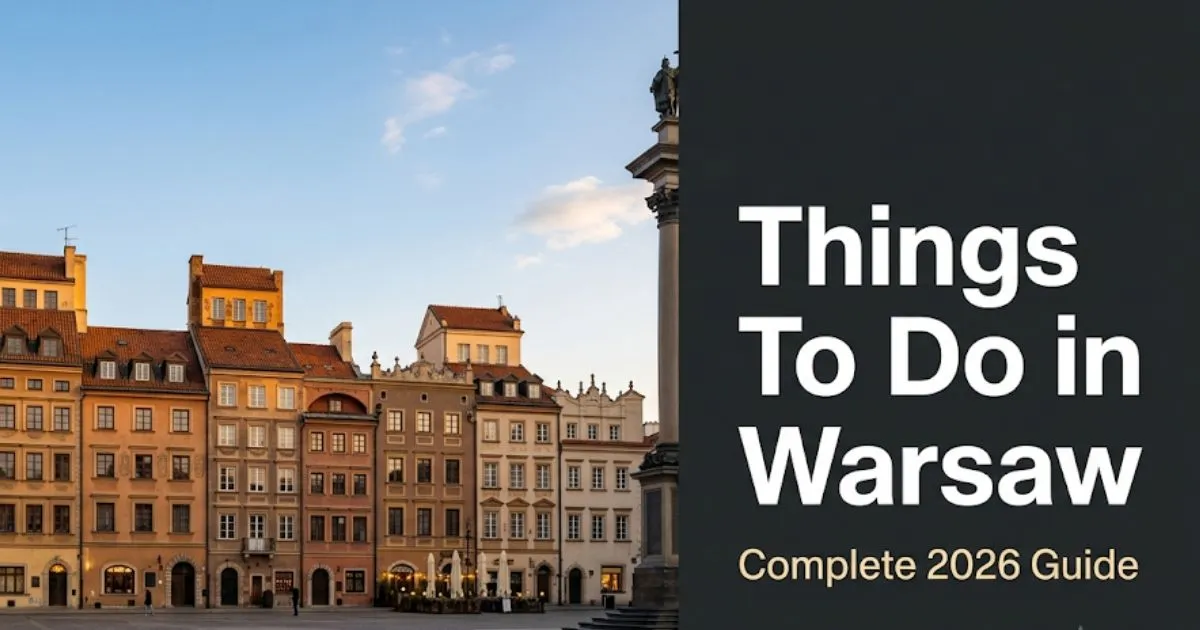
The best starting point in Warsaw is the Warsaw Old Town Market Square (Rynek Starego Miasta), surrounded by meticulously reconstructed merchant houses and home to the Royal Castle Warsaw on its eastern edge.
Walk Krakowskie Przedmiescie, the elegant boulevard running south from Castle Square, to reach Nowy Swiat Street and the city’s best cafe and restaurant concentration.
| Activity | Best For | Cost Range (PLN) | Time Needed |
|---|---|---|---|
| Old Town Market Square walk | All profiles | Free | 45 to 90 minutes |
| Royal Castle Warsaw | History travelers, couples | 30 to 50 PLN | 2 hours |
| Warsaw Rising Museum | History travelers, adults | 25 to 35 PLN | 3 to 4 hours |
| POLIN Museum | All adults, couples | 25 to 40 PLN | 2 to 3 hours |
| Lazienki Park | Families, couples, seniors | Free entry | 1.5 to 3 hours |
| Palace of Culture observation deck | Solo travelers, couples | 25 to 35 PLN | 45 minutes |
| Copernicus Science Centre | Families, solo travelers | 35 to 50 PLN | 2 to 3 hours |
| Praga district street walk | Solo travelers, couples | Free | 2 hours |
| Neon Museum | Couples, solo travelers | 15 to 25 PLN | 1 hour |
| Hala Koszyki food market | Budget travelers, all profiles | Free entry | 1 to 2 hours |
Families with children under ten should prioritize the Copernicus Science Centre and Lazienki Park. The Royal Castle and POLIN Museum suit older children and adults more effectively.
Verify all entry prices directly with venues before visiting. Polish zloty pricing changes periodically and most Warsaw museums offer discounted admission for students, seniors, and families.
Warsaw Old Town Things To Do
Warsaw Old Town is the city’s most visited neighborhood and one of the most significant urban reconstruction achievements in European history.
Every building visitors see today was rebuilt after 1945, using 18th-century paintings by Bernardo Bellotto as architectural reference guides. The result is remarkably authentic in atmosphere despite its post-war origin.
The Warsaw Barbican, the circular fortified gateway on the north side of Old Town, is the best preserved section of the original medieval city wall. Walk through it from New Town (Nowe Miasto) side for the best photographic angle.
Sigismund’s Column at Castle Square is Warsaw’s most photographed landmark. It marks the spot where King Sigismund III Vasa moved Poland’s capital from Krakow in 1596.
Insider Tip:
- The Old Town is most enjoyable before 10am and after 6pm. Midday crowds between May and September are significant.
- Strollers navigate the cobblestones with difficulty. Seniors and mobility travelers should note that most Old Town streets are uneven stone. The main market square perimeter is more manageable than the smaller side streets.
- Skip the souvenir shops along the main square perimeter. The quality is poor and pricing is tourist-inflated. Hala Mirowska market, ten minutes west on foot, is where Warsaw residents actually shop.
Warsaw Uprising Museum
The Warsaw Rising Museum (Muzeum Powstania Warszawskiego) is the single most important museum in the city and one of the most affecting history museums in Europe.
It documents the 63-day Warsaw Uprising of 1944, in which Polish civilian resistance fighters battled German occupation forces while Soviet forces held position across the Vistula River.
The museum requires advance online ticket booking through the official 1944.pl website, particularly between May and September when daily timed-entry slots fill days or weeks ahead. Walk-up availability exists in winter months.
Budget three to four hours minimum. The exhibit is multi-floor, heavily multimedia, and emotionally demanding. It is not appropriate for children under approximately twelve years old.
Couples and solo history travelers consistently rate this as Warsaw’s most essential experience. The aviation hall housing a replica B-24 Liberator bomber used in supply drops is particularly powerful in its scale and context.
According to the Warsaw Rising Museum’s official documentation, the Uprising resulted in over 200,000 civilian deaths and the deliberate destruction of what remained of Warsaw after the fighting ended.
Insider Tip:
- Visit on a weekday morning. Weekend afternoons in summer are the museum’s most congested periods.
- The museum’s rooftop terrace provides a view toward Old Town worth visiting even if your time in the exhibits is limited.
- The park surrounding the museum building contains the Wall of Memory and the Monument to the Little Insurgent, both worth spending quiet time at separately from the main museum visit.
Key Takeaway: Book Warsaw Rising Museum tickets online through 1944.pl at least two weeks in advance for any May through September visit. Walk-up access is unreliable in peak season.
POLIN Museum Warsaw
POLIN Museum of the History of Polish Jews sits in the Muranow neighborhood on the site of the former Warsaw Ghetto.
The building itself won the World Building of the Year award in 2016 at the World Architecture Festival. Its permanent exhibition covers one thousand years of Jewish life in Polish territory, from the medieval period through the Holocaust and its aftermath.
The museum is approximately fifteen minutes on foot from Old Town. Metro Line 1 serves the nearby Ratusz Arsenal station.
Entry requires online booking through the official polin.pl website. Temporary exhibitions run alongside the permanent collection and require separate tickets.
Allow two to three hours for the permanent exhibition. The building’s architecture, with its sinuous interior passage representing the parting of the waters, is worth examining separately from the exhibits themselves.
The Polish National Tourist Office identifies POLIN as one of Poland’s top-rated cultural attractions among international visitors.
| Visitor Profile | Experience Quality | Practical Note |
|---|---|---|
| Solo history travelers | Exceptional | Audio guide recommended |
| Couples | Excellent | Allow full afternoon |
| Families with teens | Very good | Age 12 and up ideal |
| Families with young children | Limited | Content is adult-focused |
| Senior travelers | Good, with considerations | Elevator access available but limited in sections |
| Budget travelers | Affordable | Reduced rates for students |
Insider Tip:
- The Warsaw Ghetto Memorial (Monument to the Ghetto Heroes) stands directly in front of the museum. Spend time there before entering.
- The Umschlagplatz Monument, a ten-minute walk north, marks the deportation point for approximately 300,000 Warsaw Jews. It receives far fewer visitors than the main museum despite its profound historical significance.
Palace of Culture and Science Warsaw
The Palace of Culture and Science (Palac Kultury i Nauki), known locally as PKiN, is Warsaw’s tallest building and its most divisive landmark.
Josef Stalin gifted it to Poland in 1955. Poles have had complicated feelings about it ever since, ranging from fond irony to genuine distaste.
The observation deck on the 30th floor offers the best aerial overview of Warsaw’s dramatic city layout, including the contrast between the reconstructed Old Town, the communist-era housing blocks, and the gleaming modern financial district.
Entry to the observation deck runs approximately 25 to 35 PLN per adult, with seasonal hours applying. Verify current hours through the official pkin.pl site before visiting.
The building houses cinemas, theaters, the Sala Kongresowa concert hall, and a science museum within its cavernous interior. It occupies an entire city block at the center of Plac Defilad.
Solo travelers find the observation deck particularly valuable on arrival day for city orientation. Families with children will find the interior’s Soviet-era scale genuinely impressive without being disturbing.
Insider Tip:
- Visit the observation deck at dusk on a clear day. The city lights coming up as the sun sets make this one of Warsaw’s best atmospheric experiences.
- The local alternative to the tourist-priced Palace cafe is Cafe Kulturalna on the ground floor, popular with locals and theater-goers.
Key Takeaway: The Palace of Culture observation deck on your first Warsaw afternoon gives you the city map orientation that makes every subsequent day more efficient.
Lazienki Park Warsaw
Lazienki Krolewskie Park (the Royal Baths Park) is Warsaw’s finest green space and one of the largest urban parks in any European capital.
The park covers approximately 76 hectares in the Ujazdow district, roughly twenty minutes on foot south of Old Town. It contains the Palace on the Isle (Palac na Wyspie), a neoclassical palace built on an artificial island in a reflecting pool.
Entry to the park is free. Entry to the Palace on the Isle, several smaller palace buildings, and the Orangery Gallery requires a ticket, typically 20 to 35 PLN per adult.
Between late May and late September on Sunday afternoons, the park hosts free Chopin Piano Concerts at the Chopin Monument. These concerts run from approximately noon to 2pm and 4pm to 6pm and draw large crowds in good weather.
Lazienki is Warsaw’s best family option. Children respond well to the park’s resident peacocks, the lake with swans, and the wide open lawns. Stroller access is good along main paths, though some secondary paths are uneven.
Seniors and mobility travelers will find the main park paths flat and well-maintained. The Palace on the Isle involves stairs; check with staff about elevator access for upper floors.
Insider Tip:
- The local alternative for a quieter park experience is Ogrod Saski (Saxon Garden) near Old Town, which is smaller but equally beautiful and far less crowded on weekends.
- Arrive early on Sunday concert days. The benches around the Chopin Monument fill quickly, and the experience on a blanket on the grass is genuinely one of Warsaw’s best summer afternoons.
Praga District Warsaw
Praga district, specifically Praga Polnoc on the east bank of the Vistula River, is Warsaw’s most genuinely interesting neighborhood for travelers willing to cross the river.
Praga survived WWII largely intact because German forces used it as headquarters. Its pre-war architecture, including art deco tenement buildings and 19th-century factory complexes, remains visible in ways impossible anywhere on the west bank.
The neighborhood hosts the Neon Museum, Warsaw’s best street art concentration, the Soho Factory creative complex, and the Bazaar Rozycki, a historic open-air market on Zabkowska Street.
Praga has gentrified significantly since approximately 2015. Galleries, design studios, craft cocktail bars, and creative coworking spaces have moved in alongside the longstanding working-class community.
Solo travelers and couples find Praga the most rewarding Warsaw neighborhood for independent exploration. Families with young children can visit the main Praga streets comfortably during daylight hours. Evening exploration on quieter Praga side streets warrants standard urban awareness.
According to Warsaw Tourism Organization, Praga now features on most international travel itineraries for the city, though visitor numbers remain far lower than the Old Town.
Insider Tip:
- Take Metro Line 2 to Dworzec Wileński station for direct Praga access. The Praga tram and bus connections from Old Town also work well.
- The street art around Minska Street and the surrounding creative district is Warsaw’s best. Combine it with the Neon Museum for a full Praga afternoon.
Key Takeaway: Cross to Praga on at least one afternoon. The architecture, street art, and food scene on the east bank offer a version of Warsaw that zero percent of day-trippers from Krakow ever see.
Neon Museum Warsaw
The Neon Museum in Praga is Warsaw’s most visually distinctive small museum and one of the few genuinely joyful spaces in a city whose major sites deal primarily with trauma.
The museum preserves neon signs from the Polish communist era, when the government promoted neon as a symbol of modernity. The collection includes hundreds of hand-crafted signs from cafes, cinemas, hotels, and entertainment venues across Poland.
Entry runs approximately 15 to 25 PLN per adult. The museum occupies a warehouse space in the Soho Factory complex at Minska 25 in Praga.
Hours are typically limited and seasonal hours apply from November through March. Verify current opening times directly through the museum’s official channels before visiting.
Couples find the museum particularly atmospheric in evening hours when the neon collection is fully illuminated. Solo travelers appreciate it as a genuinely photogenic, low-key afternoon stop that pairs well with a wider Praga exploration.
Insider Tip:
- The museum gift shop stocks genuinely good design objects, including small neon letter pieces and vintage sign reproductions. It is one of Warsaw’s better souvenir sources.
- Combine the Neon Museum with a walk along Zabkowska Street, Praga’s main pedestrian strip, for the best overall neighborhood character.
Copernicus Science Centre Warsaw
Centrum Nauki Kopernik (Copernicus Science Centre) on the Vistula riverbank is Warsaw’s best activity for families with children and one of the largest interactive science museums in Central Europe.
The museum contains over 450 interactive exhibits across multiple floors, covering physics, biology, human perception, technology, and natural science. Every exhibit is hands-on.
Entry typically runs 35 to 50 PLN per adult, with family rates available. The adjoining Planetarium requires a separate ticket purchased at the venue. Advance booking through the official kopernik.org.pl site is strongly recommended for weekends and school holidays.
The museum sits directly on the Vistula riverbank at Wybrzeze Kosciuszkowskie 20, accessible via tram from the city center or Metro Line 2 to Centrum Nauki Kopernik station.
Budget travelers with children will find this one of Warsaw’s genuine value propositions. A half-day at Copernicus for a family of four costs significantly less than equivalent science museums in London, Amsterdam, or Berlin.
Seniors visiting with grandchildren will find the ground floor exhibits fully accessible. Upper floors have elevator access. The building’s riverside glass facade makes the exterior plaza worth a stop even without entering.
Insider Tip:
- Visit on a Tuesday or Wednesday morning in summer. Weekend crowds at Copernicus are heavy and wait times for popular exhibits grow long.
- The riverside promenade in front of the museum connects to the Powisle beach bar area, which makes a good afternoon combination in summer months.
Key Takeaway: Copernicus Science Centre is Warsaw’s best family half-day. Book Planetarium tickets online separately, as they sell out before walk-up opens.
Warsaw Food Scene and Milk Bars
Warsaw’s food scene runs from communist-era Bar Mleczny milk bars serving cheap, canteen-style Polish food to modern chef-driven restaurants on Plac Zbawiciela and Nowy Swiat.
Bar Mleczny Bambino on Krucza Street is the most accessible milk bar for visitors new to the format. You order at a counter, collect a tray, and eat at communal tables. Expect pierogi, bigos (hunter’s stew), borscht, and kotlet schabowy (breaded pork cutlet) for prices often under 25 to 40 PLN per person.
Hala Koszyki on Koszykowa Street is Warsaw’s best upscale food market. The 1908 art nouveau market hall was restored and reopened in 2016. It now houses Polish craft beer, natural wine bars, sushi, Polish charcuterie, and a reliable brunch scene.
Nocny Market runs as a seasonal night market in Powisle and Praga locations from late spring through early autumn. Verify 2026 dates and locations directly through their social channels.
Budget travelers should anchor at least one meal per day in a milk bar. The food is genuinely good, culturally specific, and costs a fraction of tourist-facing restaurant pricing.
Couples seeking a proper sit-down Warsaw dinner should look to Plac Zbawiciela, where restaurants like Solec 44 (modern Polish) and the surrounding neighborhood offer intimate settings without tourist-menu pricing.
Insider Tip:
- Order zapiekanka at any Praga street stand. It is an open-faced toasted baguette with mushrooms, cheese, and various toppings, a Polish street food specific to the communist era that remains genuinely popular with locals.
- The Hala Mirowska covered market near the Mirów neighborhood is where Warsaw locals shop for produce, meat, and dairy. It operates daily and charges none of the tourist premium of Old Town shops.
Best Neighborhoods in Warsaw
Warsaw’s character varies dramatically by neighborhood. Understanding which district to base yourself in changes the entire trip experience.
Srodmiescie is the central district containing the Old Town, Nowy Swiat Street, and the Palace of Culture. It is the most convenient base for first-time visitors and has the widest accommodation range.
Powisle sits between Srodmiescie and the Vistula riverbank, south of the Copernicus Science Centre. It has transformed from a post-industrial zone into Warsaw’s most fashionable neighborhood, with restaurants, cafes, the Elektrownia Powisle converted power station complex, and the summer beach bar scene along the river.
Zoliborz is a residential neighborhood north of Old Town, popular with Warsaw’s young professional and creative class. It offers a genuinely local cafe and restaurant scene along Plac Wilsona with almost no tourist presence.
Mokotow sits south of center and offers upscale dining, the Lazienki Park southern perimeter, and Warsaw’s most established expat residential community.
Solo travelers and budget-conscious visitors get the most value from Srodmiescie accommodation. Couples seeking a quieter, more residential base should consider Powisle. Families benefit from Srodmiescie’s proximity to public transit connections.
Insider Tip:
- Praga Polnoc across the river is not recommended as a visitor base due to limited accommodation options and distance from major attractions. Visit as a day excursion from Srodmiescie instead.
- For a neighborhood comparison: Srodmiescie is to Warsaw what Midtown is to New York. Useful, central, occasionally impersonal. Powisle is what Brooklyn was around 2012. Authentic, creative, still developing, and significantly more interesting.
Free Things To Do in Warsaw
Warsaw offers an extensive range of genuinely free experiences that exceed what most European capitals provide at no cost.
Free activities include:
- Walking Warsaw Old Town Market Square and the surrounding streets, including the Barbican and city wall sections
- Strolling Lazienki Park, including the Chopin Monument and palace exterior views (paid entry applies to palace interiors)
- The Warsaw Ghetto Memorial and Umschlagplatz Monument in Muranow, both outdoors and accessible at all hours
- The Vistula riverfront promenade from Copernicus Science Centre south to the Powisle beach area
- The free Sunday Chopin Piano Concerts at Lazienki Park (late May through late September, weather permitting)
- Street art exploration in Praga district, concentrated around Minska, Zabkowska, and Konopacka Streets
- The exterior of the Palace of Culture and Science and the surrounding Plac Defilad
- Walking Nowy Swiat Street and Krakowskie Przedmiescie, Warsaw’s most elegant boulevards
Budget travelers can construct a full two-day Warsaw itinerary using primarily free attractions, spending entry fees only on one or two priority paid museums.
According to visitwarsaw.pl, the Sunday Chopin concerts in Lazienki Park are free and open to all visitors without registration. They run approximately biweekly throughout the summer season. Verify the 2026 concert schedule directly with the park before your visit.
Insider Tip:
- Many Warsaw museums offer one free admission day per month. The National Museum in Warsaw and the Warsaw Rising Museum both participate in free admission programs. Check each museum’s official site for 2026 free day dates.
Key Takeaway: A full Warsaw day costs almost nothing if you prioritize the riverfront, Lazienki, and Old Town walking, reserving paid museum budget for the Warsaw Rising Museum and POLIN.
Things To Do in Warsaw for Couples and Solo Travelers
Warsaw genuinely suits both couples and solo travelers, though for different reasons and through different experiences.
For couples, the city’s best experiences are atmospheric rather than purely educational. Evening walks along the illuminated Old Town Market Square, a Sunday afternoon at the Chopin concerts in Lazienki Park, dinner in the Powisle neighborhood, and a sunset view from the Palace of Culture observation deck all work well as shared experiences without feeling packaged or tourist-facing.
The Wilanow Palace (Palac w Wilanowie) in the southern Wilanow district is Warsaw’s most romantic architectural experience. The 17th-century baroque palace and its formal gardens, located approximately 30 minutes by bus from the city center, draws far fewer visitors than the Royal Castle and offers a quieter, more intimate atmosphere.
For solo travelers, Warsaw offers excellent safety, strong English-language availability among younger residents, an active hostel scene in Srodmiescie, and a cafe culture around Plac Zbawiciela and Nowy Swiat that is genuinely welcoming for people dining or working alone.
The social scene for solo travelers centers on Plac Zbawiciela, where bars and restaurants around the square fill with a young, international crowd from early evening. The Praga craft bar scene along Zabkowska Street is similarly accessible.
Insider Tip:
- Couples should consider an evening Vistula River cruise during summer months. These operate from the waterfront near Copernicus Science Centre and provide a view of Warsaw’s skyline that no land-based vantage point matches.
- Solo travelers should note that Warsaw’s cafe culture is table-service-forward. Arriving alone at a cafe or restaurant and asking for a single table is entirely normal and well-received.
Warsaw in Winter Versus Summer
The best time to visit Warsaw is May through June or September through October. Both windows offer comfortable temperatures, manageable crowds, and access to all outdoor attractions.
Warsaw in summer (July through August) brings temperatures regularly reaching 28 to 35 degrees Celsius, peak tourist crowds in Old Town, elevated accommodation pricing, and all outdoor attractions and beach bars at full operation. The Chopin concerts and Nocny Market run through summer. Heat can be uncomfortable by mid-afternoon in July.
Warsaw in winter (November through February) brings genuine cold, often dropping below zero degrees Celsius with wind chill. Daylight is limited to approximately eight hours. Outdoor attractions lose significant appeal. However, December brings Warsaw Christmas Markets around Old Town Market Square and the Palace of Culture area. These run typically from late November through the first week of January and are genuinely atmospheric rather than tourist-manufactured.
Spring (April through June) is Warsaw’s most balanced season. Lazienki Park blooms, outdoor cafe culture starts up, museum crowds are lighter than summer, and temperatures are comfortable for walking.
Autumn (September through October) is perhaps Warsaw’s best kept seasonal secret. Summer crowds thin significantly after August. Temperatures remain comfortable. Lazienki Park in autumn color is one of the city’s best visual experiences.
Budget travelers find Warsaw’s best hotel pricing in winter months outside the Christmas market period. Couples visiting for atmosphere will prefer spring or autumn over the peak summer crowds.
Insider Tip:
- If visiting in winter, the Warsaw Rising Museum, POLIN Museum, and Copernicus Science Centre provide full-day indoor programming that makes a cold-weather visit genuinely worthwhile without relying on outdoor time.
One Day in Warsaw Itinerary
One day in Warsaw is enough for an orientation visit. Two days allows genuine depth. Three days reveals what makes the city worth the transatlantic flight for American visitors.
One Full Day in Warsaw:
- Morning: Palace of Culture observation deck (8am to 9am). Start here for city orientation before crowds build. Take Metro Line 1 to Centrum station.
- Mid-morning: Old Town and Royal Castle (9:30am to 11:30am). Walk Krakowskie Przedmiescie north to Castle Square. Spend 90 minutes in the Royal Castle interior. Book tickets in advance online.
- Late morning: Barbican and Old Town Market Square walk (11:30am to 12:30pm). Walk the Old Town perimeter, the Barbican gate, and the market square. Avoid the tourist-facing square restaurants for lunch.
- Lunch: Bar Mleczny Bambino on Krucza Street (12:30pm to 1:15pm). Authentic, inexpensive, ten minutes south of Old Town by tram.
- Afternoon: Warsaw Rising Museum (1:30pm to 5pm). Allow three full hours minimum. Book tickets in advance. Take tram or bus from Srodmiescie.
- Early evening: Powisle neighborhood walk and Vistula riverfront (5:30pm to 7pm). Walk down to the river from the museum area. Summer months bring beach bars and a genuinely local atmosphere along the water.
- Dinner: Plac Zbawiciela area (7:30pm to 9pm). Choose from the cluster of restaurants surrounding the square for modern Polish food at non-tourist pricing.
- Evening: Old Town by night (9pm to 10pm). The illuminated Old Town Market Square after dark is the version most visitors photograph. Crowd levels drop significantly from the afternoon peak.
This itinerary works best from April through October. In winter months, substitute the Vistula riverfront walk with time at POLIN Museum or the Copernicus Science Centre.
Safety and Practical Warnings for Warsaw Travelers
Warsaw is one of Poland’s safest cities for visitors, but practical awareness improves every visit.
Key safety and practical facts every visitor should know:
- Pickpocket risk is concentrated in Old Town Market Square during peak tourist hours and on crowded trams. Keep valuables in a front-facing bag or secure inner pocket in these areas.
- Cobblestone terrain throughout Old Town creates genuine difficulty for stroller navigation and for visitors using mobility aids. Plan accordingly and stick to main paths.
- Praga district is safe during daylight hours and in the main commercial areas around Zabkowska Street at any hour. Avoid poorly lit residential side streets late at night.
- Polish zloty (PLN) is the currency. Poland does not use the euro. Airport currency exchange offices typically offer unfavorable rates. Use a low-fee bank card or withdraw zloty from an ATM at your destination bank.
- Metro and tram ticket inspection is active and fines are significant. Always validate your ZTM transit ticket upon boarding. Ticket inspectors operate in plain clothes.
- Chopin Airport (WAW) to city center: The SKM suburban rail (Line S2 or S3) connects the airport to Warsaw Central Station in approximately 20 minutes. The journey costs approximately 4.40 PLN with a transit card, making it significantly cheaper than taxi or rideshare for solo travelers.
- Winter driving in Warsaw involves ice and snow from December through February. Visitors arriving by international train at Warsaw Central Station will have no need to rent a car within the city. Public transit covers all major attractions.
- Emergency contact: Poland’s emergency number is 112 for police, fire, and ambulance.
Frequently Asked Questions About Things To Do in Warsaw
What is the best time of year to visit Warsaw?
The best time to visit Warsaw is May through June or September through October.
Temperatures are comfortable, crowds are lighter than July and August, and all major outdoor attractions including Lazienki Park and the Vistula riverfront are fully accessible.
Summer months bring heat and peak crowds to Old Town, while winter offers lower prices but cold temperatures that limit outdoor exploration significantly.
How many days do you need in Warsaw to see the main attractions?
Two full days in Warsaw covers the essential attractions, including the Warsaw Rising Museum, POLIN Museum, Old Town, Lazienki Park, and the Palace of Culture.
Three days allows time for Praga district, Wilanow Palace, and a more relaxed pace that actually lets the city’s character settle in.
One day provides a useful orientation but means making difficult choices about which museums to prioritize.
Is Warsaw safe for solo travelers?
Warsaw is a safe destination for solo travelers, with a well-developed transit system, high English proficiency among younger residents, and active solo traveler hostel and cafe culture in Srodmiescie.
Standard urban precautions apply in crowded tourist areas regarding pickpockets on Old Town Market Square and busy tram lines.
Female solo travelers consistently report feeling comfortable in central Warsaw neighborhoods, including Powisle and the Plac Zbawiciela area, in evening hours.
What is the best way to get from Chopin Airport to Warsaw city center?
The fastest and most affordable option is the SKM suburban rail, Line S2 or S3, from the airport terminal directly to Warsaw Central Station (Warszawa Centralna) in approximately 20 minutes.
Tickets cost approximately 4.40 PLN with the Warsaw transit card (ZTM), making it the cheapest option for solo travelers.
Taxi and rideshare apps like Uber and Bolt operate from the airport and cost significantly more but make practical sense for groups with heavy luggage.
Are there free things to do in Warsaw?
Warsaw offers extensive free experiences including Lazienki Park, the Old Town walking circuit, the Warsaw Ghetto Memorial and Umschlagplatz Monument, the Vistula riverfront promenade, and the free Sunday Chopin Piano Concerts at Lazienki Park from late May through September.
Many major museums also offer one free admission day per month.
Verify free admission dates directly with individual museums through their official sites, as 2026 schedules may differ from previous years.
Is Warsaw worth visiting compared to Krakow?
Warsaw and Krakow serve different travelers rather than competing directly. Warsaw suits travelers interested in layered WWII and Jewish history, a working capital city atmosphere, contemporary food and design culture, and a genuine local experience beyond preserved medieval streets.
Krakow offers better-preserved pre-war architecture, the Wawel Castle complex, and proximity to Auschwitz-Birkenau for Holocaust memorial visits.
Travelers with five or more days in Poland should visit both. Travelers with three days or fewer should choose based on which historical and cultural dimension matters most to their trip.
Planning Your Warsaw Visit
Warsaw rewards deliberate planning more than almost any European capital city. Book the Warsaw Rising Museum and POLIN Museum tickets online before your trip. Both sell out timed-entry slots well ahead in peak season.
The single logistical step that makes the biggest difference is staying in Srodmiescie or Powisle. Both neighborhoods put every major attraction within metro or tram reach, and the Vistula riverfront is walkable from either.
Travel conditions, entry prices, operating hours, transit routes, and exchange rates change regularly. Verify all practical details directly with the Warsaw Tourism Organization at visitwarsaw.pl and with individual attraction websites before departure. The city is worth the research investment.