Things to Do in Tucson: The 2026 Desert City Guide

Tucson offers some of the most genuinely distinctive things to do in the American Southwest. The city sits inside a ring of five mountain ranges at 2,400 feet elevation, surrounded by the Sonoran Desert’s most iconic landscape.
Visit Tucson, the city’s official destination organization, notes Tucson is one of only two US cities designated a UNESCO City of Gastronomy. That food identity runs deep into the city’s cultural fabric.
This guide covers the best outdoor experiences, cultural districts, local dining, day trips, and seasonal realities. It is built for travelers who want to plan an actual Tucson itinerary, not just a list of names.
Things to Do in Tucson: What Makes This City Different
Tucson is the desert city most American travelers overlook, and that is the point. Unlike Scottsdale’s resort circuit or Sedona’s spiritual tourism overlay, Tucson operates on its own terms.
The city of roughly 550,000 people sits where the Rincon, Santa Catalina, Tucson, Tanque Verde, and Santa Rita mountain ranges all meet. That geography creates an ecosystem unlike anywhere else in North America.
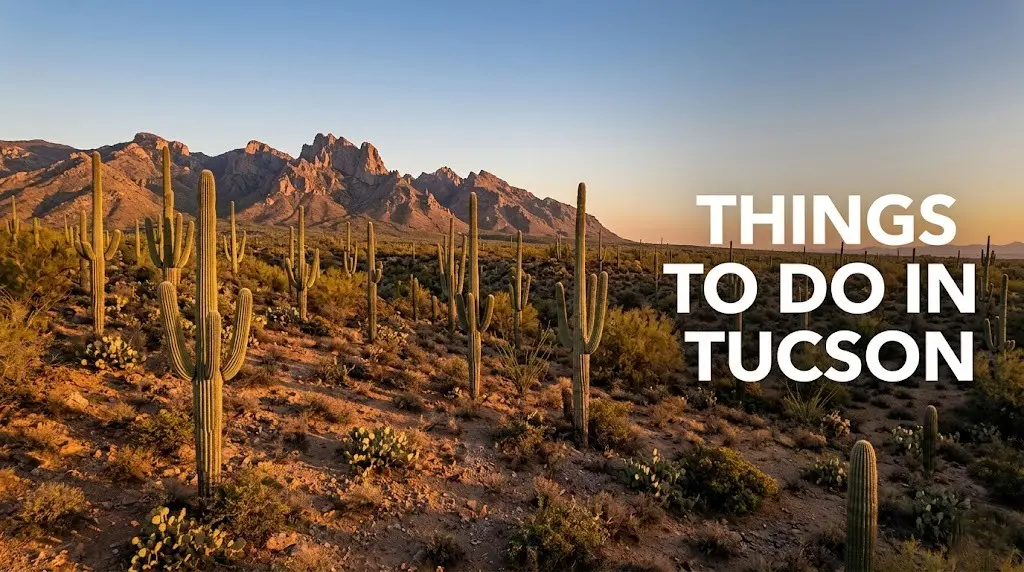
The Sonoran Desert surrounding Tucson is the only place on Earth where the giant saguaro cactus grows wild. Saguaros take 75 years to grow their first arm.
The University of Arizona brings genuine intellectual and arts energy to the city. It is not a college town, but the university’s presence shapes the restaurant scene, the gallery culture, and the city’s overall sensibility.
For solo travelers, Tucson’s walkable arts district and strong cafe culture make it easy to settle in independently. For couples, the combination of dramatic landscape, excellent food, and lower crowd density than Sedona creates a genuinely relaxed experience.
Insider Tip:
- Do not compare Tucson to Phoenix. Phoenix is a resort and sports city. Tucson is a desert ecology and food culture city. They require completely different planning approaches.
- Arrive with a car rental confirmed. The Sun Link streetcar covers downtown but reaches nothing in the mountain districts.
- Book Kartchner Caverns tours as early as 60 days out, especially for weekend visits.
Best Things to Do in Tucson
The best things to do in Tucson are anchored in three categories: desert outdoor experiences, Sonoran food culture, and a genuinely active arts scene centered on 6th Avenue and Congress Street.
Here is an honest activity hierarchy. The Arizona-Sonora Desert Museum earns every bit of its reputation. Saguaro National Park’s two districts both justify full half-day visits. The Pima Air and Space Museum is one of the largest aviation collections in the world and consistently underestimated by first-timers.
| Activity | Best For | Cost Range | Time to Allow | Insider Note |
|---|---|---|---|---|
| Saguaro National Park West | All profiles | ~$35/vehicle | 3 to 4 hours | Bajada Loop Drive at sunrise |
| Saguaro National Park East | Hikers, couples | ~$35/vehicle | 3 to 5 hours | Freeman Homestead Trail is less crowded |
| Arizona-Sonora Desert Museum | Families, wildlife lovers | ~$25 adults | 3 to 5 hours | Arrive within 30 min of opening |
| Pima Air and Space Museum | History, adults | ~$20 adults | 2 to 4 hours | 390th Memorial Museum is free inside |
| Sabino Canyon | Hikers, families | Free parking/tram fee | 2 to 4 hours | Upper Sabino Canyon Trail after tram |
| 4th Avenue corridor | Solo, couples | Free to browse | 2 to 3 hours | Weekday mornings least crowded |
| Tucson Botanical Garden | Couples, seniors | ~$15 adults | 1.5 to 2 hours | Winter butterfly exhibit is best |
Families with young children should front-load the Arizona-Sonora Desert Museum. Children can hold a stingray and observe mountain lions in naturalistic habitats. It is the single best family activity in the city.
Budget travelers should note: Saguaro National Park’s $35 per vehicle fee covers 7 consecutive days of entry. That per-day value is exceptional compared to any paid urban attraction.
Unique Things to Do in Tucson
Tucson’s most distinctive experiences are the ones no other American city can replicate. Kitt Peak National Observatory, 56 miles southwest of the city, hosts public nighttime astronomy programs that put visitors at the controls of professional telescopes.
The All Souls Procession in early November draws over 100,000 participants through downtown Tucson. It began in 1990 as a small community grief ritual and grew into one of the country’s most emotionally powerful public art events.
The Tucson Gem, Mineral and Fossil Showcase, held each February, is the largest gem and mineral show on Earth. Over 40,000 dealers descend on the city across 40-plus venues for two weeks. It transforms Tucson into a global marketplace for everything from raw amethyst to T. rex teeth.
For a genuinely singular experience, drive the Mt. Lemmon Highway (Catalina Highway) from the desert floor to 9,157 feet elevation. The drive passes through five distinct ecological zones. The temperature drops roughly 30°F from Tucson to the summit. This is the coolest summer escape in southern Arizona that does not require an airplane.
Solo travelers find the Mt. Lemmon drive excellent. The summit town of Summerhaven has a small cluster of shops and the Mt. Lemmon Cookie Cabin, known locally for generously sized baked goods and cold-weather contrast with the desert below.
Couples seeking something private: the Tumacacori National Historical Park, 45 miles south on I-19, preserves three Spanish colonial missions. Visitor volume is low. The site’s quiet intensity is unlike anything in the main tourist circuit.
Insider Tip:
- Kitt Peak requires advance reservation for evening programs. Book through the NOIRLab website 2 to 4 weeks ahead, especially October through April.
- The Gem Show’s main public venue at the Tucson Convention Center opens to the public. Entry fees and hours vary by venue. Verify directly with the Tucson Gem Mineral and Fossil Showcase before visiting.
- Summerhaven on Mt. Lemmon has limited food and fuel. Bring water and snacks for the drive.
Outdoor Things to Do in Tucson
Tucson is one of the best outdoor activity cities in the American Southwest. The combination of mountain terrain, desert canyon systems, and 300-plus annual days of sunshine creates year-round outdoor opportunities for hikers, cyclists, and wildlife observers.
Sabino Canyon Recreation Area in the Santa Catalina Mountains northeast of the city is the most accessible outdoor experience within city limits. A narrated tram service runs along the canyon road. The canyon walls reach several hundred feet on each side.
Rillito River Park provides 12 miles of paved trail along the dry riverbed. Road cyclists and casual walkers use it consistently. It connects to Pantano River Park for an extended urban trail system that runs across much of the city without requiring road crossings.
For serious hikers, Mount Wrightson in the Santa Rita Mountains south of Tucson is the definitive challenge. The Old Baldy Trail to the 9,453-foot summit gains over 3,800 feet of elevation. Allow 6 to 8 hours round trip and bring at least 3 liters of water per person.
Agua Caliente Park in the Rincon Valley area offers a genuine contrast: a spring-fed oasis in the desert with palm trees, a pond, and consistent bird activity. It is genuinely free to enter and almost entirely off the first-timer radar.
Seniors and accessibility travelers should note that Sabino Canyon’s tram is the most physically accessible outdoor experience in Tucson. The paved tram road allows wheelchair navigation. The canyon scenery from the tram is substantive, not a consolation experience.
Outdoor activity timing is critical. Between June and September, begin any hiking by 6:00 to 7:00 AM. Trails above 5,000 feet (Sabino Canyon upper area, Mt. Lemmon) remain viable longer into the day. Desert floor trails become genuinely dangerous after 9:30 AM in peak summer.
Key Takeaway: Tucson’s outdoor circuit requires a car and a morning start time. The city’s best nature experiences are spread across opposite sides of town — plan one mountain zone per day, not two.
Saguaro National Park Tucson
Saguaro National Park divides into two completely separate districts on opposite sides of Tucson, and most first-time visitors only discover this after arrival. The West District (Tucson Mountain District) and the East District (Rincon Mountain District) are 30 miles apart. Both require full half-day visits.
The West District sits adjacent to the Arizona-Sonora Desert Museum. Combining them in a single morning visit makes geographic sense. The Bajada Loop Drive, a graded dirt road, winds through the densest saguaro forest in the park. Sunrise turns the cacti gold against a purple sky. This is the most photographed sight in Tucson, and it earns it.
The East District offers more challenging hiking. The Freeman Homestead Trail (1 mile loop) provides excellent saguaro density without significant elevation gain. The Tanque Verde Ridge Trail climbs into the Rincon Mountains for views that extend to Mexico on clear days.
According to the National Park Service, Saguaro National Park receives over one million visitors annually. The West District tends to get more traffic because of its proximity to the Desert Museum. The East District’s trail system sees noticeably fewer people, even on holiday weekends.
Admission is approximately $35 per vehicle for a 7-day pass. Motorcycles are lower. Pedestrians and cyclists pay a per-person rate. Verify current fees at the NPS website before visiting.
Families with children will find the West District’s Bajada Loop Drive manageable for young kids in a car. The East District’s hiking is better for older children (8 and up) who can handle 2 to 4 miles on uneven terrain.
Insider Tip:
- The Junior Ranger program at Saguaro’s visitor centers engages children ages 5 and up. Pick up the booklet at either visitor center at the start of your visit.
- Do not attempt the Bajada Loop Drive after heavy rain. The unpaved road floods and can trap vehicles.
- Cell service is limited inside both districts. Download the NPS app map before entering.
Arizona-Sonora Desert Museum
The Arizona-Sonora Desert Museum is simultaneously a zoo, a botanical garden, an aquarium, a natural history museum, and a live raptor demonstration center — all organized around the Sonoran Desert ecosystem. It is genuinely one of the best natural history institutions in the United States.
The museum covers 98 acres in the Tucson Mountains. Over 230 animal species and 1,200 plant species are represented. The animals live in naturalistic desert habitat, not traditional zoo enclosures.
The raptor free-flight program runs seasonally, typically October through April in morning sessions. Hawks and owls fly within arm’s reach of visitors. This is among the most specific and memorable wildlife experiences available in any American museum context.
The stingray touch pool inside the Desert Museum’s aquarium section is consistently rated the top children’s experience. Young children respond to it more immediately than any other element. Plan 30 to 45 minutes for the aquarium section alone.
For seniors and accessibility travelers: the museum’s paved paths cover much of the facility. However, some habitat viewing areas involve steps or uneven terrain. A mobility aid-friendly map is available at the entrance. Request it at the ticket counter.
Arrive within 30 minutes of opening. By 10:30 AM in summer, the desert habitat areas become genuinely uncomfortable for both visitors and animals. Morning visits in summer are substantially better experiences than afternoon ones.
| Season | Best Experience | What to Avoid |
|---|---|---|
| October to April | Full museum including outdoor habitats | Arriving after noon on weekends |
| May to September | Indoor sections, aquarium, early morning only | Desert habitat areas after 10 AM |
| February | Hummingbird migration and wildflowers in habitat | Gem Show weekend crowds in city |
| December | Holiday light events (verify dates) | Cold mornings in desert walk areas |
Culture, Arts, and History in Tucson
Tucson’s arts and history identity is concentrated in a roughly one-mile corridor along Congress Street and 6th Avenue in the downtown core. This is not a polished arts district. It is genuinely active, locally run, and in places deliberately rough around the edges.
The First Friday Art Walk runs on the first Friday evening of each month. Galleries, studios, and shops along 6th Avenue open extended hours. Local artists show new work. The energy is genuine, not manufactured for tourists. Solo travelers and couples find it the best low-cost evening in Tucson.
Hotel Congress, built in 1919, is the spiritual center of downtown Tucson. The historic hotel housed the capture of bank robber John Dillinger in 1934. Today it operates as a boutique hotel, live music venue, and bar. The Club Congress concert room books national acts and regional artists consistently throughout the year.
The El Presidio Historic District preserves the original Spanish colonial presidio site. The Tucson Museum of Art anchors the district. Its permanent collection covers pre-Columbian art, Spanish Colonial art, and contemporary American Southwest artists. Admission runs approximately $12 to $15 for adults, with free days available for Pima County residents.
The Pima Air and Space Museum sits outside the downtown arts zone but belongs in any Tucson cultural itinerary. Its 390th Memorial Museum, honoring the 390th Bombardment Group of World War II, is a free-entry museum within the complex. The outdoor aircraft display of over 300 planes is one of the largest collections in existence.
According to Visit Tucson, the city’s arts sector supports over 100 galleries and performance venues. The concentration along Congress Street and 4th Avenue creates a walkable circuit that takes 2 to 3 hours to cover properly on foot.
Tucson Food Scene and Dining
Tucson is a UNESCO City of Gastronomy, one of only two American cities to hold this designation. The food identity is specifically Sonoran: a centuries-old culinary tradition that predates Arizona statehood by several hundred years.
The Sonoran hot dog is the entry point. This is not a ballpark hot dog. It is a bacon-wrapped frankfurter in a bolillo-style bun, topped with pinto beans, chopped tomatoes, mayonnaise, mustard, and jalapeño salsa. El Güero Canelo on South 12th Avenue is the most recognized name. Lines form by 11:30 AM on weekends.
El Charro Cafe, founded in 1922 on North Court Avenue, claims to be the oldest continuously operating Mexican restaurant in the United States still run by the founding family. The carne seca, a dried spiced beef unique to Tucson’s Sonoran tradition, is the signature dish.
Cafe Poca Cosa on East Pennington Street operates on a daily-changing chalkboard menu. The kitchen sources locally and interprets traditional Mexican cuisine through a contemporary lens. It is the restaurant that consistently appears on serious food critics’ Tucson lists. Reservations are recommended for dinner.
Tumerico on East 7th Street is Tucson’s standout vegetarian and vegan Sonoran restaurant. The menu rotates daily around local desert ingredients. Non-vegetarian travelers consistently report it as one of their best Tucson meals.
For breakfast, Prep and Pastry on East University Boulevard runs a serious brunch program. The wait on weekend mornings regularly reaches 45 to 60 minutes. Arrive before 8:30 AM or plan a weekday visit.
Budget travelers should note: Tucson’s food value per dollar is exceptional. A full Sonoran hot dog meal at El Güero Canelo costs around $8 to $12. Sit-down lunch at El Charro runs $15 to $25 per person. The city’s food culture rewards street-level exploration, not reservation-only dining.
Key Takeaway: Tucson’s UNESCO gastronomy designation is not marketing. The Sonoran food tradition is specific, historic, and genuinely different from generic Mexican-American restaurant food. Order the carne seca and the Sonoran hot dog before anything else.
Tucson Neighborhoods Guide
Tucson’s distinct neighborhoods operate as completely different experiences. Understanding the city’s geography saves hours of backtracking and reframes the entire planning process.
Downtown and the Arts District centers on Congress Street between 4th Avenue and Stone Avenue. Hotel Congress, the Rialto Theatre, the Fox Tucson Theatre, and the city’s gallery concentration are all within walking distance. This is the most walkable zone in the city.
4th Avenue runs north from Congress Street toward the University of Arizona. It is the city’s independent retail and dining corridor: used bookstores, vintage clothing, local bars, and restaurants that have operated for decades. Lindy’s on 4th has been serving burgers to UA students and locals since 1929.
Barrio Viejo, immediately south of downtown, is one of Tucson’s oldest surviving Hispanic neighborhoods. Adobe row houses painted in faded pastels line the narrow streets. The neighborhood’s cultural significance is genuine. It is not a tourist district. Walk it, but understand you are in a working residential neighborhood.
The University District surrounds the University of Arizona campus on University Boulevard and Park Avenue. It concentrates student-oriented dining, coffee shops, and lower-price accommodation options. The Center for Creative Photography at the UA holds the archives of Ansel Adams and over 100,000 photographs. Entry is free.
Mercado San Agustin on West Congress Street functions as a covered market and food hall. Local vendors operate daily. It anchors the emerging Menlo Park neighborhood on Tucson’s west side, and it is the locals’ alternative to the more tourist-trafficked 4th Avenue corridor.
Seniors and accessibility travelers: Downtown Tucson is relatively flat. 4th Avenue has good sidewalk infrastructure. Barrio Viejo’s uneven historic streets can be difficult for mobility aids. Plan accordingly.
Things to Do in Tucson with Kids
Tucson’s best family experiences are concentrated at the Arizona-Sonora Desert Museum, Saguaro National Park’s West District, and Reid Park Zoo. These three form a natural family day circuit.
Reid Park Zoo on East 22nd Street is a compact, manageable zoo that takes 2 to 3 hours for most families. It lacks the scale of major metropolitan zoos. However, for young children under 8, its size is an advantage: no marathon walking distances between exhibits. Admission runs approximately $10 to $15 per person.
The Tucson Children’s Museum on East Broadway Boulevard engages children ages 2 to 10 with hands-on exhibits built around science and local culture. It is a practical indoor option during summer afternoons when outdoor activity is genuinely dangerous.
Colossal Cave Mountain Park, 20 miles east of downtown, offers guided cave tours that most children ages 5 and up find genuinely engaging. The cave’s constant 70°F temperature makes it a welcome summer relief. Verify current tour schedules before visiting, as hours vary seasonally.
For older children (10 and up), the Pima Air and Space Museum’s aircraft collection creates strong engagement. The SR-71 Blackbird on outdoor display is an aircraft most children have seen in books but never at eye level. The scale is striking.
Families should build summer days around the 6:00 to 9:00 AM window for all outdoor activity. The Arizona-Sonora Desert Museum’s early morning hours are the most comfortable for children in summer. By 11:00 AM, transition to indoor experiences or head toward higher elevations.
Insider Tip:
- Reid Park Zoo has a splash pad area near the entrance. In summer, bring a change of clothes for young children.
- The Children’s Museum in downtown Tucson validates parking at the nearby city garage. Ask at the front desk.
Romantic Things to Do in Tucson
Tucson’s romantic appeal comes from its combination of dramatic landscape, excellent dining, low crowd density, and a calm city pace that rewards slow exploration over checklist tourism.
Sunset from the Gates Pass Overlook in the Tucson Mountains is the most consistently praised single moment in the city by couples. The overlook sits at the crest of Gates Pass Road west of downtown. Saguaro cacti line the ridge in silhouette. The color range at sunset runs from deep orange through violet. Arrive 30 minutes before official sunset time and expect to share the overlook with other visitors, but it never feels crowded.
A dinner reservation at Cafe Poca Cosa on East Pennington Street is the anchor of a serious Tucson date night. The daily-changing menu creates a different experience every visit. The intimate dining room seats relatively few tables, making the atmosphere genuinely private for a downtown restaurant.
For a longer romantic arc, the White Stallion Ranch west of Tucson operates as an all-inclusive dude ranch with horseback riding through the Sonoran Desert. It is not a budget experience. But for couples who want an immersive two-night desert experience away from urban noise, it is the most specific Tucson romantic option.
The Tucson Botanical Garden on North Alvernon Way is a quieter, lower-key daytime option for couples. The garden covers 5.5 acres of themed gardens including a butterfly house that operates seasonally. Morning visits during spring wildflower season are genuinely beautiful.
According to the Arizona Office of Tourism, the Tucson foothills area at the base of the Santa Catalina Mountains concentrates the city’s resort and spa properties. Couples seeking luxury accommodation should look at the Loews Ventana Canyon Resort and the Hacienda del Sol Guest Ranch Resort in this zone.
Free Things to Do in Tucson
Tucson offers a genuinely wide range of free and low-cost experiences. This is one of the city’s practical strengths compared to resort-heavy Southwest destinations.
Free and genuinely worthwhile activities:
- Gates Pass Overlook: Sunset views over the Tucson Mountains. Free parking at the overlook.
- Agua Caliente Park: Spring-fed oasis in the Rincon Valley. Free entry. Consistent bird activity.
- Center for Creative Photography (UA campus): Free entry. Holds archives of Ansel Adams and other 20th-century masters.
- University of Arizona Museum of Art: Free to UA students and Pima County residents. Low admission for others.
- Rillito River Park: 12 miles of paved trail along the dry riverbed. Free access. Bike rentals available nearby.
- First Friday Art Walk: Free gallery openings along 6th Avenue and Congress Street on the first Friday evening of each month.
- Barrio Viejo walking tour: Self-guided walk through Tucson’s oldest surviving Hispanic neighborhood. No admission. Numerous interpretive markers.
- Tumamoc Hill: A steep 1.5-mile trail on volcanic basalt west of downtown. No entry fee. One of Tucson’s most consistent locals’ hiking spots.
- Saguaro National Park (bicycle entry): If you cycle into either district, entry is a fraction of the vehicle fee. Many Tucson locals access the West District by bike from the city.
Budget travelers should structure their Tucson visit around the free outdoor and cultural experiences and spend their dining budget on Sonoran food experiences. The combination delivers a richer trip than most paid-attraction itineraries.
Key Takeaway: Tucson’s free outdoor and cultural circuit, from Gates Pass at sunset to the Center for Creative Photography, delivers genuine destination-specific experiences that cost nothing and outperform most paid alternatives.
Best Time to Visit Tucson and Seasonal Guide
The best time to visit Tucson is October through April. The worst months for most outdoor activity are June through mid-September, when heat regularly exceeds 100°F and afternoon monsoon thunderstorms bring flash flood risk.
| Season | Temperatures | Crowd Level | What’s Best | What to Avoid |
|---|---|---|---|---|
| October to November | 70s to 80s°F days | Low to moderate | Hiking, cycling, All Souls Procession, fall wildflowers | Nothing significant |
| December to February | 50s to 70s°F days | Moderate (snowbirds) | Birding, stargazing, Gem Show (Feb), mild hiking | Occasional cold snaps below 40°F at night |
| March to May | 70s to 90s°F days | Low | Wildflower peak (March), spring birding, all outdoor activity | Late May heat building |
| June to September | 95°F to 115°F | Low overall | Mt. Lemmon escape, monsoon photography (for enthusiasts), indoor museum circuit | Any desert floor hiking after 9 AM |
February deserves special attention. The Tucson Gem, Mineral and Fossil Showcase transforms the city for two weeks. Accommodation prices rise. Book 3 to 4 months in advance if planning a February visit.
March brings the Sonoran Desert wildflower season. Brittlebush, poppies, and desert marigolds cover the hillsides around Saguaro National Park’s West District in good rainfall years. The bloom timing varies by winter precipitation. Check Tucson’s wildflower reports through the Arizona-Sonora Desert Museum’s website in early March.
December through January is Tucson’s best-kept seasonal reality. Days are mild and clear. Visitor volume is lower than spring. Snowbirds arrive from cold-climate states but rarely overwhelm the outdoor circuit.
Summer is workable if you restructure every outdoor activity to the pre-10:00 AM window. Mt. Lemmon provides a genuine temperature escape. The Arizona-Sonora Desert Museum is better than its summer reputation if you arrive at opening time.
Things to Do Near Tucson (Day Trips)
Tucson sits within day-trip range of several genuinely distinct experiences that no competitor guide covers with adequate specificity.
Biosphere 2, 30 miles north of Tucson in Oracle, is operated by the University of Arizona as an active earth systems research facility. Guided tours take visitors inside the world’s largest enclosed ecological research structure. It is simultaneously a real science institution and one of the most visually surreal spaces in Arizona. Admission runs approximately $20 to $25 for adults. Book tours in advance; availability on weekends fills.
Kartchner Caverns State Park, 47 miles southeast of Tucson near Benson, is one of the most scientifically significant living cave systems in the United States. The cave remains 99.4% humidity inside. Stalactites and stalagmites are still actively growing. Tours fill up weeks in advance during peak season (October through April). Book directly through Arizona State Parks as early as 60 days ahead.
Bisbee, 90 miles southeast of Tucson, is a former copper mining town that became an arts community. The Queen Mine Tour descends into an actual underground copper mine. The town’s Victorian architecture and warren-like hillside streets create a walking experience unlike any other Arizona town. Drive time from Tucson is approximately 90 minutes via I-10 and AZ-80.
Tombstone, 70 miles southeast of Tucson via I-10 and AZ-80, is the most tourist-oriented of the Tucson day trips. The OK Corral gunfight reenactments are genuinely theatrical but feel heavily commercialized after an hour. Pair it with Bisbee on the same day for a more balanced experience.
Madera Canyon, 45 miles south of Tucson in the Santa Rita Mountains, is North America’s single best birding destination for spring hummingbird migration. During April and May, 15-plus hummingbird species pass through. Birders, couples, and solo travelers find the canyon exceptional. Arrive before 8:00 AM for the best bird activity.
For solo travelers: the Biosphere 2 tour works well alone. The guided structure provides built-in social context. For families: Kartchner Caverns is appropriate for children 7 and up who can handle 45 minutes of walking in enclosed spaces.
Getting Around Tucson
A rental car is essential for experiencing Tucson properly. The city’s best experiences — Saguaro National Park’s two districts, the Arizona-Sonora Desert Museum, Sabino Canyon, and Mt. Lemmon — are all spread across a wide geographic area with no practical transit connections between them.
Tucson International Airport (TUS) serves the city directly with connections through major hub airports including Phoenix Sky Harbor, Dallas, Denver, Los Angeles, and Chicago. Car rental desks are located at the terminal. Budget travelers arriving on a tight schedule often find driving from Phoenix Sky Harbor (approximately 1.5 to 2 hours south on I-10) a cost-effective alternative, especially when bundled with a road trip itinerary.
The Sun Link streetcar runs a 4-mile route connecting the University of Arizona campus to downtown and the Mercado San Agustin area. It is genuinely useful for moving between the University District and downtown without parking concerns. It does not reach any major outdoor attraction.
Sun Tran, Pima County’s bus system, covers the metropolitan area. It is a workable option for reaching Reid Park Zoo and some neighborhood destinations. It is not practical for reaching Saguaro National Park or the mountain recreation areas.
Parking in downtown Tucson is generally affordable at city-operated garages on Church Avenue and Pennington Street. Rates run approximately $1 to $2 per hour. Surface lot options exist on Congress Street and 6th Avenue for evening visits.
Rideshare services operate in Tucson but have limited coverage in outer neighborhoods and along mountain road corridors. Do not rely on rideshare to reach the Arizona-Sonora Desert Museum or Sabino Canyon without confirming pickup availability in advance.
Suggested 1-Day Tucson Itinerary:
- 6:30 AM: Arrive at Saguaro National Park West District (Bajada Loop Drive). Beat the heat and the day-visitor surge.
- 9:00 AM: Drive 10 minutes to the Arizona-Sonora Desert Museum. Enter at opening. Spend 3 hours including the raptor program (seasonal).
- 12:30 PM: Return toward downtown. Lunch at El Güero Canelo on South 12th Avenue. Order the Sonoran hot dog.
- 2:00 PM: Walk Congress Street and 4th Avenue. Visit the Center for Creative Photography at the UA campus (free).
- 5:00 PM: Drive to Gates Pass Overlook. Arrive 30 minutes before sunset.
- 7:30 PM: Dinner reservation at Cafe Poca Cosa on East Pennington Street.
Safety and Practical Warnings for Tucson
Tucson’s primary safety risk is not urban crime. It is the Sonoran Desert’s extreme heat and the physical demands it places on visitors who underestimate it.
Heat is the primary danger. Between June and September, temperatures regularly reach 105°F to 115°F on the desert floor. Dehydration and heat exhaustion can develop quickly, especially on exposed desert trails.
Key safety and practical facts every visitor should know:
- Carry at least 2 liters of water per person for any trail hike, even short ones. Desert air is dry and sweat evaporates faster than most visitors expect.
- Never hike desert trails after 9:30 AM in summer. The heat intensifies quickly after 10:00 AM. Many Tucson emergency calls involve hikers who started at 9:00 AM without adequate water.
- Flash flood awareness is critical during monsoon season (July through mid-September). Never cross a flooded wash or low-water crossing, even if the water appears shallow. Water volume can increase within seconds from upstream rainfall you cannot see or hear.
- Rattlesnakes are present on all desert trails year-round. Stay on marked trails. Watch where you step. Do not put hands into rock crevices or under brush.
- Scorpions are common in the Tucson area. Shake out shoes and clothing left outdoors or on the ground, especially in the morning.
- Sun protection is non-negotiable. Apply SPF 50 sunscreen before any outdoor activity. Wear a wide-brimmed hat. Bring UV-blocking sunglasses.
- Cell service is limited in Sabino Canyon’s upper areas and along the Catalina Highway above 6,000 feet. Download offline maps before leaving cell range.
For medical emergencies, Banner University Medical Center and Tucson Medical Center are the primary trauma-capable hospitals in the city. The Tucson Fire Department operates a wilderness emergency response division.
Key Takeaway: Tucson’s single biggest practical danger for visitors is underestimating the heat. Carry twice the water you think you need and start every outdoor activity before 8:00 AM in summer.
Frequently Asked Questions About Things to Do in Tucson
What is the best time of year to visit Tucson Arizona?
The best time to visit Tucson Arizona is October through April, when daytime temperatures range from the 60s to the mid-80s°F and all outdoor activities are fully accessible.
February is exceptional for the Tucson Gem, Mineral and Fossil Showcase. March brings Sonoran Desert wildflower season.
Summer visits (June through September) are workable only if you structure outdoor activities before 9:30 AM and use Mt. Lemmon or indoor attractions for afternoon hours.
How many days do you need to see Tucson properly?
Three to four days is the right amount of time to cover Tucson’s essential experiences without rushing.
Day one covers Saguaro National Park West and the Arizona-Sonora Desert Museum. Day two covers Sabino Canyon, downtown arts, and a serious dinner. Days three and four allow for a day trip to Kartchner Caverns or Bisbee and Mt. Lemmon.
Two days is enough for a strong first impression, but you will leave having missed at least one major experience.
Is Tucson worth visiting compared to Scottsdale or Sedona?
Tucson is worth visiting for travelers who prioritize authentic outdoor experiences, Sonoran food culture, and genuine local character over resort amenities.
Scottsdale offers more luxury hospitality infrastructure and a polished nightlife scene. Sedona’s red rock landscape is more visually dramatic on first impression.
Tucson is the most locally rooted of the three and the best value for outdoor recreation and food-focused travel.
What is Tucson Arizona most famous for?
Tucson is most famous for Saguaro National Park, the Arizona-Sonora Desert Museum, its status as a UNESCO City of Gastronomy, and the Sonoran Desert ecosystem that surrounds it.
The Tucson Gem, Mineral and Fossil Showcase held each February is the largest event of its kind in the world.
The city is also recognized for dark sky astronomy access, the Mt. Lemmon Sky Island ecosystem, and some of the best Sonoran cuisine in the United States.
Are there good things to do in Tucson in the summer heat?
Yes, but the itinerary requires restructuring around temperature realities.
All outdoor activity should begin before 8:00 AM and end by 10:00 AM. The Arizona-Sonora Desert Museum, Pima Air and Space Museum, Tucson Children’s Museum, and Center for Creative Photography provide full afternoon indoor alternatives.
Mt. Lemmon is the most effective summer escape: temperatures at the 9,157-foot summit run 25 to 30°F cooler than the city floor, and the forest environment is completely different from the desert below.
What are the best free things to do in Tucson AZ?
The best free things to do in Tucson AZ include the Gates Pass sunset overlook, Agua Caliente Park, the Center for Creative Photography at the University of Arizona, Rillito River Park trail, Tumamoc Hill hiking trail, Barrio Viejo neighborhood walking, and the First Friday Art Walk along 6th Avenue.
Saguaro National Park charges a vehicle entry fee, but pedestrian and bicycle entry is significantly lower.
The free outdoor and cultural circuit in Tucson is more substantive than most US cities of comparable size.
Plan Your 2026 Tucson Trip With Confidence
Tucson rewards intentional planning more than most American cities. The geographic spread between its best experiences means a poorly structured itinerary wastes more time in transit than in experience.
Book Kartchner Caverns tours first. They fill earliest and are the hardest to access day-of. Then confirm car rental at TUS. Then plan your outdoor activity schedule around morning starts, especially if visiting May through September.
Travel conditions, admission prices, operating hours, permit requirements, and seasonal availability in Tucson change regularly. Verify all key logistics directly with Visit Tucson, the National Park Service (Saguaro National Park), and Arizona State Parks (Kartchner Caverns) before departure. The information in this guide reflects general 2026 guidance and should be confirmed as you finalize your itinerary.
Tucson gives experienced travelers exactly what they came for. Start early, eat Sonoran, and put the saguaros in front of the sunset at Gates Pass.