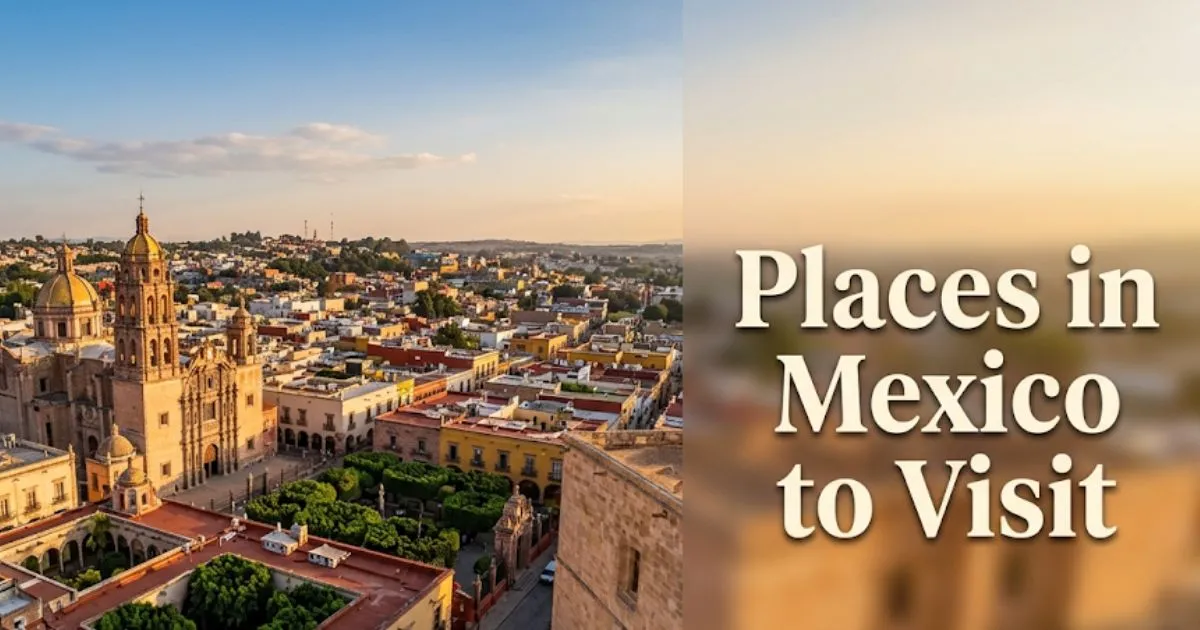
Best Places in Mexico to Visit in 2026: A Real Guide

The best places in Mexico to visit in 2026 span an extraordinary range. Mexico City’s Roma Norte neighborhood and Oaxaca’s mezcal-laced food markets belong in the same conversation as the Yucatan’s cenotes and the Pacific surf of Puerto Escondido.
Mexico received over 32 million international tourists in recent years, according to the Consejo de Promocion Turistica de Mexico. Most of them went to five beach resorts. The interior of the country, where the food, architecture, and culture actually are, sees a fraction of those numbers.
This guide covers 17 key destination questions. It tells you which city fits which traveler type, what each destination honestly costs, and when to go versus when to stay home.
Places in Mexico to Visit: How to Choose the Right Destination
The best place in Mexico to visit depends entirely on what you are actually looking for, since Mexico contains roughly eight distinct travel experiences within one country.
Mexico is not a single destination. It is a Pacific surf coast, a Caribbean beach peninsula, a highland colonial heartland, a volcanic plateau capital city, a desert peninsula, a canyon wilderness, and a network of Indigenous cultural centers, all within one country’s borders.
Start your decision with a single question. Do you want beach, city, culture, adventure, food, or some combination?
Beach travelers divide further into Caribbean (calm turquoise water, reef diving, cenote access) and Pacific (surf, whale watching, fishing, wilder landscapes). Budget matters enormously here. Tulum and Los Cabos now price at European resort levels. Puerto Escondido and Huatulco on the Pacific coast of Oaxaca state deliver genuine beach quality at a fraction of the cost.
Culture and food travelers should point their trip toward Mexico City, Oaxaca, Puebla, or Merida. These cities are where Mexico’s pre-Columbian and colonial heritage, its Indigenous food traditions, and its contemporary creative class all coexist.
Insider Tip:
- First-timers often book Cancun because it is familiar. Experienced Mexico travelers almost never return to Cancun once they have visited Merida, Oaxaca, or Mexico City.
- The 90-minute drive from Cancun’s airport to Tulum opens access to the entire Riviera Maya and the colonial city of Valladolid, which is vastly undervisited by US travelers.
- Solo travelers and budget travelers get the most from Mexico’s interior cities, where hostel culture is excellent and street food costs almost nothing.
Best Places in Mexico to Visit
The best places to visit in Mexico for 2026 are Mexico City, Oaxaca, Merida, Puerto Vallarta, San Miguel de Allende, Puerto Escondido, Bacalar, and Guanajuato.
This list is built on four criteria: genuine destination quality, honest value for money, reasonable safety profile, and experiences that cannot be replicated at home or at a generic resort.
| Destination | Best For | Budget Tier | Best Season | Experience Type |
|---|---|---|---|---|
| Mexico City | Food, culture, nightlife, art | Budget to mid-range | Oct to Nov, March to May | Urban, culinary, museum |
| Oaxaca | Food, Indigenous culture, craft, mezcal | Budget to mid-range | Oct to April | Cultural, culinary, artisan |
| Merida | Colonial architecture, Yucatan culture | Budget to mid-range | Nov to April | Colonial, cultural, day trips |
| San Miguel de Allende | Romance, colonial beauty, arts | Mid-range to premium | Year-round; busiest Dec and Easter | Romantic, arts, boutique |
| Puerto Vallarta | Beach, nightlife, water sports | Mid-range | Nov to April | Beach, social, water sports |
| Puerto Escondido | Surf, budget beach, local atmosphere | Budget | Nov to April (surf peaks July to Oct) | Surf, backpacker, local |
| Bacalar | Quiet, scenery, alternative to Tulum | Budget to mid-range | Nov to April | Nature, water, low-key |
| Guanajuato | Student city, architecture, history | Budget | March to June, Sept to Nov | Colonial, historic, social |
| Los Cabos | Luxury beach, sport fishing, couples | Premium | Oct to June | Luxury, beach, couples |
| Tulum | Beach clubs, yoga, cenotes | Mid-range to premium | Dec to April | Beach, wellness, party |
The table above is the framework this article builds on. Use it to jump directly to the section most relevant to your travel style.
Best Places to Visit in Mexico for Young Adults
Puerto Vallarta, Playa del Carmen, Mexico City, and Guanajuato are the best places in Mexico for young adults in 2026, for genuinely different reasons.
Puerto Vallarta’s Zona Romantica around Olas Altas Street and the beach bars of Playa Los Muertos is where the city’s social scene concentrates. This is not a party-strip in the Cancun hotel zone sense. It is a walkable neighborhood with rooftop bars, gay-friendly venues, beach clubs, and genuinely good tacos within the same three blocks.
Playa del Carmen’s Fifth Avenue (Quinta Avenida) is more commercial and more crowded than it was five years ago. The real social life has shifted to side streets off Fifth Avenue, particularly around Calle 12 and Calle 38, where local bars operate without the tourist markup.
Mexico City’s Condesa and Roma Norte neighborhoods are where young Mexican professionals, creatives, and international travelers overlap. Weekend nights around Avenida Amsterdam in Condesa or the bar corridor on Avenida Alvaro Obregon in Roma Norte offer a social environment with genuine local culture attached.
Guanajuato is the sleeper pick. This university city fills with Mexican students during the academic year. The annual Festival Internacional Cervantino in October draws an arts and performance crowd that genuinely mixes local and international young adults.
Insider Tip:
- Playa del Carmen over Cancun: the hotel zone in Cancun is a self-contained resort bubble; Playa has streets you can actually walk and local life you can engage with.
- Mexico City hostels in Roma Norte and Condesa (Casa Pepe, for example) have communal spaces that function as the city’s best social networks for solo young travelers.
- Budget approximately 400 to 800 Mexican pesos (roughly $20 to $40 US at current rates, verify before traveling) for a full night out in Guanajuato including food, drinks, and cover.
Best Places to Visit in Mexico for Couples
San Miguel de Allende, Oaxaca, Bacalar, and Los Cabos are consistently the strongest romantic destinations in Mexico for couples in 2026.
San Miguel de Allende is the most architecturally concentrated romantic city in Mexico. The rose-pink facade of La Parroquia de San Miguel Arcangel presides over a central square, the Jardin Principal, where the entire social life of the city flows on weekend evenings. Cobblestone streets, boutique hotels in converted colonial mansions, and some of Mexico’s finest restaurant dining (Moxi at Hotel Matilda; Aperi on Recreo Street) create an environment that rewards slow, wandering couples.
Oaxaca works for couples who want their romance alongside serious culinary and cultural depth. Dinner at one of the mezcaleria bars around Macedonio Alcala street, followed by an evening at the Teatro Macedonio Alcala, is a genuinely special evening that costs far less than an equivalent experience in most US cities.
Bacalar, on the Quintana Roo side of the Yucatan Peninsula, is Mexico’s most underrated couples destination. The Laguna de Bacalar, known as the Lake of Seven Colors, runs 60 kilometers of freshwater so clear it is visually disorienting. Small boutique hotels and guesthouses line the western shore. There are no large resorts, no spring break crowds, and no branded beach clubs.
Los Cabos serves couples who want luxury infrastructure: overwater spa treatments, high-end sport fishing charters, and the dramatic meeting of Pacific and Sea of Cortez at Land’s End near El Arco. It is not an authentically Mexican experience. It is a beautifully executed luxury beach vacation in Mexico.
Best Beach Destinations in Mexico
The best beach destinations in Mexico in 2026 are not all equal, and the distinction between Caribbean and Pacific is the most important decision a beach-focused traveler will make.
The Caribbean coast (Tulum, Playa del Carmen, Cancun, Isla Mujeres, Holbox) offers warm turquoise water, coral reef snorkeling and diving, cenote access, and calm swimming conditions. The Pacific coast (Puerto Vallarta, Puerto Escondido, Huatulco, Sayulita, Mazatlan) offers more dramatic scenery, surf, whale watching from December through March, and local fishing culture.
| Beach Destination | Water Type | Best For | Best Season | Crowd Level | Budget Tier |
|---|---|---|---|---|---|
| Tulum | Caribbean | Cenotes, beach clubs, wellness | Dec to April | Very high in season | Premium |
| Playa del Carmen | Caribbean | Social scene, day trips, families | Nov to April | High | Mid-range to premium |
| Isla Holbox | Caribbean | Whale sharks, quiet beaches, flamingos | June to Sept (whale shark) | Moderate | Mid-range |
| Bacalar | Freshwater lagoon | Couples, quiet, nature | Nov to April | Low | Budget to mid-range |
| Puerto Vallarta | Pacific | Water sports, nightlife, couples | Nov to April | Moderate to high | Mid-range |
| Puerto Escondido | Pacific | Surf, budget beach, local culture | Nov to April | Moderate | Budget |
| Huatulco | Pacific | Quiet, snorkeling, family | Nov to April | Low | Budget to mid-range |
| Los Cabos | Pacific/Sea of Cortez | Luxury, sport fishing, couples | Oct to June | High in season | Premium |
| Sayulita | Pacific | Surf, bohemian, young adults | Nov to April | Moderate | Budget to mid-range |
Families with children should note that Tulum’s beach road is not walkable with strollers without significant difficulty. Huatulco, with its nine sheltered bays and calm water, is considerably better suited for families with young children.
Solo travelers heading to Pacific beach destinations should be aware that Sayulita, Sayulita’s neighbor Punta de Mita, and Puerto Escondido’s Playa Zicatela all have thriving hostel-to-surf-school social ecosystems where meeting other travelers is straightforward.
Best Colonial Cities in Mexico
Oaxaca, San Miguel de Allende, Merida, Guanajuato, Puebla, and Zacatecas are Mexico’s best colonial cities, and each has a fundamentally different character despite sharing UNESCO World Heritage Site status.
Oaxaca de Juarez is the most complete colonial city experience in Mexico. The grid of streets around Santo Domingo de Guzman Church contains the city’s best restaurants, mezcalerias, craft markets, and galleries within a comfortable walking radius. Oaxaca is also the gateway to Monte Alban, the pre-Columbian Zapotec capital, and to the artisan villages of Teotitlan del Valle (textiles) and San Bartolo Coyotepec (black clay pottery).
Guanajuato’s geography is its character. The city was built in a ravine, so streets run underground, over bridges, and up hillsides in a configuration that genuinely defeats first-time navigation. The Callejón del Beso (Alley of the Kiss) is the most photographed spot; the overlook from the Monumento al Pipila statue above the city is where the actual view is.
Merida is colonial Mexico at its most livable. Wide boulevards, French-influenced mansions on Calle 60, Sunday street markets on the Plaza Grande, and Yucatecan cuisine at the Mercado Lucas de Galvez make Merida feel like a functioning city rather than a tourist artifact. It is also the safest large city in Mexico by most crime metric assessments.
Puebla is underrated relative to its culinary significance. Mole poblano and chiles en nogada originated here. The Barrio del Artista and the tile-covered facades around Calle 6 Norte are worth a full morning.
Key Takeaway: Start your Mexico planning with Oaxaca or Merida if you want colonial culture; both are safer, cheaper, and more genuinely rewarding than their tourist footprint suggests.
Best Cities to Visit in Mexico for Food and Culture
Mexico City and Oaxaca are the two best food and culture cities in Mexico, and the gap between them and any other destination is substantial.
Mexico City’s food identity is not a single cuisine. It is a layered accumulation of pre-Hispanic ingredients, Spanish colonial cooking, French influence (from the 19th century), regional Mexican immigration, and contemporary innovation. Pujol in Polanco, run by chef Enrique Olvera, appears on the World’s 50 Best Restaurants list. El Cardenal on Calle Palma in Centro Historico has been serving traditional Mexican breakfast since 1969 and remains where serious food travelers eat their first morning meal in the city.
The Mercado de San Juan in Centro Historico is the city’s best specialty market for local tastings: grasshoppers (chapulines), huitlacoche, mole pastes, fresh cheese, and international specialty ingredients side by side.
Oaxaca’s food culture is built around the seven moles, a tradition with roots in pre-Columbian Zapotec cooking. The Mercado 20 de Noviembre on Calle Aldama is where to eat the real food: tlayudas, tasajo (air-dried beef), chorizo cooked over charcoal braziers, and fresh-ground chocolate at the stalls near the market entrance.
Guadalajara earns a mention for tequila tourism, since the Tequila town and region (a 45-minute drive from central Guadalajara) is the legally defined origin zone for tequila production and home to distilleries including Jose Cuervo’s La Rojena, the oldest continuously operating distillery in Latin America.
According to Visit Mexico, the country’s official tourism promotion board, Mexico City, Oaxaca, and Puebla together form the acknowledged triangle of Mexican culinary heritage travel, drawing food-focused travelers from over 40 countries annually.
Budget travelers should know that Mexico City’s best food is street-level. A full taco al pastor meal at a late-night stand near Mercado de Mediodia in Roma Norte costs under 100 pesos. The food quality there is not inferior to the restaurant versions.
Safest Places to Visit in Mexico
The safest places to visit in Mexico are Merida (Yucatan state), Oaxaca city, San Miguel de Allende, Mexico City (specifically the tourist neighborhoods of Roma, Condesa, Polanco, and Coyoacan), Puerto Vallarta, and the Yucatan Peninsula’s tourist corridor from Cancun to Tulum.
The US State Department issues state-by-state travel advisories for Mexico, not a single nationwide rating. Checking advisory levels at travel.state.gov by specific Mexican state is the first practical step every traveler should take.
States with Level 1 (Exercise Normal Precautions) or Level 2 (Exercise Increased Caution) advisories as of recent reporting include Yucatan, Campeche, Baja California Sur, Quintana Roo (with the note to use toll roads and avoid isolated areas), Jalisco (with similar notes), Oaxaca, and Guanajuato. Verify current advisory levels before departure, as these ratings are subject to change.
Merida is frequently cited as one of the safest cities in Mexico by Mexican federal crime statistics. The Yucatan state government has invested substantially in tourist infrastructure and police presence in the historic center.
Petty theft, phone snatching in crowded markets, and scam taxis are the most common traveler concerns across all tourist destinations. Using Uber (which operates openly in Mexico City, Guadalajara, Puerto Vallarta, and Cancun) eliminates the taxi scam risk. Keeping phones in front pockets and using anti-theft bags in markets eliminates most petty theft exposure.
Seniors and accessibility travelers should know that Merida and Oaxaca city have level, wide sidewalks in their historic centers that are significantly more manageable than the steep cobblestone streets of Guanajuato or San Miguel de Allende.
Key Takeaway: The single most useful Mexico safety step is checking the US State Department’s advisory level for your specific destination state at travel.state.gov, not reacting to the headline country-level rating.
Best Places in Mexico for Solo Travelers
Mexico City, Oaxaca, Merida, and Guanajuato are the best places in Mexico for solo travelers, combining safety, social infrastructure, budget efficiency, and ease of independent navigation.
Mexico City’s Roma Norte and Condesa neighborhoods have a hostel and co-living ecosystem that rivals Berlin or Lisbon for the quality of traveler social life. Hostels like El Patio 77 in the Cuauhtemoc neighborhood run organized food tours, mezcal tastings, and city walks that function as social connectors. Solo travelers who stay in Roma Norte and spend their first two days attending one organized group experience and one evening at a mezcaleria on Avenida Alvaro Obregon rarely report loneliness.
Oaxaca has a smaller but extremely concentrated solo travel community centered around the three-block area near Calle Garcia Vigil. The city’s walkability and the genuine cultural richness of the surrounding area (three UNESCO heritage sites within day-trip distance) make it easy to fill two weeks without a travel partner and without repeating an experience.
Merida’s grid street plan and well-lit historic center make solo evening walks genuinely comfortable. The Sunday market around Plaza Grande, where locals bring their families, kids sell food, and live music plays all afternoon, is one of the most socially welcoming public spaces in Mexico for solo travelers.
For solo women travelers specifically: Oaxaca and Merida are consistently rated among Mexico’s most comfortable environments by solo female travel communities on Reddit’s r/solotravel. The catcalling and unsolicited attention that is common in some beach resort towns is markedly lower in Merida and Oaxaca’s historic centers.
Budget travelers traveling solo will find Mexico City and Oaxaca the most efficient destinations. Private rooms in quality hostels run approximately 400 to 700 pesos per night (verify current rates before booking). Street food costs around 50 to 120 pesos per full meal.
Best Places to Visit in Mexico on a Budget
Oaxaca, Merida, Guanajuato, Puerto Escondido, and Mexico City offer the strongest value for budget travelers in Mexico in 2026.
The most important budget principle in Mexico travel is that interior colonial cities and Pacific coast beach towns consistently deliver better value than the Caribbean coast resort infrastructure. A quality boutique guesthouse in Oaxaca costs roughly 50 to 60 percent of an equivalent-quality room in Tulum.
Free and low-cost experiences across Mexico’s best budget destinations:
- Zocalo (main square) culture: Every colonial city’s main square is free, animated, and central to local life. Merida’s Zocalo on a Sunday night is better free entertainment than most paid attractions in Mexico.
- Public markets: Oaxaca’s Mercado Benito Juarez, Merida’s Mercado Lucas de Galvez, and Mexico City’s Mercado de San Juan charge nothing for entry and sell the country’s best food at local prices.
- Archaeological day trips on public transit: Monte Alban from Oaxaca runs approximately 80 pesos round trip by colectivo (shared van). Entry to the site itself runs approximately 80 to 100 pesos (verify current INAH pricing before visiting).
- Church interiors and neighborhoods: Guanajuato’s entire historic center and its churches are free to walk and enter during open hours.
- Beach without beach club pricing: Puerto Escondido’s Playa Principal and Playa Carrizalillo are public beaches with no entrance fee. Beach clubs at Tulum charge $30 to $80 US per person minimum spend.
Budget travelers should set a daily target of 600 to 1,200 pesos for food, transport, and entertainment in Mexico’s interior cities. That range covers a hotel, three meals, and one paid attraction per day in Oaxaca or Merida.
Families with children traveling on a budget should target Huatulco and Puerto Escondido on the Oaxacan Pacific coast. These destinations have calm bay swimming, low accommodation pricing, and genuinely affordable local seafood restaurants.
Best Places to Visit in Mexico in Winter
The best places to visit in Mexico in winter (December through February) are Oaxaca, Merida, Los Cabos, Puerto Vallarta, and the Riviera Maya, all of which are at or near their best in terms of weather, visibility, and activity availability.
December through February is Mexico’s peak tourist season in most destinations. Book accommodation at least three to four months ahead for any travel during the Christmas to New Year period. Prices spike significantly across the Caribbean coast and Los Cabos during this window.
| Destination | December-February Weather | Crowd Level | Hotel Rate vs. Average |
|---|---|---|---|
| Oaxaca city | Dry, mild (15-24°C/59-75°F) | High Dec-Jan, moderate Feb | +20 to 40% in late Dec |
| Merida | Dry, warm (22-30°C/72-86°F) | Moderate | +15 to 25% in late Dec |
| Puerto Vallarta | Dry, warm (25-30°C/77-86°F) | High | +25 to 40% Dec-Jan |
| Los Cabos | Dry, warm (22-27°C/72-80°F) | Very high | +40 to 60% late Dec |
| Riviera Maya/Tulum | Dry, warm (26-30°C/79-86°F) | Very high | +30 to 50% Dec-Feb |
| Mexico City | Cool, dry (12-22°C/54-72°F) | Moderate | Stable; fewer tourists |
Winter whale watching off Los Cabos and Puerto Vallarta is a genuine seasonal highlight. Humpback whales migrate to the warm waters of the Sea of Cortez and Banderas Bay from December through March. Whale watching tours operate from both cities’ marinas.
Seniors and accessibility travelers will find winter the most physically comfortable season for Mexico travel. The heat and humidity that strain mobility in summer are absent. Oaxaca’s mild winter temperatures are particularly well-suited for older travelers covering the city’s uneven historic center terrain.
Key Takeaway: For winter travel, book accommodation by September to guarantee both availability and reasonable pricing, especially for the week between Christmas and New Year’s.
Best Places to Visit in Mexico in Summer
Puerto Escondido, Guanajuato, Mexico City, and the Pacific coast of Jalisco are the best places to visit in Mexico in summer (June through August) when the Caribbean coast faces hurricane season risk.
Summer is the low season on most of Mexico’s Caribbean coast, which means lower prices but also higher humidity, afternoon rain, and genuine hurricane risk from June through October with September being statistically the most active month. Travelers committed to the Caribbean in summer should consider comprehensive travel insurance covering weather-related cancellations.
The Pacific coast and highland interior perform well in summer. Puerto Escondido from July through October is in full surf season. The Mexican Pipeline at Playa Zicatela hosts professional surfing competitions in this window. Non-surfers will find smaller crowds at neighboring Playa Carrizalillo, which has calm water and is sheltered enough for swimming.
Mexico City in summer experiences afternoon rain showers most days, but mornings are dry and mild. The city’s museum circuit (the National Museum of Anthropology in Chapultepec Park, the Frida Kahlo Museum in Coyoacan, the Templo Mayor in Centro Historico) is unaffected by rain and operates year-round.
Guelaguetza, Oaxaca’s signature Indigenous cultural festival, takes place in late July. This is genuinely one of Mexico’s most significant cultural events, with traditional dancing, music, and processions representing all eight of Oaxaca’s Indigenous regions. Hotels in Oaxaca city book out six to nine months in advance for Guelaguetza weekend. Plan accordingly.
Young adults seeking summer beach options should look at Sayulita (Nayarit state, 40 minutes north of Puerto Vallarta airport) and Mazatlan (Sinaloa state), both of which have lower Caribbean coast crowd levels in summer and strong social hostel and surf school scenes.
Where to Go in the Yucatan Peninsula
The Yucatan Peninsula’s best destinations beyond Cancun are Merida, Valladolid, Isla Holbox, Bacalar, and the cenote networks around Tulum and Valladolid.
The Yucatan Peninsula contains three Mexican states: Quintana Roo (Cancun, Playa del Carmen, Tulum, Bacalar, Holbox), Yucatan (Merida, Valladolid, Chichen Itza), and Campeche (Campeche city, Edzna). Most US travelers only visit Quintana Roo’s coastal strip. The interior is significantly less visited and significantly more interesting.
The most efficient Yucatan itinerary structure for 7 to 10 days:
- Fly into Cancun (CUN). Drive or take ADO bus directly to Merida (4.5 hours). Do not stay in Cancun unless you are there specifically for the all-inclusive resort experience.
- Spend 2 to 3 nights in Merida. Day trip to Chichen Itza (book timed-entry tickets in advance through INAH’s official website; arrive at opening to beat heat and crowds).
- Drive or take ADO east to Valladolid. This small colonial city is 2 hours from Merida and 1.5 hours from Cancun. It is genuinely beautiful, very cheap, and the base for visiting Cenote Ik Kil and Cenote Samula nearby.
- From Valladolid, continue to Tulum (1.5 hours south) or divert north to Isla Holbox (2 hours north; car ferry from Chiquila).
- If budget allows, spend final nights in Bacalar (3 hours south of Tulum) before returning to Cancun airport.
ADO bus connects all these cities reliably. First-class ADO buses are air-conditioned, on time, and affordable. This bus network is the Yucatan’s single most underused budget travel tool for US tourists who default to renting cars.
Families with young children should be aware that Chichen Itza involves significant sun exposure, uneven terrain, and very limited shade. Visiting at sunrise with a pre-booked timed entry is the only reasonable approach for families. Bring hats, sunscreen, and far more water than you think you need.
Places to Visit in Mexico Besides Cancun
The most rewarding places in Mexico beyond Cancun are Oaxaca, Mexico City, Merida, San Miguel de Allende, Puerto Vallarta, and Bacalar, each offering experiences that Cancun’s hotel zone infrastructure is architecturally incapable of providing.
Cancun is not a bad destination. It is a specific destination: a resort infrastructure built for sun, pool, beach, and easy all-inclusive logistics. What it is not: a gateway to Mexican culture, food, history, or genuine local life. The hotel zone is effectively a US resort on Mexican soil.
Travelers who return to Mexico after Cancun almost universally report that the transition to an interior or non-resort city feels like visiting a different country.
The five most common “beyond Cancun” upgrades, based on what experienced Mexico travelers recommend in forums including Reddit’s r/travel and r/mexico:
- Merida over Cancun for Yucatan culture: Same regional access, radically different atmosphere, fraction of the price.
- Oaxaca over Cancun for food, craft, and cultural depth: No beach, but everything else that makes Mexico remarkable.
- Puerto Vallarta over Cancun for Pacific coast social beach travel: Genuine city, genuine neighborhoods, beach included.
- Mexico City over Cancun for urban sophistication and food: World-class museum and food culture at budget prices.
- Bacalar over Tulum for quiet natural beauty: The Caribbean water experience without the resort pricing or spring break crowds.
Couples should note that San Miguel de Allende is the single most frequently cited alternative to resort Mexico in romantic travel contexts. It has no beach. It has something Cancun cannot manufacture: a town center built in the 17th century where every street corner is genuinely photogenic.
Best Small Towns in Mexico to Visit
Valladolid, Bacalar, Tepoztlan, Taxco, Izamal, and San Cristobal de las Casas are Mexico’s best small towns for travelers seeking authentic character outside the major cities.
Valladolid (Yucatan) deserves far more credit than it receives. This colonial city of roughly 60,000 people sits equidistant between Cancun and Merida, 2 hours from each. Its central plaza, the Parque Francisco Canton, is ringed by colonial-era buildings. The cenote Zaci sits within the town limits, accessible on foot from any guesthouse.
Izamal (Yucatan, 1.5 hours from Merida) is painted entirely yellow: streets, buildings, walls, and arches. The enormous Convento de San Antonio de Padua, built on top of a pre-Columbian pyramid base, is one of the most striking examples of colonial appropriation of Indigenous sacred sites in Mexico.
San Cristobal de las Casas (Chiapas) is the only major tourist town in Chiapas state and one of Mexico’s most compelling small cities. The Indigenous Tzotzil and Tzeltal communities around the city (particularly Zinacantan and San Juan Chamula, accessible by colectivo) give San Cristobal a cultural depth that most colonial cities in Mexico lack.
Taxco (Guerrero state) is Mexico’s silver jewelry capital and one of the most dramatically situated cities in the country. Built on a steep hillside around Santa Prisca Church, the city is visually unlike anything else in Mexico. Check current US State Department advisory levels for Guerrero state before visiting, as the state carries elevated advisory status due to specific security concerns, though Taxco itself has maintained tourist infrastructure and a meaningful visitor presence.
Tepoztlan (Morelos state, 1.5 hours south of Mexico City) is a weekend destination for chilangos (Mexico City residents). The hike to Tepozteco Pyramid above the town takes approximately 90 minutes round trip and rewards with views across the Morelos valley. The Sunday market in the town center is excellent.
Key Takeaway: Valladolid is the single most underrated small town in Mexico for US travelers specifically because it requires no additional flights, just a 2-hour bus from Cancun or Merida.
Mexico Travel Tips and Getting Around
Getting around Mexico efficiently requires understanding that the country has four distinct transportation systems, and the right one depends entirely on which region you are in.
ADO bus is the backbone of long-distance surface travel in central Mexico, the Yucatan Peninsula, and Oaxaca. First-class ADO buses travel between Cancun, Playa del Carmen, Tulum, Merida, Valladolid, Oaxaca city, Puebla, and Mexico City on reliable schedules with air conditioning and luggage storage. Book online at the ADO website or at any bus terminal.
Domestic air travel (Aeromexico, Volaris, VivaAerobus) is necessary for reaching Oaxaca, Chiapas (Tuxtla Gutierrez for San Cristobal), Guadalajara, and destinations not on ADO’s network from a Cancun or Mexico City base. Domestic flights in Mexico are inexpensive by US standards. Book direct through airline websites for the best fares.
Uber operates in Mexico City, Guadalajara, Monterrey, Puebla, Puerto Vallarta, Cancun, and most major tourist cities. It is safer, more transparent in pricing, and more reliable than street taxis in most contexts. The app functions identically to the US version. Always confirm your Uber matches the license plate before entering.
Colectivos (shared vans or minibuses) are the local transportation backbone between small towns and villages. The Valladolid to Chichen Itza colectivo, the Oaxaca city to Teotitlan del Valle colectivo, and the San Cristobal to nearby Indigenous villages all run on colectivo networks for a fraction of taxi prices.
Practical pre-departure checklist:
- Confirm your US passport is valid for at least 6 months beyond your travel dates
- Check the US State Department Mexico advisory level for each specific state you are visiting at travel.state.gov
- Download the Uber app and confirm it works before your first taxi moment
- Have the ADO app or website bookmarked for bus tickets if traveling the Yucatan or Oaxaca corridor
- Carry Mexican pesos in cash for colectivos, market food, and small businesses; not all vendors accept cards
- Verify current FMM tourist card requirements directly with your airline or at CBP.gov before departure, as the process has changed in recent years
Places to Visit in Mexico Besides Cancun: What the Tourism Board Won’t Tell You
The overrated experience in Mexico that most US travelers book first is the Cancun all-inclusive resort. The underrated experience they should book instead depends on who they are.
This section is an honest assessment of what Mexico’s most-visited destinations actually deliver versus what their marketing suggests:
Tulum: Overrated relative to its current price and crowds. Tulum was genuinely special a decade ago. In 2026, it is a premium-priced resort town with a beach road permanently jammed with construction vehicles, boutique hotel lighting that competes for “most Instagram-able” rather than most livable, and beach clubs charging $40 to $80 minimum spends per person for access to a public beach. The cenotes around Tulum (Gran Cenote, Cenote Dos Ojos, Cenote Calavera) remain excellent and should be the primary reason to visit. The beach club scene is tourist infrastructure, not authentic Mexico.
Chichen Itza: Genuinely worth visiting, but only at opening. The site is extraordinary. Arriving at 10am on a Saturday in February means 5,000 other tourists and a gauntlet of vendors between you and the Pyramid of Kukulcan (El Castillo). Arriving at opening (typically 8am, verify with INAH before visiting) with a pre-booked timed entry and leaving before 11am is the only approach that allows you to see what the site actually is.
San Miguel de Allende: Genuinely earns its reputation for couples and arts travelers. The criticism that it has become “too American” (there is a substantial US expat community) has some validity. What remains is still one of the most beautiful urban environments in the Americas.
According to the National Institute of Anthropology and History (INAH), which manages Mexico’s archaeological zones, Chichen Itza, Teotihuacan, and Palenque are the three most-visited archaeological sites in the country. Timed-entry ticketing is required at Chichen Itza and is being expanded to other major sites. Book through INAH’s official channels only; third-party scalpers charge multiples of the official price.
Mexico Travel Safety 2026
Mexico travel safety in 2026 is fundamentally a question of which specific state and destination you are visiting, not whether Mexico as a whole is safe or unsafe for US tourists.
The US State Department’s Mexico travel advisory system rates states individually on a scale from Level 1 (Exercise Normal Precautions) to Level 4 (Do Not Travel). As of the most recent advisory reviews, Tamaulipas, Colima, Guerrero (excluding Taxco, which has a different note), Zacatecas, and parts of Michoacan carry Level 3 or Level 4 designations. Yucatan, Campeche, Oaxaca state (with notes on specific regions), Quintana Roo, Jalisco (with specific regional caveats), and Baja California Sur carry lower-level advisories.
Always check travel.state.gov for current state-level advisory ratings before finalizing any Mexico itinerary. Ratings change and the information here reflects general patterns, not real-time status.
Key safety and practical facts every Mexico visitor should know in 2026:
- Use Uber over street taxis in every city where Uber operates. Express kidnapping from unregulated taxis, while not common in tourist zones, has been reported; Uber eliminates the risk.
- Stay on toll highways when driving. Free highways (carreteras libres) in some regions pass through areas with elevated security concerns. Toll highways (cuotas) are better maintained and better monitored.
- Do not travel between cities after dark by road outside of known-safe corridors. The US Embassy in Mexico City recommends avoiding nighttime driving in most regions outside major urban centers.
- Keep a low profile with valuables. Expensive watches, visible camera equipment, and phones used openly in crowded markets are the primary theft targets.
- Register your trip with STEP (Smart Traveler Enrollment Program) at step.state.gov. This free service allows the US Embassy to contact you in an emergency.
- Carry the US Embassy Mexico City emergency line: +52 55 5080 2000.
Solo travelers should share their itinerary with someone at home and check in daily. This is basic travel practice that is especially important when using remote transportation like colectivos in areas with limited cell service.
Families with young children should be aware that Mexican medical facilities in major tourist cities (Mexico City, Cancun, Puerto Vallarta, Los Cabos) are generally adequate for tourist-level medical needs. Remote destinations including Copper Canyon and some Oaxacan villages have very limited emergency medical access. Purchase comprehensive travel medical insurance before departure.
Safety and Practical Warnings for Mexico Travelers
The single greatest practical danger for most Mexico tourists is not crime; it is sun exposure combined with dehydration at outdoor archaeological sites and beaches in high heat.
Chichen Itza and Teotihuacan are both located in areas where midday temperatures in spring and summer exceed 35°C (95°F) with no shade. Every year, visitors require medical attention for heat exhaustion at these sites.
Key safety and practical warnings every visitor should know:
- Montezuma’s Revenge (traveler’s diarrhea) is a genuine risk. Drink bottled or filtered water everywhere except hotels that specifically state they filter tap water. Do not add ice in restaurants you are not certain about. This is the most common reason Mexico trips are disrupted.
- Ocean safety on the Pacific coast. Puerto Escondido’s Playa Zicatela has some of the world’s most dangerous surf conditions for casual swimmers. The beach has a permanent red flag much of the year. Swim only at beaches marked with green flags and ask locals before entering unfamiliar Pacific coast water.
- ATM safety. Use ATMs inside bank branches, not standalone street machines. Card skimming is prevalent at tourist-area standalone ATMs. Withdraw larger amounts less frequently rather than small amounts often.
- Altitude adjustment in Mexico City. Mexico City sits at 2,240 meters (7,350 feet) above sea level. Altitude sickness (headache, fatigue, nausea) affects some visitors for the first 24 to 48 hours. Arrive, rest, drink water, and do not schedule intensive activities on your first day.
- Hurricane season awareness. June through October on the Caribbean coast. September is peak. Monitor NOAA’s National Hurricane Center (nhc.noaa.gov) if traveling during this window.
- Cell service in remote areas. Copper Canyon, some Oaxacan villages, and parts of Chiapas have very limited or no cell service. Download offline maps on Google Maps or Maps.me before leaving urban centers.
The US Embassy in Mexico City operates a 24-hour emergency line at +52 55 5080 2000. Register your travel at step.state.gov before departure.
Frequently Asked Questions About Places in Mexico to Visit
What is the best place in Mexico to visit for the first time?
Mexico City or Oaxaca are the best first-time Mexico destinations for travelers who want genuine cultural depth and outstanding food at budget-friendly prices.
Both cities are well-connected from major US airports, have strong English-speaking tourist infrastructure in their main visitor neighborhoods, and offer day-trip access to major archaeological sites.
Cancun and Los Cabos are the simplest first-time logistical choice, but travelers who visit the interior cities first rarely choose the resort coast for their second Mexico trip.
What are the safest places to visit in Mexico for tourists?
Merida (Yucatan state), Oaxaca city, San Miguel de Allende, and the tourist neighborhoods of Mexico City (Roma, Condesa, Polanco) are consistently identified as among Mexico’s safest destinations for tourists.
The US State Department’s travel advisory for Mexico is issued by individual state, not as a single nationwide rating.
Always check current state-specific advisory levels at travel.state.gov before finalizing your itinerary, as ratings change based on security conditions.
What is the best time of year to visit Mexico?
The best time to visit most of Mexico is November through April, when the dry season brings comfortable temperatures, low humidity, and clear skies across the Pacific coast, Yucatan Peninsula, and highland interior.
December through February is peak season on the Caribbean coast and in Los Cabos, with the highest prices and largest crowds of the year.
Summer (June through August) is ideal for Oaxaca’s Guelaguetza festival and Puerto Escondido’s surf season, but the Caribbean coast faces hurricane season risk from June through October.
What are the best places in Mexico to visit on a budget?
Oaxaca, Merida, Guanajuato, and Mexico City are the most affordable major destinations in Mexico, where quality guesthouse accommodation, excellent street food, and free cultural experiences combine for genuinely low daily costs.
Budget travelers should avoid Tulum and Los Cabos, where the pricing structure now rivals expensive US coastal destinations.
A realistic daily budget for comfortable travel in Oaxaca or Merida in 2026 runs approximately 600 to 1,200 Mexican pesos for accommodation, food, and one paid activity.
What are the best places in Mexico to visit for young adults?
Puerto Vallarta, Playa del Carmen, Mexico City, and Guanajuato are the best Mexico destinations for young adults, each for different reasons.
Puerto Vallarta’s Zona Romantica offers beach social life with genuine local neighborhoods; Playa del Carmen has nightlife and day-trip access to cenotes and Cozumel; Mexico City offers the most sophisticated urban nightlife in Latin America; Guanajuato provides a student-city atmosphere at extremely low cost.
Young adults seeking surf and beach culture on a budget should add Sayulita and Puerto Escondido to this list.
Do I need a passport to visit Mexico from the United States?
US citizens require a valid US passport to enter Mexico by air. REAL ID-compliant driver’s licenses are not sufficient for international travel.
A passport card (as opposed to a passport book) is accepted for land and sea crossings but not for air travel; confirm your document type before booking flights.
Verify current entry requirements directly with CBP.gov and your airline before departure, as entry documentation requirements are subject to policy updates.
Planning Your Mexico Trip: The Last Step That Most Travelers Skip
Book accommodation and timed-entry tickets for Chichen Itza, Teotihuacan, and any Oaxaca Guelaguetza travel at least 3 to 4 months before departure. These are the three Mexico experiences where showing up without advance planning genuinely costs you the experience.
Verify current US State Department advisory levels at travel.state.gov for every state on your itinerary. Confirm your passport has at least six months of validity beyond your return date. Download offline maps before leaving your first city.
Travel conditions, prices, operating hours, and advisory ratings change. Cross-check all key logistics with official sources (visitmexico.com, travel.state.gov, INAH for archaeological sites) and directly with accommodation and tour providers before departure. The traveler who does this 10 minutes of verification before leaving home saves the hours of frustration that unprepared travelers spend at closed sites and wrong terminals.
Mexico rewards specificity. The traveler who books the right city for their actual travel style will understand why experienced Mexico travelers keep returning.