Things to Do in Rotterdam: The 2026 Insider Guide

The best things to do in Rotterdam reward travelers who give the city at least two full days. Rotterdam is not Amsterdam’s lesser sibling; it’s a genuinely distinct European city built almost entirely from scratch after World War II bombings and turned that necessity into an architectural identity unlike anywhere else in the Netherlands.
Rotterdam Make It Happen, the city’s official tourism organization, identifies Rotterdam as Europe’s largest port city and one of the continent’s most forward-thinking design capitals. That combination of industrial scale and creative ambition defines every neighborhood, market, and museum here.
This guide covers the city’s 17 most valuable planning topics for 2026 visitors. From the Markthal’s famous food hall ceiling to the quieter historic streets of Delfshaven, you’ll leave this article knowing exactly what to prioritize and what to skip.
Things to Do in Rotterdam Netherlands: What Makes This City Different
Rotterdam is the right destination for travelers who want a European city that feels genuinely alive in the present, not preserved in the past.
Most Dutch cities offer medieval canals and heritage architecture. Rotterdam offers something rarer: a city that rebuilt itself into a living architecture museum after wartime destruction, then filled that framework with world-class food culture and a port city’s creative restlessness.
Rotterdam Make It Happen notes that Rotterdam is home to more than 1,800 murals and public art installations. That number alone tells you something about how the city uses its walls.
The city is also far less crowded than Amsterdam. Visitors who have done Amsterdam twice often find Rotterdam delivers a more authentic experience of contemporary Dutch culture.
Couples and solo travelers tend to get the most from Rotterdam’s walkable neighborhoods and café culture. Families with children under eight may find the city’s architecture-heavy identity harder to translate into child-friendly engagement; check the Blijdorp Zoo section for the primary exception.
Insider Tip:
- Rotterdam’s central zone is compact enough to walk most major sights in one day, but the outer neighborhoods like Katendrecht and Delfshaven reward a slower second day
- The city’s cycling infrastructure is exceptional; renting a bike from OV-fiets at Rotterdam Centraal is a genuinely practical option for covering ground quickly
- First-time visitors from the US often underestimate the weather variability; a compact rain jacket stays in your bag all day and becomes essential by afternoon
Best Things to Do in Rotterdam for First-Time Visitors
First-time visitors to Rotterdam should anchor their trip around three core experiences: the Markthal food hall, the Erasmusbrug waterfront, and at least one architectural landmark like the Cube Houses or Depot Boijmans Van Beuningen.
These three form the city’s identity more honestly than any top-ten list. They are not interchangeable with experiences available in other European cities.
Beyond those anchors, Witte de Withstraat is the city’s arts and nightlife corridor. It’s where you find independent galleries, unpretentious bars, and the street art that gives Rotterdam its creative edge.
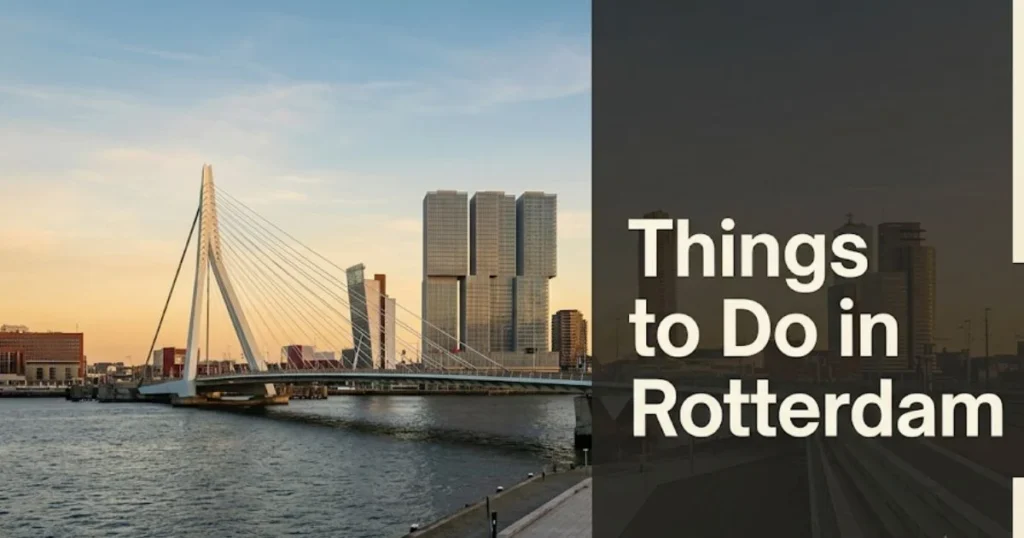
A Spido Harbor Tour gives first-timers essential geographic context. Seeing the port’s industrial scale from the water recalibrates how you understand the rest of the city.
Budget travelers can cover many first-timer priorities affordably. The Erasmusbrug waterfront, Witte de Withstraat, and the exterior of the Cube Houses all cost nothing. The Markthal entrance is free; spending is optional.
| First-Timer Priority | Best For | Cost Range | Time Needed |
|---|---|---|---|
| Markthal | Everyone | Free entry; food optional | 45 to 90 minutes |
| Erasmusbrug waterfront walk | Couples, solo travelers | Free | 30 to 60 minutes |
| Cube Houses exterior + museum | Architecture enthusiasts | Free exterior; small museum fee | 30 to 45 minutes |
| Spido Harbor Tour | Families, first-timers | Approximately €15 to €18 per adult | 75 minutes |
| Witte de Withstraat | Solo travelers, couples | Free to explore; dining costs vary | 1 to 3 hours |
| Depot Boijmans Van Beuningen | Art and design travelers | Approximately €20 to €25 per adult | 2 to 3 hours |
Verify all admission prices at venue websites before visiting; prices reflect general 2025 ranges and may change for 2026.
Seniors and accessibility travelers should note that Rotterdam’s city center is extremely flat. The RET metro and tram network provides wheelchair-accessible cars. Depot Boijmans Van Beuningen has elevator access throughout its mirrored building structure.
Rotterdam Architecture Things to Do
Rotterdam’s architecture is the primary reason architects and design-focused travelers fly here specifically. After Allied bombing destroyed 80 percent of the city center in 1940, Rotterdam effectively gave itself permission to build without historical constraint.
The result is a city where Rem Koolhaas’s De Rotterdam building sits along the Nieuwe Maas alongside Piet Blom’s tilted Cube Houses and the mirrored sphere of Depot Boijmans Van Beuningen. No other European city concentrates this density of post-1980 architectural landmarks in a walkable zone.
Rotterdam Architecture Month (Maand van de Architectuur), held annually in May and June, opens buildings normally closed to the public. It runs guided walking tours, lectures, and exhibitions. Verify the 2026 program at architectuurmaand.nl before planning around it.
For self-guided architecture walks, start at Rotterdam Centraal Station (itself a 2014 architectural statement), walk south toward Blaak, and follow the waterfront to the Wilhelminapier. This 45-minute route passes more significant buildings per block than most European cities manage in an entire district.
Architecture enthusiasts and design-focused travelers will find Rotterdam genuinely rewarding for two to three full days of focused exploration. Casual tourists may find the exterior-heavy nature of the experience less engaging; the Depot Boijmans and the Markthal deliver interior payoff.
Insider Tip:
- MVRDV’s Markthal and the Timmerhuis (a pixelated apartment block near Blaak) are within a 5-minute walk of each other; do both in one loop
- The Rotterdam Architecture Guide published annually by the Rotterdam Architecture Institute (Het Nieuwe Instituut) is worth downloading before your visit
- Solo travelers particularly benefit from the city’s free self-guided architecture walking map available at Rotterdam Centraal’s tourist information point
Key Takeaway: Rotterdam’s architecture is not a backdrop — it’s the main event. Build your first full day around the Centraal to Wilhelminapier walk and you’ll understand why design travelers come specifically for this city.
Markthal Rotterdam
Markthal Rotterdam is a horseshoe-shaped residential and market building whose interior vault is covered with a 11,000-square-meter artwork called “Cornucopia,” painted directly onto the ceiling by artists Arno Coenen and Iris Roos.
Opened in 2014, it functions simultaneously as an upscale food market, a neighborhood with 228 apartments built into its arch, and one of the most photographed interiors in the Netherlands. The ceiling alone is worth the visit.
Ground-floor vendors sell Dutch cheeses, fresh stroopwafels, raw herring, Indonesian-influenced street food, and specialty produce. The quality is genuine, not purely tourist-oriented.
Saturdays between 11 a.m. and 3 p.m. are the most crowded periods. Weekday mornings offer the same vendors with significantly lower density.
Families with children respond well to the Markthal. The food variety is broad enough for picky eaters. The visual drama of the ceiling creates genuine engagement for kids who otherwise resist market visits.
The Markthal is connected directly to Blaak Metro Station via an underground passage. It’s free to enter; your only spend is food and drink.
Insider Tip:
- The basement-level supermarket beneath the Markthal is a full Albert Heijn grocery store. Locals do their weekly shopping there while tourists crowd the market floor above.
- For a less crowded market experience with more local character, the Fenix Food Factory in Katendrecht (covered later in this guide) is the genuine local alternative
Cube Houses Rotterdam
The Cube Houses (Kubuswoningen), designed by architect Piet Blom and completed in 1984, are private residences built as tilted yellow cubes atop hexagonal pedestals over the Blaak pedestrian street.
One cube, called the Kijk-Kubus (Show Cube), is open to visitors as a small museum. The interior reveals the spatial reality of living in a cube tilted at 45 degrees: usable floor space concentrates in the lower levels, and upper corners become angled wall surfaces that function as built-in storage.
The museum visit takes about 15 to 20 minutes. Admission runs approximately €4 to €6 per adult as of recent years; verify the 2026 price at kubuswoning.nl before visiting.
The exterior of the Cube Houses is the more impressive experience. Walking through the Blaak covered market plaza beneath the cubes is free and takes just minutes.
The honest assessment: The Cube Houses are worth seeing. They are not worth more than 30 to 45 minutes of your day, and the interior museum is a minor addition to what the exterior delivers for free.
Budget travelers can experience the Cube Houses completely by photographing the exterior and walking through the plaza without paying museum entry. The architectural experience from outside is the dominant one.
Seniors and accessibility travelers should note that the interior staircase is steep. The museum is not wheelchair accessible beyond the ground floor. The exterior experience has no accessibility barriers.
| Experience | Cost | Time | Accessibility |
|---|---|---|---|
| Exterior walk and photography | Free | 15 to 20 minutes | Fully accessible |
| Kijk-Kubus museum interior | Approximately €4 to €6 per adult | 20 minutes | Limited upper-floor access |
Rotterdam Neighborhoods to Explore
Rotterdam’s most interesting districts are distinct enough from each other that spending one full day moving between them yields a dramatically different experience from staying in the tourist center.
Witte de Withstraat is the city’s arts and bar street. Independent galleries, experimental music venues, and the kind of café that puts six craft beers on tap without charging tourist prices line a walkable corridor south of the Lijnbaan.
Katendrecht, the former red-light district that reinvented itself as a food and creative hub, is where Rotterdam’s most interesting culinary scene currently lives. The Fenix Loodsen warehouse complex anchors it.
Noordereiland is a residential island in the Nieuwe Maas river connected by bridge to both banks. It’s quiet, walkable, and gives you the sense of how actual Rotterdammers live. Few tourists make it here.
Scheepvaartkwartier (the Shipping Quarter) has a different character entirely: grand early-20th-century office buildings from Rotterdam’s pre-war maritime era, now converted into hotels and restaurants. Hotel New York occupies the former headquarters of the Holland America Line.
Solo travelers do well exploring these neighborhoods independently with a bike rental. Couples find Katendrecht and Noordereiland especially well-suited for an unhurried afternoon.
| Neighborhood | Character | Best For | Walk or Transit |
|---|---|---|---|
| Witte de Withstraat | Arts, bars, galleries | Solo travelers, couples | 10-minute walk from Blaak |
| Katendrecht | Food, creative industry | Food-focused travelers | Tram or 20-minute walk |
| Noordereiland | Residential, quiet | Couples, repeat visitors | 15-minute walk from Blaak |
| Scheepvaartkwartier | Maritime heritage, hotels | History and architecture travelers | 15-minute walk from Centraal |
| Delfshaven | Historic harbor, museums | First-timers wanting pre-war character | Metro to Delfshaven station |
Delfshaven Rotterdam
Delfshaven is the only Rotterdam neighborhood that survived World War II bombing intact, and it is consequently the one place in the city where you can stand on a canal-side street and feel what Rotterdam looked like before 1940.
The historic harbor quarter has 17th-century warehouses, a working windmill, and the Pilgrim Fathers Church (Pelgrimvaderskerk), from where the Pilgrim Fathers departed for England before sailing to America in 1620. For American visitors, this specific connection is historically meaningful.
The Delfshaven Museum (Museum Delfshaven) occupies a historic malt distillery and covers the neighborhood’s maritime and industrial history. Entrance runs approximately €6 to €8 per adult as of recent years; verify 2026 pricing before visiting.
Delfshaven’s canal streets are best in the morning before tour groups arrive. The windmill on Voorhaven is a working gin distillery (Distilleerderij De Pelgrim) that offers tastings.
Local alternative note: Delfshaven is the honest alternative to central Rotterdam’s modern architecture scene. Travelers who find the city center’s aesthetic demanding will find genuine relief in Delfshaven’s quiet, human-scaled streets.
Families with children find Delfshaven a pleasant half-day that combines outdoor walking with visual historical interest that doesn’t require sustained museum concentration. The canal paths are stroller-accessible.
Insider Tip:
- The Distilleerderij De Pelgrim gin distillery inside the historic windmill offers tastings and is usually uncrowded compared to the main Delfshaven canal walk
- RET Metro Line B stops at Delfshaven station; the walk from the metro to the canal takes under five minutes
Key Takeaway: Delfshaven is the most photogenic and historically significant neighborhood in Rotterdam for American visitors. Go on a weekday morning before 10 a.m. for the quietest experience.
Rotterdam Museums and Culture
Rotterdam’s museum and cultural institution scene is anchored by three major venues: Depot Boijmans Van Beuningen, Kunsthal Rotterdam, and the Maritime Museum Rotterdam (Maritiem Museum Rotterdam).
Each serves a different traveler type and requires a different amount of time. Understanding which one suits your interests is more useful than visiting all three back to back.
Kunsthal Rotterdam on Westzeedijk hosts major temporary exhibitions from international art, photography, fashion, and design. It’s the right choice if you want a concentrated two-hour cultural experience without committing to a permanent collection. The building itself, designed by Rem Koolhaas, is architecturally notable.
The Maritime Museum Rotterdam tells the story of Rotterdam’s identity as Europe’s largest port. Its outdoor collection of historical vessels on the Leuvehaven canal is free to view; the indoor museum charges admission. Children respond well to the vessel collection.
Budget travelers can experience Kunsthal Rotterdam’s exterior and the Maritime Museum’s outdoor vessel collection at no cost. Both provide substantial cultural engagement without admission fees.
Seniors and accessibility travelers should note that Kunsthal Rotterdam has elevator access and step-free entry from the museum park side. The Maritime Museum’s outdoor vessel area involves uneven dockside surfaces; mobility aid access varies by vessel.
According to the Netherlands Board of Tourism and Conventions (NBTC), Rotterdam’s cultural institutions collectively attract over two million annual visitors, with Depot Boijmans Van Beuningen registering as one of the fastest-growing new museum destinations in Europe since its 2021 opening.
Depot Boijmans Van Beuningen
Depot Boijmans Van Beuningen is the world’s first fully publicly accessible art storage facility, opened in 2021, and it is the single most architecturally and conceptually significant new museum experience in the Netherlands.
The building is a mirrored sphere rising from Museumpark that reflects the surrounding park and cityscape in constantly changing light. Inside, 151,000 art objects from the permanent collection of Museum Boijmans Van Beuningen are stored on open shelves visible to visitors. You see how a museum actually works.
The rooftop terrace is accessible by elevator and offers one of the best free viewpoints over the city. The terrace café is a legitimate reason to visit even without a museum ticket.
Advance ticket booking for the full museum experience is recommended, particularly on weekends and during Rotterdam Architecture Month in May and June. Tickets typically run approximately €20 to €25 per adult; verify 2026 pricing at depotboijmans.nl.
Architecture enthusiasts and art travelers should treat the Depot as a half-day minimum. The experience of seeing a museum’s full collection in open storage is genuinely unlike any other museum visit in Europe.
Solo travelers find the Depot particularly well-suited. The open storage format rewards self-directed curiosity better than a conventional guided museum tour.
Insider Tip:
- The rooftop terrace requires a separate (usually free or low-cost) timed entry booking in advance; do this simultaneously with your museum ticket booking
- The Depot is located in Museumpark, directly adjacent to Kunsthal Rotterdam; combining both in one day is practical and efficient
Rotterdam Food Scene and Nightlife
Rotterdam’s food scene is more honest and less tourist-inflated than Amsterdam’s. The city’s port history brought Indonesian, Surinamese, Cape Verdean, and Moroccan culinary traditions into Dutch culture, and those influences are genuinely present in the city’s neighborhood restaurants and food halls.
Fenix Food Factory in Katendrecht is the local answer to the Markthal. It occupies a warehouse on the Rijnhaven waterfront and houses cheese makers, craft brewers, a coffee roaster, and a fishmonger selling that day’s catch. Locals shop here regularly. Tourists find it far less crowded than the Markthal.
Witte de Withstraat and the surrounding streets in the Witte de With quarter hold the city’s densest concentration of independent restaurants. Indonesian-influenced Dutch cuisine is the local starting point; the rijsttafel (rice table) format, served at several Katendrecht and city-center restaurants, is the traditional multi-dish experience worth seeking.
For nightlife, Witte de Withstraat operates as the city’s main bar corridor. BAR Rotterdam on Witte de Withstraat is a long-running venue that functions as both a bar and a concert space. The club and live music scene extends to LantarenVenster on Otto Reuchlinweg for jazz and world music, and Annabel Rotterdam for electronic music events.
Solo travelers find Rotterdam’s nightlife geography easy to navigate. The concentration of bars and venues on Witte de Withstraat means you’re never more than a short walk from something happening.
Budget travelers benefit from Rotterdam’s strong café culture. Ordering a small beer (klein biertje) at a brown café costs approximately €3 to €5 and comes with the social atmosphere of a full evening out.
Key Takeaway: Skip the Markthal for lunch on a Saturday and go to Fenix Food Factory in Katendrecht instead. Same food quality, half the crowd, and you’ll eat where Rotterdammers actually eat.
Rotterdam Outdoor Activities and Parks
Kralingse Bos is Rotterdam’s primary urban forest and lake park, located in the eastern part of the city near the Kralingse Plas lake. It covers over 200 hectares and provides sailing, cycling, walking paths, and several waterside café terraces.
In spring and summer, the lake attracts windsurfers and small sailboats. The cycling paths through the forest connect to the broader RotterdamBike network. This is where Rotterdammers spend weekend afternoons when the weather cooperates.
The Het Park near the Euromast is smaller but more centrally located. It hosts outdoor festivals in summer and connects directly to the Euromast tower and the Scheepvaartkwartier waterfront.
Families with children find Kralingse Bos particularly useful. The flat cycling paths are manageable for children on bikes or ride-along attachments. Rental options exist near the park entrance; verify availability at OV-fiets locations before traveling out.
Seniors and accessibility travelers should note that Kralingse Bos paths are paved and flat throughout most of the lakeside circuit. The surfaces are mobility aid-compatible along the main lake loop.
Outdoor and active travelers who want a full day outside the city center should combine Kralingse Bos in the morning with a waterbus ride along the Nieuwe Maas in the afternoon.
Rotterdam Waterfront and Harbor Activities
Spido Harbor Tours operate from the Wilhelminapier and give visitors a 75-minute boat tour of the Port of Rotterdam, Europe’s largest port. Seeing container ships the size of city blocks from water level is a genuinely dramatic experience.
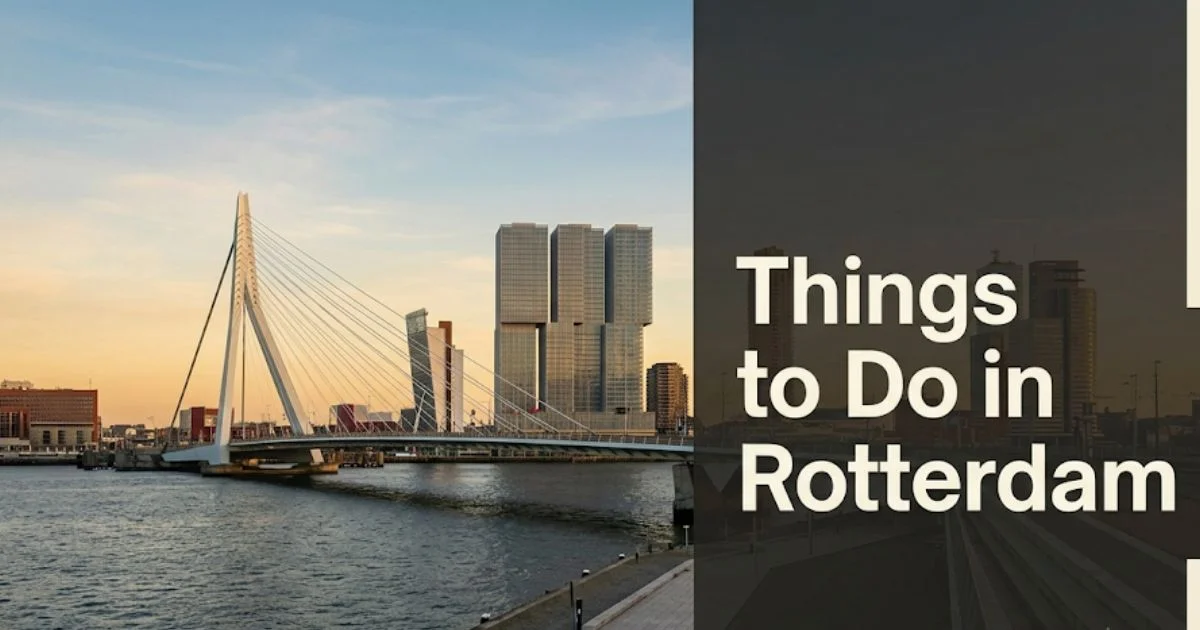
The Erasmusbrug bridge, the De Rotterdam building, and the full Wilhelminapier skyline all read completely differently from the water. This is the single best way to understand Rotterdam’s geographic scale.
Tours typically run several times daily in summer, with reduced schedules from November through February. Prices run approximately €15 to €18 per adult as of recent years; verify 2026 schedules and pricing at spido.nl.
The waterbus (Waterbus Rotterdam) is a public ferry service that connects Rotterdam to Dordrecht and other river cities. It also serves as an effective and scenic transit option between Rotterdam’s waterfront districts.
Families with children find the harbor tour the single best child-engaging paid activity in Rotterdam. The scale of the port infrastructure holds children’s attention in a way that most architecture and museum content cannot.
Couples find the early evening Spido tour particularly atmospheric. The Erasmusbrug and Wilhelminapier skyline in late afternoon light is the city’s best visual moment.
| Waterfront Activity | Best For | Cost Range | Season |
|---|---|---|---|
| Spido Harbor Tour | Families, first-timers | ~€15 to €18 per adult | Year-round; reduced schedule in winter |
| Erasmusbrug walk | Couples, solo travelers | Free | Year-round |
| Waterbus to Dordrecht | Day-trippers, scenic travelers | Public transit fare | Year-round |
| Fenix Loodsen waterfront | Food travelers, couples | Free to explore | Year-round |
Rotterdam With Kids
Rotterdam works better for families than its architecture-heavy reputation suggests, provided parents build the itinerary around child-appropriate anchors rather than treating kids as passengers through adult experiences.
Diergaarde Blijdorp (Rotterdam Zoo) is one of the best-designed zoos in the Netherlands. It houses the Oceanium, a walk-through aquatic tunnel that consistently earns high engagement from children of all ages. Admission runs approximately €25 to €30 per adult and €18 to €22 per child as of recent years; verify 2026 pricing at diergaarde-blijdorp.nl. Plan for at least three hours.
The Spido Harbor Tour works for children over about age four. The boat ride, the massive ships, and the port machinery hold young attention effectively.
The Markthal works for children who respond to sensory variety. The ceiling art generates genuine reactions. The food stalls offer enough variety to accommodate selective eaters.
Families with strollers should note that Rotterdam’s flat terrain and wide sidewalks make it one of the most stroller-friendly major European cities. The RET metro is stroller-accessible, though some older tram stops require lifting.
Families with older children (ages 10 and above) can engage meaningfully with the Cube Houses museum, Depot Boijmans Van Beuningen’s open storage format, and the harbor tour. Younger children (under eight) will get far more from the zoo and the harbor boat.
Insider Tip:
- Diergaarde Blijdorp sells combination tickets with the adjacent Rotterdam Zoo botanical garden section; the combined experience fills a full day for families
- Book Blijdorp tickets online in advance, especially during Dutch school holiday periods (July, August, and Dutch autumn break in October)
Key Takeaway: Build a family day in Rotterdam around Diergaarde Blijdorp in the morning and a Spido Harbor Tour in the afternoon. This combination outperforms any architecture-first itinerary for children under 12.
Rotterdam Things to Do for Free
Rotterdam offers a substantial range of genuinely worthwhile free experiences. This is not a consolation category; several of the city’s best experiences cost nothing.
Free Rotterdam experiences worth your time:
- Erasmusbrug waterfront walk: Rotterdam’s iconic cable-stayed bridge and the Wilhelminapier skyline view from the south bank cost nothing and take 30 to 45 minutes
- Cube Houses exterior: The full architectural experience of Piet Blom’s tilted cube residences is available without paying museum entry
- Markthal entrance: Walking through and viewing the Cornucopia ceiling is free; spending on food is optional
- Witte de Withstraat: The street art corridor, gallery windows, and café culture of this district have no admission cost
- Depot Boijmans Van Beuningen rooftop terrace: Usually accessible with a separate free timed-entry reservation; verify 2026 access policy before visiting
- Kralingse Bos: The forest park and lake paths are free and open daily
- Het Park: The riverside park near the Euromast is free and connects the Scheepvaartkwartier waterfront walk
- Delfshaven canal walk: Walking the historic harbor district and viewing the windmill exterior costs nothing
- Noordereiland walk: The river island neighborhood requires only the walk across the bridge
Budget travelers can spend a full day in Rotterdam on almost zero admission costs. The free waterfront walk, Markthal interior, Witte de Withstraat, and Delfshaven canal together form a complete and genuinely rewarding first day.
The Netherlands Board of Tourism and Conventions (NBTC) notes that Rotterdam consistently scores among Europe’s most affordable major city-break destinations for budget-conscious travelers compared to Amsterdam, Paris, or Copenhagen.
Getting Around Rotterdam
Rotterdam’s RET public transit network (metro, tram, and bus) covers the entire city efficiently and connects directly with the national rail network at Rotterdam Centraal.
The OV-chipkaart is the standard contactless transit card used across all Dutch public transport. Purchase one at Rotterdam Centraal or Schiphol Airport. You can also use contactless bank cards or Apple/Google Pay on most RET vehicles as of recent years; verify current card acceptance at ret.nl before relying on this.
The Rotterdam Welcome Card combines unlimited RET transit with discounts at major museums and attractions. It’s available for 24, 48, or 72 hours. For travelers planning multiple paid museum visits, the math typically favors the card; for primarily free-experience travelers, it may not.
Rotterdam’s cycling infrastructure is among the best in Europe. OV-fiets rental bikes are available at Rotterdam Centraal and several other RET stations with an OV-chipkaart. Day rates run approximately €4 to €7; verify 2026 pricing at ns.nl/ov-fiets.
Taxis and ride-share apps (Uber operates in Rotterdam) are available for late-night or accessibility-required travel. Standard taxi fares from Rotterdam Centraal to Katendrecht run approximately €10 to €15; verify current rates with your app before booking.
Seniors and accessibility travelers should know that RET metro cars and most modern trams have low-floor entry and are wheelchair accessible. Step-free journey planning is available through the 9292.nl journey planner, which indicates accessibility at each station.
To get from Amsterdam Schiphol Airport to Rotterdam:
- Take the Intercity Direct or standard Intercity train from Schiphol toward Rotterdam Centraal.
- The Intercity Direct is faster (approximately 40 minutes) but requires a supplement fee.
- The standard Intercity takes approximately 60 to 70 minutes with no supplement.
- Purchase tickets at NS (Dutch Railways) ticket machines or via the NS app before boarding.
- Trains run frequently throughout the day; verify the 2026 schedule at ns.nl before travel.
Best Time to Visit Rotterdam
The best time to visit Rotterdam is late April through June, when temperatures are mild, the city’s outdoor spaces are fully activated, and daylight lasts until nearly 10 p.m.
May and June also coincide with Rotterdam Architecture Month (Maand van de Architectuur), which opens buildings normally closed to the public and runs guided tours and events specifically for architecture-focused visitors. This is the single best period for design-oriented travelers.
September and early October are the second-best window. Temperatures remain comfortable, summer crowds have thinned, and the North Sea Jazz Festival has concluded. Accommodation rates typically drop from their summer peaks.
July and August bring the highest visitor volumes and the best weather consistency, but also the highest hotel prices and the most crowded experiences at the Markthal and major museums.
November through February is the most challenging period. Days are short (darkness arrives by 4:30 p.m. in December), temperatures hover near freezing, and rain is frequent. Some outdoor attractions and seasonal Spido schedules are reduced. Hotel rates reach their annual lows during this window, which suits budget-focused travelers willing to trade weather for savings.
| Season | Crowd Level | Weather | Best For |
|---|---|---|---|
| April to June | Moderate | Mild, 12 to 18°C | Architecture visitors, outdoor exploring |
| July to August | High | Warm, 18 to 24°C | Outdoor activities, families |
| September to October | Low to moderate | Mild, 12 to 18°C | Budget travelers, food-focused visitors |
| November to March | Low | Cold, wet, 2 to 8°C | Ultra-budget travelers; indoor museum focus |
The North Sea Jazz Festival is held annually in July at Ahoy Rotterdam. It is one of Europe’s premier jazz festivals and draws international headliners. If your visit coincides with it, book accommodation three to four months in advance; hotel availability shrinks dramatically during festival weekend.
Key Takeaway: May is the single best month to visit Rotterdam if you can choose freely. Architecture Month programming, mild weather, and lower crowds than summer make it the optimal combination.
Rotterdam Day Trips
Rotterdam’s geographic position in South Holland makes it one of Europe’s best day-trip hubs. Three destinations in particular deserve serious consideration for any visit of two days or more.
Kinderdijk is a UNESCO World Heritage Site located approximately 15 km east of Rotterdam. Its 19 windmills, built in the 18th century to manage water levels in the Alblasserwaard polder, form one of the most iconic Dutch landscapes in existence.
Getting there: Waterbus Line 20 from Rotterdam’s Erasmusbrug pier takes approximately 30 minutes and is the most scenic approach. Bus connections are available but slower. Entry to the Kinderdijk visitor center runs approximately €10 to €16 per adult as of recent years; verify 2026 pricing and seasonal opening hours at kinderdijk.nl. Advance ticket booking is strongly recommended in summer.
Delft is 15 minutes from Rotterdam by direct train. Its canal network, Vermeer museum (the Johannes Vermeer Centre), and traditional Delft Blue pottery studios are the closest experience to a medieval Dutch city that travelers based in Rotterdam can access in half a day. The historic market square (Markt) and Old Church (Oude Kerk) are worth the short journey.
The Hague (Den Haag) is 20 minutes by train and holds the Mauritshuis museum, home to Vermeer’s “Girl with a Pearl Earring” and Rembrandt’s “The Anatomy Lesson.” The Mauritshuis is one of the finest small art museums in Europe. Advance tickets are recommended.
| Day Trip | Distance | Travel Time | Best For | Advance Booking |
|---|---|---|---|---|
| Kinderdijk | 15 km | 30 min (waterbus) | Families, first-timers | Yes, especially in summer |
| Delft | 15 km | 15 min (train) | History and art travelers, couples | Not required |
| The Hague | 25 km | 20 min (train) | Art travelers, government history | Mauritshuis recommended |
| Gouda | 25 km | 30 min (train) | Food-focused travelers | Not required |
Families with children find Kinderdijk the most immediately engaging day trip. The windmill landscape, outdoor paths, and boat arrival are all child-appropriate.
Rotterdam Weekend Itinerary
A two-day Rotterdam weekend itinerary for 2026, structured to cover the city’s core experiences without overcrowding any single day:
Day 1: Architecture, Waterfront, and Food
- Start at Rotterdam Centraal Station and walk the Centraal to Blaak architecture corridor, pausing at Timmerhuis and Blaak Station (the metro station itself is a landmark circular structure).
- Reach the Markthal by 10 a.m. for the Cornucopia ceiling before crowds peak. Buy Dutch cheese and a coffee from a market vendor.
- Walk five minutes to the Cube Houses exterior and, if interested, pay the small fee for the Kijk-Kubus interior.
- Walk south along the Nieuwe Maas to the Erasmusbrug. Cross the bridge for the Wilhelminapier skyline view from the south bank.
- Take a Spido Harbor Tour from the Wilhelminapier (book in advance; typical tours depart midday).
- Return to Katendrecht for late afternoon at Fenix Food Factory. Eat dinner in Katendrecht; try an Indonesian-influenced restaurant on or near the waterfront.
Day 2: Neighborhoods, Museums, and Parks
- Morning in Delfshaven: walk the canal, visit the Pilgrim Fathers Church, taste gin at Distilleerderij De Pelgrim.
- Mid-morning: RET metro or tram to Depot Boijmans Van Beuningen in Museumpark. Combine with the Kunsthal if your interest extends to the current temporary exhibition.
- Lunch in the Museumpark café or walk to Witte de Withstraat for a brown café meal.
- Afternoon: explore Witte de Withstraat and the surrounding gallery district at your own pace.
- Late afternoon: cycle or walk to Kralingse Bos for a lake-side wind-down, or take the waterbus toward Noordereiland for a quieter residential perspective.
- Evening dinner back in Katendrecht or the Scheepvaartkwartier; Hotel New York restaurant serves dinner in the grand former Holland America Line headquarters.
Note for travelers with more time: A third day is best spent on a Kinderdijk or Delft day trip. Both require no more than a half-day and return you to Rotterdam by mid-afternoon.
Safety and Practical Warnings for Rotterdam
Rotterdam is a generally safe European city with no specific high-alert travel advisories for US citizens as of 2026. Standard urban awareness applies.
Key safety and practical facts every visitor should know:
- Cycling lane rules are strictly observed by Dutch cyclists. Pedestrians walking in bike lanes will be passed at speed without warning. Stay on sidewalks marked for foot traffic and treat bike lanes as you would vehicle lanes.
- Pickpocket risk is concentrated at Rotterdam Centraal Station and the Markthal on weekend afternoons. Use a crossbody bag or front-pocket wallet in these high-density areas.
- Weather is highly variable year-round. Rotterdam averages 200 rain days annually. Pack a compact waterproof layer regardless of forecast.
- Timed-entry attractions require advance booking. Depot Boijmans Van Beuningen and Kinderdijk in summer can sell out days in advance. Book before your trip, not on the day.
- OV-chipkaart balance must be sufficient before boarding transit. Attempting to board with insufficient balance can result in a fine. Load extra credit at any RET service point.
- Sun exposure in summer is significant despite the northern latitude. UV levels in July and August reach index 6 to 7; sunscreen is necessary for extended outdoor days.
For emergencies in the Netherlands, dial 112 (equivalent to 911 in the US). The US Consulate General in Amsterdam handles consular services for Americans in Rotterdam; the US Embassy is located in The Hague.
Frequently Asked Questions About Things to Do in Rotterdam
What are the best things to do in Rotterdam for first-time visitors?
First-time visitors should prioritize the Markthal, the Erasmusbrug waterfront walk, the Cube Houses, and at least one harbor or waterfront activity like the Spido Harbor Tour.
Adding Depot Boijmans Van Beuningen for a half-day gives a genuinely memorable museum experience unavailable anywhere else in Europe.
Delfshaven rounds out a first visit with the historical contrast that the modern city center cannot provide.
How many days do you need in Rotterdam?
Two full days is the practical minimum for a meaningful visit to Rotterdam.
One day allows you to cover the central landmarks but leaves the neighborhoods, the Depot, and Delfshaven unexplored.
Three days is the comfortable length if you plan to include a day trip to Kinderdijk or Delft.
Is Rotterdam worth visiting or should I just do Amsterdam?
Rotterdam is worth a dedicated visit and is not a substitute for Amsterdam; the two cities offer genuinely different experiences.
Amsterdam delivers canal heritage, the Rijksmuseum, and the Anne Frank House. Rotterdam delivers modern architecture, a port city’s raw creative energy, and a food scene less oriented toward tourist expectations.
Travelers who have done Amsterdam once will often find Rotterdam more surprising and more rewarding on a return trip to the Netherlands.
What is the Markthal in Rotterdam and is it worth visiting?
The Markthal is a horseshoe-shaped building completed in 2014 that contains an upscale food market beneath a 11,000-square-meter painted ceiling artwork called “Cornucopia.”
It is worth visiting for the ceiling art and the food variety, but go on a weekday morning to avoid the worst Saturday afternoon congestion.
The Fenix Food Factory in Katendrecht is the local alternative for a quieter market experience with the same quality of Dutch food products.
What is the best neighborhood to stay in Rotterdam?
The area between Rotterdam Centraal Station and Witte de Withstraat provides the most practical base for first-time visitors.
It places you within walking distance of the Markthal, Cube Houses, and Blaak, while keeping you close to the city’s best bars and cafés on Witte de Withstraat.
Katendrecht is the better choice for food-focused travelers who want to be close to Fenix Food Factory and the waterfront dining scene.
What is the cheapest way to get around Rotterdam?
The cheapest way to get around Rotterdam is the RET metro, tram, and bus network using an OV-chipkaart or contactless payment.
A single trip costs approximately €1.10 to €2.50 depending on distance as of recent years; the Rotterdam Welcome Card may offer better value for visitors planning multiple museum visits combined with transit use.
Cycling with an OV-fiets rental bike is the most cost-effective option for covering larger distances across the city and is straightforward even for visitors unfamiliar with Dutch cycling infrastructure.
Plan Your Rotterdam Trip With Confidence
Rotterdam rewards specific planning more than most European cities. The difference between a forgettable visit and a genuinely memorable one comes down to which neighborhoods you reach, whether you arrive at the Markthal before 11 a.m. on a weekend, and whether you get on a Spido boat to understand the city’s scale from the water.
Book the Depot Boijmans Van Beuningen in advance, particularly for weekend visits. If you’re traveling in July, add the Kinderdijk to your itinerary before hotel prices spike during North Sea Jazz Festival weekend.
Travel conditions, admission prices, transit fare structures, and seasonal hours change regularly. Verify all key logistics directly at rotterdam.info, ret.nl, and individual venue websites before your departure date. The most current practical information comes from those official sources, not from any guide published in advance.