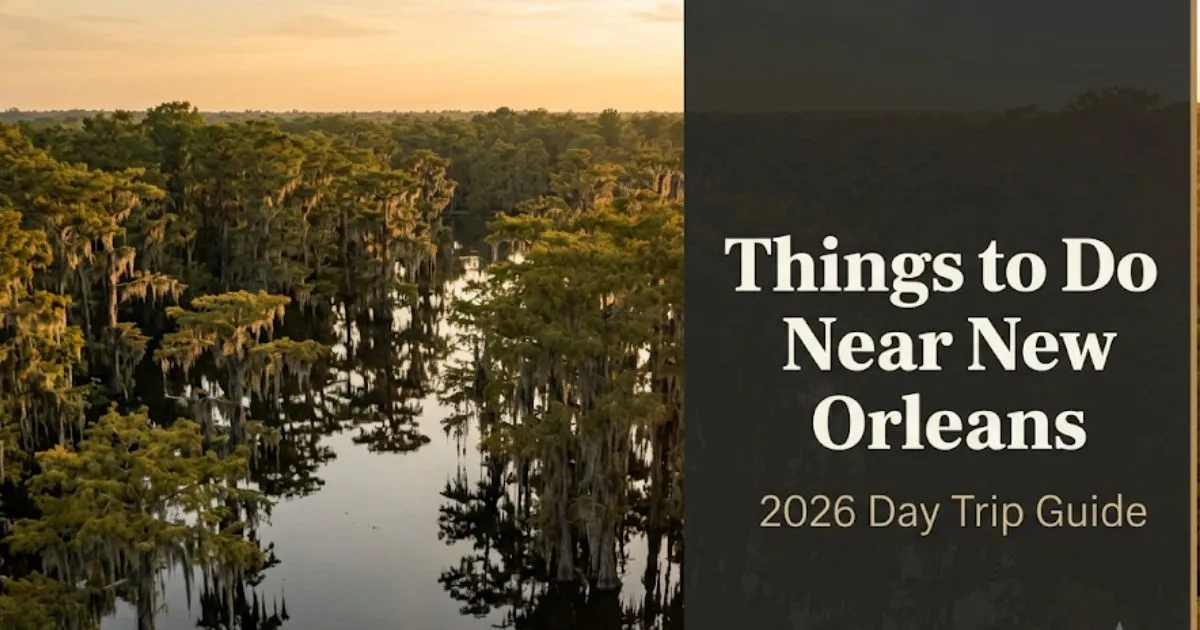
Things to Do Near New Orleans: 2026 Day Trip Guide

The best things to do near New Orleans stretch across swamp country, Mississippi River plantation roads, Cajun villages, and Gulf beaches within two hours of the French Quarter.
Louisiana’s surrounding region is one of the most ecologically and culturally distinct landscapes in North America. The Greater New Orleans Convention and Visitors Bureau identifies over a dozen distinct day trip corridors from the city.
This guide covers 16 specific destinations and experiences, with drive times, honest crowd assessments, traveler profile guidance, and the local alternatives that most visitors never find.
Things to Do Near New Orleans: What to Expect Beyond the City
Things to do near New Orleans range from deep-swamp eco-tours and antebellum plantation history to Cajun music towns and undeveloped Gulf barrier beaches.
The surrounding region is genuinely different from the city itself. New Orleans is urban, dense, and nightlife-forward. The surrounding parishes and neighboring states offer landscape, history, and food culture that the French Quarter cannot replicate.
Most experiences worth making the drive for sit within 30 to 90 minutes of the city. A few, like Natchez and Gulf Shores, require two to three hours.
The most common mistake is skipping these day trips entirely and spending all time in the Quarter. That misses the majority of what makes this corner of Louisiana genuinely distinctive.
What defines this region’s identity:
- Atchafalaya Basin: the largest river swamp in North America
- Louisiana’s River Road: 70 miles of antebellum plantation sites along the Mississippi
- Cajun Prairie and Teche corridor: living French Creole culture, not museum culture
- Gulf Coast barrier islands: undeveloped and largely uncrowded compared to Florida beaches
- Mississippi River towns: Natchez and its antebellum architecture above the bluffs
Travelers who get the most from this region are those who appreciate landscape, food culture, and history equally. Pure beach travelers should note that Louisiana’s Gulf Coast is murkier and less developed than the Florida Panhandle, which is sometimes a feature and sometimes a limitation depending on what you want.
Seniors and mobility-limited travelers should note significant terrain variation. Swamp tours require boat boarding and dock navigation. Plantation grounds vary from paved to gravel to unpaved. Call ahead to each site to confirm accessibility specifics before making the drive.
Best Day Trips from New Orleans: Drive Times and Planning
The best day trips from New Orleans are the Honey Island Swamp (45 minutes), Whitney Plantation (55 minutes), and Breaux Bridge in Cajun country (2 hours).
Drive time context matters enormously here. I-10 runs east and west from New Orleans with reliable access to most surrounding destinations. The Lake Pontchartrain Causeway provides a 24-mile shortcut north to the Northshore region.
Day Trip Comparison Table:
| Destination | Drive Time | Best For | Cost Range | Reserve Ahead? |
|---|---|---|---|---|
| Honey Island Swamp | 45 min | Outdoor, eco-travelers | $30-$55/adult | Yes, recommended |
| Whitney Plantation | 55 min | History, couples, adults | $20-$30/adult | Yes, strongly |
| Oak Alley Plantation | 55 min | Architecture fans | $25-$35/adult | Yes |
| Breaux Bridge | 2 hrs | Cajun food and culture | Low/free mostly | No |
| Northshore (Covington) | 45 min via Causeway | Families, outdoor | Free to low | No |
| Grand Isle State Park | 2 hrs | Beach, fishing | $3-$6/vehicle | No |
| Baton Rouge | 1.5 hrs | History, food, families | Free to $15 | No |
| Natchez MS | 2.5 hrs | History, couples | Free to $30 | For specific tours |
| Biloxi MS | 1.5 hrs | Beach, budget | Free to $15 | No |
| Fontainebleau State Park | 45 min | Families, hiking | $3/vehicle | No |
For a 1-day framework, the most rewarding single-day structure combines Whitney Plantation in the morning (9 AM opening, allow 2 hours) with lunch in Donaldsonville at Grapevine Café and a late afternoon drive back along River Road past Destrehan Plantation’s exterior.
Budget travelers should note that the Northshore and Fontainebleau State Park deliver a full day for under $10 per person, making them the best value day trips in this region.
Swamp and Bayou Tours Near New Orleans
The best swamp and bayou tours near New Orleans operate out of the Barataria Preserve, Honey Island Swamp, and Lake Salvador, all within 45 minutes of the French Quarter.
This is where the region earns its reputation. No comparable swamp ecosystem exists within a two-hour drive of any other major American city.
Jean Lafitte National Historical Park and Preserve (Barataria Unit) in Marrero offers free self-guided walking trails through cypress swamp. It is the best introduction to the ecosystem for budget travelers and families with older children.
For guided tours, Honey Island Swamp near Slidell is the most credible option. Tours run on small pontoon boats with naturalist guides. Expect to see American alligators, great blue herons, roseate spoonbills, and river otters on most trips.
How to book a swamp tour near New Orleans:
- Decide between Barataria-area tours (west of the city, closer to plantation sites) and Honey Island tours (east, toward Slidell)
- Book directly through named operators, not third-party aggregators, for the best departure time selection
- Choose morning departures (7 AM to 10 AM) for active wildlife and cooler temperatures
- Confirm the boat type: small pontoon boats offer closer wildlife encounters than large airboats, which are louder and scare wildlife
- Bring insect repellent, sunscreen, and water regardless of season. Shade is limited on open water.
Insider Tip:
- Manchac Swamp, accessible by kayak from the boat launches near Akers, Louisiana, offers a genuinely wild paddling experience without a tour group
- The Atchafalaya Basin near Henderson, Louisiana (2 hours west) is larger and more remote than Honey Island and rewards travelers willing to make the drive
- Solo travelers will find small-group swamp tours ideal for meeting other travelers. Most tours run 8 to 12 people.
Families with young children should note that boat boarding requires stepping over a gap between dock and boat. This is manageable for most children 6 and up but requires adult assistance. Tour operators typically note age minimums (usually 3 to 5 years, depending on operator).
Plantation Tours Near New Orleans: The Honest Assessment
Whitney Plantation in Wallace, Louisiana is the most historically significant and emotionally substantive plantation tour near New Orleans, not Oak Alley, despite Oak Alley’s greater fame.
This is the single most important editorial distinction to make in this section. Oak Alley’s famous alley of 300-year-old live oaks and its Greek Revival house are genuinely impressive. But its tour experience centers the architecture and the planter family’s story.
Whitney Plantation is the only plantation museum in Louisiana whose entire interpretive framework centers on the enslaved people who built and worked the property. The on-site memorial, sculpture garden by artist Rod Moorhead, and detailed naming of enslaved individuals make it one of the most powerful historical experiences in the American South.
Laura Plantation in Vacherie takes a French Creole approach distinct from the Anglo-American plantation narrative. Its research archive is exceptional. The tour draws heavily on the documented testimonies of the enslaved people who lived there.
Destrehan Plantation in Destrehan is the closest to New Orleans (25 minutes) and suits travelers with limited time. Its historical significance is genuine: it was a site of the 1811 German Coast Uprising, the largest slave revolt in US history.
Overrated pick: Oak Alley. It is the most Instagrammed plantation in Louisiana for the alley of oaks, which is genuinely dramatic. But the tour experience is closer to architectural tourism than historical engagement. Repeat visitors and local historians consistently recommend Whitney and Laura over Oak Alley.
Practical logistics:
- All major plantation sites require advance reservation for guided tours
- Tours typically run 60 to 90 minutes
- Most sites are closed on major holidays. Verify before visiting.
- River Road (Louisiana Highway 18 and 44) can be driven as a scenic route connecting multiple sites
Couples find the River Road plantation circuit a deeply romantic but historically sobering drive. The tension between the beauty of the landscape and the weight of the history is the point.
Cajun Country Day Trip from New Orleans
A Cajun country day trip from New Orleans means driving west on I-10 to the Lafayette-Breaux Bridge-Henderson corridor, roughly two hours from the French Quarter.
This is the most culturally distinct day trip available from New Orleans. Cajun culture is genuinely different from New Orleans Creole culture. The music, the food, the French dialect, and the social rhythms are distinct.
Breaux Bridge is the correct starting point, not Lafayette. It is smaller, more walkable, and more authentically Cajun than the city. The town center on Rees Street hosts the annual Breaux Bridge Crawfish Festival (first weekend of May; verify 2026 dates) and the weekly zydeco dances at Café des Amis.
Café des Amis hosts a Saturday zydeco brunch that is one of the most genuinely local experiences available within range of New Orleans. Live zydeco music starts around 8:30 AM. The place fills with Breaux Bridge locals, not tour groups.
Henderson, Louisiana, 10 minutes from Breaux Bridge, sits on the Atchafalaya Basin and offers Pat’s Fisherman’s Wharf restaurant, floating on the water, serving crawfish étouffée that rivals anything you will find in New Orleans.
Lafayette’s Vermilionville Living History Museum and the Acadian Cultural Center (operated by the National Park Service) provide structured cultural context for travelers who want to understand Cajun history before experiencing it firsthand.
Insider Tip:
- Drive US-90 instead of I-10 on the return trip for a completely different landscape view
- Boudin from Johnson’s Boucanière in Lafayette is a specific local experience: a pork and rice sausage eaten as a snack, pulled from the casing with your fingers
- Budget travelers will find Cajun country extremely affordable. A full day of food, walking, and live music in Breaux Bridge can easily cost under $50 per person.
Families with children should note that Café des Amis’s Saturday brunch is genuinely family-friendly. Children dance alongside adults. It is one of the few truly local cultural experiences in this region that works equally well for adults and kids.
Key Takeaway: Whitney Plantation, Honey Island Swamp, and Breaux Bridge’s Café des Amis Saturday zydeco brunch are the three experiences near New Orleans that most first-time visitors miss entirely and most repeat visitors name as their favorites.
Gulf Coast Beaches Near New Orleans
The closest beaches to New Orleans are on Grand Isle, approximately 100 miles south, and on the Mississippi Gulf Coast (Biloxi, Pass Christian, Bay St. Louis), approximately 90 miles east.
Neither option rivals the Florida Panhandle for water clarity or sand quality. That is the honest reality. Louisiana’s Gulf beaches have darker sand and murkier water because of the Mississippi River’s sediment load.
Grand Isle State Park at the southern tip of Jefferson Parish is the most accessible Louisiana beach. It offers a genuine barrier island experience: relatively undeveloped, good fishing, and real Gulf of Mexico wind. The state park charges a small per-vehicle fee. Call ahead to confirm current access and fees.
The drive to Grand Isle (Louisiana Highway 1) is itself the experience. You pass through working fishing villages, shrimp docks, and the absolute end of the American road before arriving at the island. It reads more like coastal Alaska than Florida.
For better swimming beaches, the Mississippi Gulf Coast at Pass Christian or Bay St. Louis offers calmer water and cleaner sand than Grand Isle. Bay St. Louis, in particular, has developed a genuinely interesting small-city culture with galleries, restaurants, and a walkable waterfront.
The local alternative to Grand Isle: Fort Pike State Historic Site near Slidell (currently closed for restoration as of recent years; verify 2026 status) and the Barataria Bay water access points in Plaquemines Parish offer isolated coastal fishing and birding without the beach-day infrastructure.
Families should choose Biloxi’s protected beach areas over Grand Isle for young children. The Gulf Coast Mississippi beaches have gentler wave action and better lifeguard coverage during peak summer.
Summer warning: Gulf beach jellyfish (primarily moon jellyfish and Portuguese man-o-war) are most prevalent July through September. Check local reports before swimming.
The Northshore: Covington, Abita Springs, and Fontainebleau
The Northshore of Lake Pontchartrain, reached via the 24-mile Lake Pontchartrain Causeway, offers Fontainebleau State Park, the Abita Brewing Company, and the walkable arts district of Covington within 45 minutes of New Orleans.
This is the most overlooked day trip corridor in the region. Most visitors head west on I-10 toward plantations or swamps and miss the Northshore entirely. That is a genuine planning error.
Fontainebleau State Park near Mandeville sits on the north shore of Lake Pontchartrain with hiking trails, a beach area on the lake, and the ruins of a 19th-century sugar mill that provide one of the more quietly atmospheric historical sites in the region. Day use fees apply; verify current rates.
Abita Brewing Company in Abita Springs is a legitimate regional institution. The tasting room and museum on the original brewery campus offer tours, samples, and an honest look at Louisiana craft brewing culture. Abita Amber and Turbodog are the classic pours.
Covington’s Lee Lane district has evolved into a genuinely solid small-city arts and dining strip. Oxlot 9 restaurant serves southern-inflected farm-to-table food that competes with New Orleans’ better casual restaurants. The Saturday Covington Farmers’ Market at City Park is the best morning-start option on weekends.
Solo travelers find the Northshore easy to navigate alone. Covington is walkable, bike-friendly, and relaxed in a way that New Orleans’ tourist zones are not. The pace difference is itself the attraction.
According to the Louisiana Office of Tourism, the Northshore region saw significant hospitality growth between 2022 and 2025, with new dining and accommodation options expanding the day trip potential from New Orleans.
Accessibility note: Fontainebleau State Park has paved paths in several areas but unpaved trails in others. The lakeshore picnic area is accessible. Verify specific trail conditions before visiting with mobility aids.
Baton Rouge from New Orleans: Capital City Day Trip
Baton Rouge sits 80 miles west of New Orleans on I-10 and rewards a day trip primarily for the LSU Rural Life Museum, the Old State Capitol, and the genuine food culture that differs from New Orleans without imitating it.
The drive is just over an hour with clear traffic. Baton Rouge is not a pretty city in the conventional travel sense. It is an industrial capital with scattered cultural highlights that require targeting.
LSU Rural Life Museum on Essen Lane is one of the most underrated open-air history museums in the American South. Its collection of 32 original structures, including slave quarters, an overseer’s house, and working-class rural buildings, covers 19th-century Louisiana life with genuine historical depth.
Old State Capitol is a genuine Gothic Revival castle on the Mississippi River bluff. Mark Twain called it a “monstrosity.” It now houses an interactive state political history museum. Admission is free or low-cost (verify current status).
For food in Baton Rouge: Parrain’s Seafood on Perkins Road is the authentic local choice for fried catfish and boiled crawfish. It draws families and LSU faculty, not tourists.
Families will find the LSU Campus a good free afternoon destination. The Mike the Tiger habitat (free viewing), the Pete Maravich Assembly Center, and the campus lakes are all walkable and legitimately interesting for children.
Budget travelers should note that Baton Rouge’s major cultural sites are largely free or low-cost. A full day including LSU Rural Life Museum, Old State Capitol, and a meal at Parrain’s can run under $40 per person.
Key Takeaway: Baton Rouge’s LSU Rural Life Museum and Old State Capitol are two of the most substantive and least-visited historical sites within two hours of New Orleans. They reward travelers who want history without a tour bus in sight.
Natchez and the Mississippi River Towns
Natchez, Mississippi, 180 miles northeast of New Orleans on US-61 (the Blues Highway), is the most historically layered day trip available from the city, requiring either a long day or an overnight.
Natchez sits on dramatic bluffs above the Mississippi River. It was the wealthiest city per capita in the antebellum United States. That wealth rested entirely on enslaved labor, and the best Natchez tours now engage honestly with that history.
Natchez National Historical Park includes the Melrose Estate and the William Johnson House, a free museum in the home of William Johnson, a freed Black man who lived as a businessman in antebellum Natchez. It is one of the most specific and unusual historical narratives at any National Park Service site in the South.
Magnolia Grill near the Natchez bluffs is the local lunch choice. Its views of the Mississippi River are the kind that make you understand why the river has shaped American culture for three centuries.
The Natchez Trace Parkway begins (or ends) in Natchez. Even driving 30 to 40 miles of it before turning back delivers the experience of the Trace: no commercial vehicles, no billboards, forested corridor, and milepost pull-offs for historical sites.
Couples consistently rate Natchez as the most romantic day trip from New Orleans in the region. The combination of dramatic bluff views, historic architecture, and unhurried small-city pace creates a specific atmosphere that no coastal or swamp destination replicates.
Practical note: The drive on US-61 through Mississippi takes approximately 2.5 to 3 hours each way. Consider an overnight in Natchez to avoid a rushed experience.
Biloxi and the Mississippi Gulf Coast
Biloxi, Mississippi, sits 90 miles east of New Orleans on I-10 and offers accessible Gulf Coast beaches, the Gulf Islands National Seashore, and a local food culture centered on Gulf seafood.
The drive is approximately 90 minutes. Biloxi’s identity is complicated by its casino industry, which dominates the waterfront. But beyond the casino strip, the Mississippi Gulf Coast has genuine character.
Gulf Islands National Seashore (Davis Bayou Unit near Ocean Springs) provides the most natural experience on this stretch of coast. The National Park Service operates campgrounds, kayak launches, and nature programs here.
Ocean Springs, Mississippi, just east of Biloxi, is the specific recommendation for travelers who want Gulf Coast character without casino noise. The town has a genuine arts identity, walkable downtown, and Mary Mahoney’s Old French House restaurant, a Gulf seafood institution serving gumbo and she-crab soup since 1964.
Pass Christian and Bay St. Louis (further west, closer to New Orleans) offer quieter Gulf beach access and cleaner small-town atmosphere than Biloxi proper. Bay St. Louis has particularly good gallery and restaurant density for its size.
Budget travelers will find Biloxi’s beach access entirely free. The casino buffets, while unglamorous, are genuinely affordable large-format meals if cost is the primary constraint.
Families should target the Biloxi Lighthouse area and the pedestrian-accessible beachfront for young children. The Gulf water here is shallow and calm compared to Atlantic or Pacific beaches, which suits young swimmers well.
Key Takeaway: Ocean Springs, Mississippi, not Biloxi proper, is the Mississippi Gulf Coast destination that rewards travelers who care about food, art, and atmosphere over casino proximity.
Outdoor and Nature Activities Near New Orleans
The best outdoor and nature activities near New Orleans are kayaking the Barataria Preserve, birding at Fontainebleau State Park, and hiking the Longleaf Vista Trail at Kisatchie National Forest (3 hours northwest, worth a dedicated trip).
For day-trip distance, the options are concentrated and excellent. Louisiana’s wetlands are one of the most productive wildlife habitats in North America.
Jean Lafitte National Historical Park Barataria Preserve offers 8 miles of boardwalk trails through bottomland hardwood swamp. Entry is free. The Bayou Coquille and Plantation trails are the most rewarding for wildlife. Bring insect repellent year-round.
Kayaking on Bayou Segnette (Westwego) or Bayou Bienvenue (St. Bernard Parish) provides a self-directed paddling option for experienced kayakers. Rentals are available from outfitters in the Westwego area. Paddling experience is genuinely required; these are not calm flat-water beginner courses.
Birding along the Louisiana Birding Trail’s Mississippi River Coastal Loop reaches extraordinary numbers during spring and fall migration. The area around Grand Isle produces some of the highest songbird fallout counts in North America during April migration.
According to the National Park Service, Jean Lafitte National Historical Park hosts over 300 species of birds across its units, making it one of the most biodiverse National Park sites in the Gulf South.
Solo travelers with outdoor interests will find the Barataria Preserve trail system easy to navigate alone. Cell service is limited in the preserve interior. Download trail maps offline before arriving.
Families with children over 8 find the boardwalk trails at Barataria genuinely engaging, particularly in winter and spring when alligators are visible sunning on banks from the boardwalk. Summer midday heat makes the trails uncomfortable.
Family-Friendly Day Trips from New Orleans
The best family-friendly day trips from New Orleans are Fontainebleau State Park on the Northshore, the Barataria Preserve boardwalk trails, and the Mississippi Gulf Coast beaches near Biloxi.
The plantation circuit is not ideal for young children. The content is heavy, the tours are adult-paced, and there is minimal child-specific engagement at most sites. Families with children under 10 should skip the plantation road and focus on nature and beach options.
Fontainebleau State Park near Mandeville ticks every family day trip requirement: lakeside swimming area, hiking trails, playground facilities, picnic areas, and the historical ruins of the Fontainebleau sugar mill that genuinely capture children’s attention.
Honey Island Swamp tours work well for families with children 7 and up. The boat ride is inherently exciting, alligator sightings are virtually guaranteed on morning tours, and the naturalist commentary holds children’s attention better than most museum environments.
Practical family logistics for Northshore day trips:
- Cross the Lake Pontchartrain Causeway toll ($5 to $6 southbound; verify current toll rates) early to arrive at Fontainebleau before 10 AM
- Pack a full cooler: dining options near Fontainebleau are limited
- Check Fontainebleau’s swimming area status before arriving, as it varies seasonally
- Build swamp tour booking as an afternoon activity after the park
- Return via Causeway before 5 PM to avoid southbound late-afternoon traffic
Stroller access note: Fontainebleau’s paved paths accommodate strollers. Barataria Preserve boardwalks also accommodate strollers on the main trails but not on unpaved side paths.
For older children (12 and up): The LSU Rural Life Museum in Baton Rouge and the Natchez Trace Parkway provide more substantive historical and educational engagement than the Northshore nature circuit.
Romantic Day Trips from New Orleans
The most romantic day trips from New Orleans are Natchez for historic atmosphere, the River Road plantation corridor for dramatic landscape, and Breaux Bridge for live music and Cajun food culture.
Romance in the context of day trips near New Orleans is not about beach sunsets, which are obscured by Louisiana’s flat coastal geography. It is about intimate historic environments, excellent food, and landscape so particular it feels cinematic.
The River Road drive between Destrehan and Donaldsonville combines the live oak corridors, riverside landscape, and historical weight of Louisiana’s antebellum past into one of the most visually dramatic drives in the American South. Stop at Donaldsonville’s Grapevine Café for lunch.
Breaux Bridge on a Saturday morning is the most genuinely local romantic experience near New Orleans. Café des Amis’s zydeco brunch, followed by a walk along Bayou Teche and lunch at the Café’s terrace, delivers Cajun culture at its most relaxed and accessible.
Natchez is the most overtly romantic option for couples who enjoy historic architecture, bluff-top views, and unhurried small-city atmosphere. Stanton Hall’s grounds and the Natchez bluffs overlook are specifically worth the drive for couples.
Couples with a wine and beer focus should build the Northshore into a romantic half-day: Abita Brewing Company tasting room in the afternoon, dinner at Oxlot 9 in Covington, and the return Causeway crossing at night delivers a specific combination of relaxed pace and quality food that the French Quarter cannot replicate.
What to avoid for romantic day trips: Grand Isle in summer. The heat, insects, and utilitarian Gulf beach atmosphere are not conducive to romance. Save Grand Isle for the genuine fishing and birding experience it actually is.
Key Takeaway: For romantic day trips near New Orleans, the River Road corridor between Destrehan and Donaldsonville is the single most visually dramatic and culturally layered drive in the region, and most visiting couples skip it entirely.
Budget and Free Things to Do Near New Orleans
The most budget-friendly and free things to do near New Orleans include the Barataria Preserve trails (free entry), Fontainebleau State Park (minimal vehicle fee), Bay St. Louis waterfront (free access), and the Cajun country towns of Breaux Bridge and Henderson.
Traveling outside New Orleans significantly reduces costs compared to in-city spending. Hotels, restaurants, and activity fees are all lower in surrounding parishes and towns.
Completely free experiences:
- Jean Lafitte National Historical Park Barataria Preserve trail system (free entry, National Park Service)
- Old State Capitol museum in Baton Rouge (free or low-cost, verify current status)
- William Johnson House at Natchez National Historical Park (free with National Park entry)
- Natchez Trace Parkway driving and hiking (free, National Park Service)
- Bay St. Louis waterfront and downtown walking (free)
- Breaux Bridge town center walking, bayou access (free)
- Covington’s Lee Lane arts district walking (free)
- Grand Isle beach access outside state park (free for walk-in)
Low-cost experiences (under $15 per person):
- Fontainebleau State Park day use
- Jean Lafitte Barataria boat launch and kayak access (bring your own kayak)
- Gulf Islands National Seashore Davis Bayou Unit
- Abita Brewing Company tasting room (tasting fees apply, low-cost)
- LSU Rural Life Museum (verify current admission)
Budget travelers should note that swamp tours and plantation tours are the two highest-cost categories in this region, running $20 to $55 per adult. Both are optional: the Barataria Preserve delivers a genuine swamp experience for free, and Destrehan Plantation’s grounds can be seen from the road for no cost.
Honest budget note: A full day in Cajun country (Breaux Bridge to Henderson and back) can genuinely be accomplished for under $30 per person including lunch at Pat’s Fisherman’s Wharf, which is one of the best food values within two hours of New Orleans.
Practical Logistics for Day Trips from New Orleans
Day trips from New Orleans work best when departing before 9 AM, using I-10 as the primary corridor, and reserving swamp tours and plantation guided tours at least 48 to 72 hours in advance.
Traffic on I-10 through New Orleans can be severe during morning rush hours (7 to 9 AM) and afternoon rush (4 to 6 PM). Departing before 7:30 AM or after 9 AM makes a measurable difference in drive time to western destinations.
Getting around:
- A rental car is essentially required. Public transit does not serve surrounding day trip destinations.
- Gas stations become sparse south of US-90 toward Grand Isle and in Atchafalaya backcountry.
- The Lake Pontchartrain Causeway is the fastest route north to the Northshore. Tolls apply southbound; verify current rates.
- US-90 (the Old Spanish Trail) runs parallel to I-10 as a slower, more scenic alternative through swamp country.
Parking reality:
- Plantation sites have dedicated lots with free parking.
- Breaux Bridge town center has free street parking.
- Grand Isle beach parking is informal and unlimited outside the state park.
- Covington and Bay St. Louis have free downtown parking.
Booking requirements:
- Guided plantation tours at Whitney and Laura require advance reservation, especially on weekends and in spring season (February through April).
- Honey Island Swamp tours book out on spring and fall weekends. Book at minimum 48 hours ahead.
- National Park Service sites require no advance booking for trail access.
Cell service: Limited to no service exists in the Barataria Preserve interior, Atchafalaya backcountry, and on Grand Isle during storm outages. Download offline maps (Google Maps or Maps.me) before departing.
Fuel and food planning: The stretch of Louisiana Highway 1 south of Leeville toward Grand Isle has extremely limited services. Fill your tank and bring food before heading south of Golden Meadow.
Safety and Seasonal Warnings for Exploring Near New Orleans
The most significant safety risks for travelers exploring near New Orleans are extreme summer heat and humidity, hurricane season disruption (June through November), Gulf beach rip currents, and alligator encounter risk on swamp trails.
Plan with full awareness of Louisiana’s climate reality. Summer in this region is genuinely extreme.
Key safety and practical facts every visitor should know:
- Heat index regularly exceeds 105°F from June through August. Outdoor swamp trails and beach days require aggressive hydration. Carry at least two liters of water per person.
- Hurricane season runs June 1 through November 30. Peak risk is August through October. Monitor National Weather Service forecasts before any Gulf-area day trip during this period.
- Gulf beach rip currents are present year-round but most dangerous during storm swell periods. Swim only at beaches with posted lifeguard coverage when possible.
- Alligators are present on all swamp walking trails. Stay on boardwalks. Do not approach or feed alligators. Keep small children and pets on leashes and away from water’s edge.
- Mosquitoes and insects are severe in swamp areas from April through October. DEET-based repellent is not optional in the Barataria Preserve or Honey Island during spring and summer.
- Limited cell service exists in Grand Isle, Barataria Preserve interior, and Atchafalaya backcountry. Share your itinerary with someone before entering these areas.
- Hurricane evacuation routes on Louisiana Highway 1 (Grand Isle) and coastal US-90 can become congested with no warning during storm approach. Monitor conditions during any Gulf area visit in summer and fall.
- Flash flooding can affect low-lying River Road sites and coastal areas. This is a year-round risk but most acute during summer storm season.
For medical emergencies, Ochsner Medical Center Northshore (Slidell) and Our Lady of the Lake Regional Medical Center (Baton Rouge) are the primary regional trauma facilities outside New Orleans proper.
Frequently Asked Questions About Things to Do Near New Orleans
What is the best day trip from New Orleans?
Whitney Plantation combined with a drive along the River Road corridor is the single most historically and visually rewarding day trip from New Orleans.
For nature-focused travelers, Honey Island Swamp on a morning tour delivers a genuinely wild experience within 45 minutes of the French Quarter.
For cultural immersion, the drive to Breaux Bridge for the Saturday zydeco brunch at Café des Amis represents a completely different Louisiana from anything the city itself offers.
How far are the swamp tours from New Orleans?
Honey Island Swamp tours depart from Slidell, approximately 40 to 45 minutes northeast of the French Quarter on I-10.
Barataria Preserve tours and the Jean Lafitte National Historical Park trails are located in Marrero and Crown Point, approximately 30 to 40 minutes west.
The Atchafalaya Basin swamp tours near Henderson are the most remote option, at approximately 2 hours west.
Is Whitney Plantation or Oak Alley better to visit?
Whitney Plantation is the more historically substantive and emotionally significant tour, centering the experience of enslaved people rather than the planter family’s architecture.
Oak Alley’s alley of 300-year-old live oaks and Greek Revival facade are genuinely dramatic photographically, but the interpretive experience is shallower.
For travelers with time for only one plantation visit, Whitney is the clear recommendation from historians, travel journalists, and repeat visitors alike.
What are the closest beaches to New Orleans?
The closest beaches to New Orleans are on the Mississippi Gulf Coast (Biloxi, Pass Christian, Bay St. Louis), approximately 90 minutes east on I-10.
Louisiana’s own Grand Isle is approximately 2 hours south, offering a more isolated barrier island experience with darker sand and murkier water than Mississippi beaches.
For cleaner sand and clearer water, the Florida Panhandle (Pensacola, Destin) is approximately 3.5 to 4 hours east, requiring a commitment to a longer day or an overnight.
Can you do a Cajun country day trip from New Orleans in one day?
Yes, a Breaux Bridge and Henderson Cajun country day trip is fully achievable in one long day from New Orleans.
Departing by 8 AM, arriving in Breaux Bridge for the Saturday zydeco brunch at Café des Amis, then driving to Henderson for lunch at Pat’s Fisherman’s Wharf on the Atchafalaya, and returning by 6 PM creates a realistic and deeply satisfying day.
Lafayette’s Vermilionville and Acadian Cultural Center add a worthwhile 2 hours if you want structured cultural context alongside the food and music experience.
What is the best time of year to visit places near New Orleans?
The best time of year to visit places near New Orleans is March through May and October through November.
Spring brings mild temperatures (65 to 80°F), active swamp wildlife, green bayou landscapes, and the Breaux Bridge Crawfish Festival in early May.
Fall offers equally comfortable temperatures with lower humidity than spring, reduced insect pressure compared to summer, and the best conditions for Gulf Coast beach days before winter closes some seasonal services.
Start Planning Before You Book the First Night
The most important logistics decision for day trips near New Orleans is reserving Whitney Plantation and Honey Island Swamp tours before anything else.
Both book out significantly on spring and fall weekends. Confirm availability for those first. Then build your itinerary around those anchors.
Travel conditions, hours, admission fees, state park access, and seasonal availability for all destinations in this guide change regularly. Verify key logistics directly with each attraction, the Louisiana Office of Tourism, and the National Park Service for Jean Lafitte sites before departure.
The region surrounding New Orleans rewards travelers who look one layer past the obvious tourist circuit. The specific destinations named in this guide are where that reward is found.