23 Best Things To Do in Ithaca, NY in 2026

Ithaca, New York offers things to do that few comparably sized American cities can match: gorges, waterfalls, and Cornell-caliber cultural institutions all within city limits.
The city sits at the southern tip of Cayuga Lake in the Finger Lakes region. It holds more gorges, waterfalls, and hiking trails per square mile than any other urban area in New York State.
This guide covers every major category: outdoor adventures, cultural institutions, dining, local markets, seasonal timing, day trips, and the honest logistics most travel guides ignore.
Things to Do in Ithaca NY: What Makes This City Distinct
The best things to do in Ithaca NY combine genuinely extraordinary natural scenery with a locally driven cultural scene that exists independently of tourism.
Ithaca is not a resort destination assembled for visitors. It is a working college city with two major universities, a decades-old cooperative food culture, and gorge systems that would be national headlines if located anywhere less understated.
The outdoor experiences here are not manufactured. Cascadilla Gorge runs directly through the Cornell campus.
Fall Creek Gorge drops into downtown at multiple points. These are not day trips from the city. They are the city.
The restaurant culture runs from the 1970s-era vegetarian institution Moosewood Restaurant to newer farm-to-table kitchens sourcing from Tompkins County farms. Neither is particularly expensive by major city standards.
For travelers coming from New York City, Philadelphia, or Boston, Ithaca functions as a genuinely different pace. The city rewards travelers who slow down enough to follow a gorge trail to its source.
Insider Tip:
- Arrive on a Thursday or Friday to beat the weekend parking crunch at state parks
- Book accommodations early for Cornell parent weekend in October; the city sells out entirely
- Solo travelers: Ithaca’s walkable downtown core and Collegetown district are safe and easy to navigate alone at all hours
Best Things to Do in Ithaca NY: The Honest Ranking
The best things to do in Ithaca NY, ranked by genuine experiential value rather than tourism board priority, begin with the gorge trail system and end with the Finger Lakes wine country accessible within 30 minutes.
The most overrated experience in Ithaca is the Ithaca Commons pedestrian mall during peak summer. It is a fine downtown gathering space. It is not worth anchoring your itinerary around.
The most underrated experience is Cascadilla Gorge Trail, a free, gorge-level hike accessible from downtown that most visitors walk past on their way to the state parks.
| Activity | Best For | Cost Range | Physical Demand | Best Season |
|---|---|---|---|---|
| Cascadilla Gorge Trail | Solo, couples, budget travelers | Free | Moderate (stairs) | May to October |
| Buttermilk Falls State Park | Families, all profiles | Low (parking fee) | Moderate | June to September |
| Robert H. Treman State Park | Outdoor enthusiasts | Low (parking fee) | Moderate-High | May to October |
| Taughannock Falls State Park | Families, seniors (lower trail) | Low (parking fee) | Low to Moderate | Year-round lower trail |
| Sapsucker Woods Bird Sanctuary | Solo, seniors, nature travelers | Free | Low | Year-round |
| Cornell Botanic Gardens | Couples, seniors, families | Free | Low | April to October |
| Ithaca Farmers Market | Families, food travelers, budget | Free entry | Low | May to December |
| Moosewood Restaurant | Couples, food travelers | Mid-range | None | Year-round |
| Cayuga Wine Trail | Couples, adult groups | Low to Mid | None | May to November |
Couples and romantic travelers will find the most satisfying concentration of experiences in the gorge trails and the wine country corridor along Route 89 north of the city.
Families with young children should prioritize Buttermilk Falls lower trail, Stewart Park, the Sciencenter, and the Ithaca Farmers Market. The upper gorge trails at Robert H. Treman involve steep staircases and are not stroller-accessible.
Ithaca NY Waterfalls and Gorges: The Core of the Destination
Ithaca’s gorges and waterfalls are the genuine reason most non-Cornell visitors make the drive, and they fully earn their reputation.
The city sits at the convergence of multiple glacially carved gorges. Fall Creek, Cascadilla Creek, and Six Mile Creek all carved dramatic descents into Cayuga Lake from the surrounding plateau.
Cascadilla Gorge Trail is the most accessible and least crowded major gorge walk. It runs 1.3 miles from the base of the Cornell campus to downtown Ithaca, entirely free.
The trail follows the creek through narrow stone walls, past cascades and pools, with stone staircase sections throughout. Allow 45 to 75 minutes one way.
Fall Creek Gorge at the north end of the Cornell campus provides access to both Triphammer Falls and Beebe Lake. It connects to the Cornell campus paths and is free.
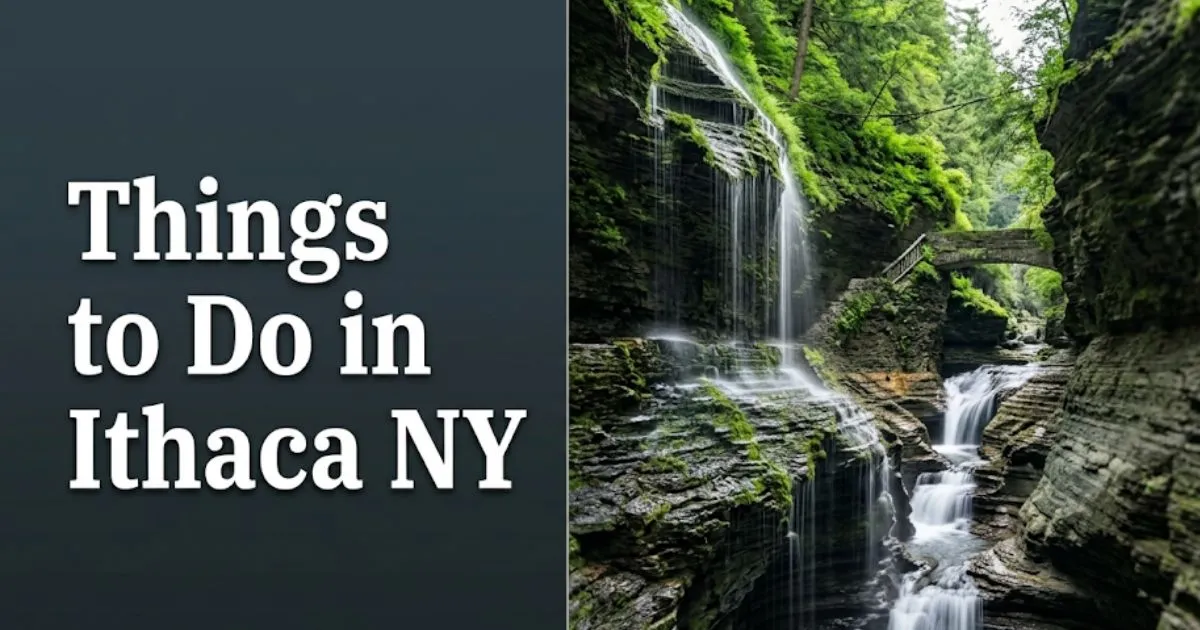
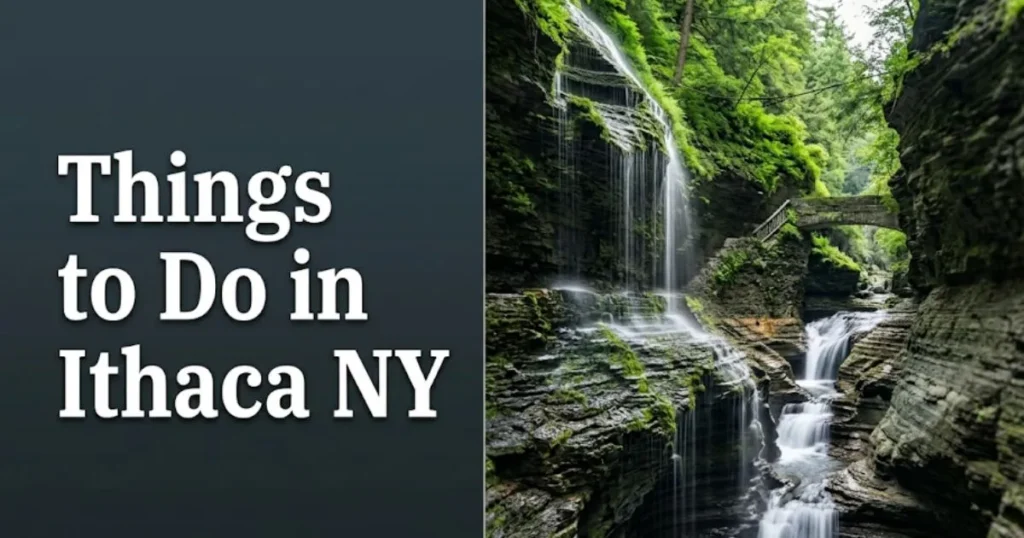
For experienced hikers, the Gorge Trail at Robert H. Treman State Park is the most dramatic route in the system, terminating at Lucifer Falls, one of the most photogenic waterfalls in New York State.
Seniors and accessibility travelers: Taughannock Falls State Park’s lower trail to the falls viewpoint is mostly flat and manageable with a cane or walker. The gorge rim trails at other parks involve significant staircases and are not accessible to those with limited mobility.
Insider Tip:
- Wet trail conditions make the stone staircases in all gorge systems genuinely slippery; wear trail shoes or hiking boots, not sneakers
- The gorge trails close during periods of high water; check the New York State Office of Parks, Recreation and Historic Preservation website before visiting after heavy rain
- Photographically, gorge light is best before 10 a.m. and after 4 p.m. in summer
Buttermilk Falls State Park and Robert H. Treman State Park
Buttermilk Falls State Park and Robert H. Treman State Park are Ithaca’s two most visited state parks and two genuinely different experiences within 4 miles of each other.
Buttermilk Falls sits at the southern edge of the city, immediately accessible from downtown. The main falls cascade 500 feet down the gorge face in a series of drops visible from the parking area. No strenuous hiking required to see the signature waterfall.
The park’s swimming area at the base of the falls operates seasonally, typically June through Labor Day. It is one of the most photographed swimming holes in New York State and crowded accordingly on summer weekends.
Robert H. Treman State Park, 5 miles southwest on Route 327, is the more demanding and more rewarding experience for experienced hikers. The Gorge Trail descends through 12 named waterfalls over 2 miles to the park’s signature feature, Lucifer Falls, a 115-foot plunge waterfall.
The lower park has its own swimming area at Enfield Creek. It is typically less crowded than Buttermilk’s.
According to the New York State Office of Parks, Recreation and Historic Preservation, both parks charge a daily parking fee or accept the New York State Empire Passport. The Empire Passport covers unlimited parking at all state parks for one year and pays for itself within two to three visits.
Families with young children: The lower trail loop at Buttermilk Falls is manageable for children who can walk steadily. The upper rim trail is steep. Robert H. Treman’s full gorge trail involves significant scrambling and is best suited to children ages 8 and older.
Parking reality: Both lots fill before 10 a.m. on summer Saturdays and Sundays. Arrive by 8:30 a.m. or plan a weekday visit. This is not a minor inconvenience. Visitors who arrive after 10 a.m. on peak summer weekends regularly find the lot gates closed.
Taughannock Falls State Park
Taughannock Falls State Park is located 8 miles north of Ithaca on Route 89 along the Cayuga Lake shoreline, and it contains the tallest single-drop waterfall in New York State.
Taughannock Falls drops 215 feet, exceeding Niagara Falls in vertical drop by 33 feet. The lower gorge trail to the falls viewpoint runs less than a mile from the parking area, mostly flat, through an impressive amphitheater of stone walls.
The rim trail above the gorge offers elevated views across the Cayuga Lake valley. Allow an additional 1.5 hours if adding the rim loop.
The park also operates a Cayuga Lake waterfront area with a beach, boat launch, and picnic facilities. It functions as a full day destination, not a single-stop viewpoint.
Seasonal note: The waterfall is most dramatic from March through June when snowmelt and spring rain maximize flow. Summer flow is significantly lower. Fall provides the combination of adequate flow and foliage color that makes October the most photographed month.
Seniors and accessibility travelers: The lower gorge trail to the Taughannock viewpoint is the single most accessible major waterfall experience in the Ithaca area. The mostly flat packed-gravel path is manageable for most mobility levels. The rim trail is not accessible.
Budget travelers: Taughannock is the best value state park in the Ithaca orbit. One parking fee grants access to the waterfall trail, the Cayuga Lake beach, picnic areas, and the full rim trail system.
Key Takeaway: Arrive at Buttermilk Falls or Robert H. Treman before 9 a.m. on summer weekends. Parking lots close to new arrivals before most travelers have finished breakfast.
Cayuga Lake and Ithaca Waterfront Activities
Cayuga Lake is the second-longest of the Finger Lakes at 61 miles, and Ithaca sits at its southern tip with direct waterfront access through multiple parks and trails.
The Cayuga Waterfront Trail runs 5.2 miles along the western shore of the Cayuga Inlet from the Ithaca Farmers Market to Allan Treman State Marine Park. It is flat, paved, and fully accessible.
Cyclists, joggers, and families with strollers all use it daily. Cayuga Lake paddle sports are accessible from the inlet.
Stewart Park, at the point where the inlet meets the lake on Route 34, is Ithaca’s lakeside community park. It has a restored 1920s carousel, picnic facilities, a restored boathouse, and direct lake views.
The park is free to enter. It serves local families as much as visitors.
Kayak and canoe rentals are available seasonally from several Cayuga Inlet outfitters. Rental costs typically run in the $20 to $50 per hour range; verify current availability directly with providers as operations change seasonally.
The Allan Treman State Marine Park marina is the primary public boat launch on the Ithaca end of Cayuga Lake. Anglers and kayakers use it regularly.
Couples: Sunset from the Cayuga Lake shoreline near Stewart Park or from the wine trail roads on the lake’s western shore (Route 89) is a legitimately compelling evening. It requires no reservation and no cost.
Families with young children: Stewart Park’s carousel and lakefront picnic area are a reliable afternoon option that holds children’s genuine interest for two to three hours.
Cornell University Campus and Cornell Botanic Gardens
Cornell University’s campus is one of the most architecturally and geographically dramatic university settings in the United States, and it is entirely open to the public.
The campus sits on a plateau above Cayuga Lake, with Fall Creek Gorge and Cascadilla Gorge framing its eastern and southern edges. The combination of Collegiate Gothic architecture, active gorges, and lake views is genuinely unusual at any research university.
Self-guided campus walks are free. The Herbert F. Johnson Museum of Art, designed by I.M. Pei, houses a permanent collection spanning Asian art, contemporary works, and European masters. Admission is free.
The Sciencenter on First Street in downtown Ithaca is the hands-on science museum associated with Cornell’s outreach programs. It charges a moderate admission fee and is one of Ithaca’s most reliably engaging experiences for children ages 4 through 14.
Cornell Botanic Gardens covers 2,800 acres encompassing the main arboretum on campus, four natural areas including gorge sections, and specialty gardens. Admission and parking are free.
The F.R. Newman Arboretum within the Botanic Gardens is particularly strong in spring (flowering trees, May) and fall (foliage, October). It deserves two to three hours for anyone interested in botanical collections.
According to Visit Ithaca, the Cornell Botanic Gardens is one of the most visited free attractions in the Finger Lakes region. It is consistently underused by visitors who assume they need a campus connection to enter.
Sapsucker Woods Bird Sanctuary, managed by the Cornell Lab of Ornithology, is a 220-acre bird sanctuary adjacent to the Lab’s headquarters at 159 Sapsucker Woods Road. It is free, open daily, and features 4 miles of trails through forest and wetland with exceptional birding year-round.
Seniors and accessibility travelers: The Botanic Gardens main arboretum paths are wide, mostly flat, and manageable for most mobility levels. Sapsucker Woods has a fully accessible elevated pond viewing platform adjacent to the Lab building.
Ithaca Commons and Downtown Ithaca
Downtown Ithaca’s Commons is a six-block pedestrian mall on East State Street that functions as the commercial and social center of the city. It is worth an afternoon, not a full day.
The Commons contains independent retailers, restaurants, coffee shops, and regular public events. Gimme Coffee, one of New York’s more respected independent roasters, has a location here.
The Commons is at its best during the Ithaca Farmers Market season when the energy extends from Cayuga Street into the surrounding blocks. It is at its most ordinary in winter.
The surrounding downtown streets hold more interesting independent businesses than the Commons itself. Dewitt Mall, a converted 1874 building at 215 North Cayuga Street, houses several locally-loved restaurants and independent shops in a covered interior courtyard.
Collegetown, the dense commercial strip on College Avenue immediately east of the Cornell campus, operates more like a college town main street than a tourist district. It is where Cornell students actually eat, drink, and spend evenings.
For travelers who want the honest Ithaca dining scene rather than the tourist-facing version, Collegetown restaurants are worth the 10-minute walk or bus ride from downtown.
Budget travelers: The Commons is entirely walkable at no cost. Several free public events and outdoor concerts occur in the space throughout the summer; check the Ithaca Downtown Partnership events calendar before visiting.
Solo travelers: The Commons and surrounding downtown blocks are well-populated and active evenings from spring through fall. The area is genuinely safe for solo exploration at all hours.
Key Takeaway: Skip the Commons as a primary destination; walk through it on your way to Dewitt Mall or the Farmers Market, and spend your actual time on the gorge trails or waterfront.
Ithaca Farmers Market and Local Food Scene
The Ithaca Farmers Market is one of the most cited examples of a genuinely excellent American farmers market, and it earns the reputation.
The market operates at Steamboat Landing on the Cayuga Inlet, with the lake visible across the water from the vendor pavilions. The setting separates it from every other farmers market in the region.
It runs Saturdays and Sundays from May through December, with a condensed winter indoor market through April. Hours are typically 9 a.m. to 3 p.m., though verify current times directly before visiting as seasonal schedules adjust.
Vendors include farms growing in Tompkins County and surrounding counties, prepared food vendors covering everything from wood-fired pizza to Colombian arepas, local honey, Finger Lakes wines and ciders, handmade crafts, and live music.
Budget travelers should note that the Ithaca Farmers Market is one of the most satisfying affordable meals in the city. Prepared food vendors typically charge $8 to $15 per dish.
Families: The market’s open pavilion layout, waterfront setting, and variety of food and activity options make it a reliable two-hour family experience. Children engage with it more readily than most cultural attractions.
The local alternative to the tourist-facing farmers market experience: The Greenstar Community Market cooperative grocery at 701 West Buffalo Street is where Ithaca locals actually shop year-round. It stocks local farms, regional cheeses, and Finger Lakes wines at grocery prices, not market prices. Worth visiting for self-catered meals.
According to Visit Ithaca, the Ithaca Farmers Market has been operating continuously since 1973, making it one of the longest-running farmers markets in New York State.
Best Restaurants in Ithaca NY
Ithaca’s restaurant scene is disproportionately strong for a city of 32,000 people, driven by Cornell’s international community and a long local food cooperative tradition.
Moosewood Restaurant at 215 North Cayuga Street (Dewitt Mall) is the most famous restaurant in Ithaca’s history. It opened in 1973 and helped define American vegetarian cooking nationally. It is not the most exciting restaurant currently operating in Ithaca, but it remains worth a visit for food history context.
Agava Restaurant on the Commons serves elevated Mexican cuisine with locally sourced ingredients and Finger Lakes spirits in the cocktail program. It consistently outperforms its casual exterior.
L’Ithaki Mediterranean on Cayuga Street brings Greek and Eastern Mediterranean cooking to a food scene that skews heavily local-American. The lamb dishes and meze plates are the reliable orders.
Hai Hong Restaurant on State Street is the honest local answer to a Chinese food craving in Ithaca: the lunch specials are priced for the student budget and the cooking is consistent.
For the best breakfast in the city, Collegetown Bagels on College Avenue, known locally as CTB, is an Ithaca institution with multiple locations. Order the egg sandwich on an everything bagel. Know the line moves slowly on weekend mornings.
Ithaca Beer Company at 122 Ithaca Beer Drive (with a taproom also operating downtown on Green Street at various times) represents the Finger Lakes craft beer culture accurately. The taproom at the production facility is the better experience.
Budget travelers: Multiple solid restaurants near the Cornell campus serve full meals under $15. The area around East State Street and College Avenue offers the highest concentration of affordable options.
Couples: Agava and L’Ithaki both have the atmosphere for a proper dinner out without the formality that makes a romantic evening feel like an obligation.
Free and Budget-Friendly Things to Do in Ithaca NY
Ithaca is one of the most budget-friendly outdoor destinations in the northeast, with most of its best natural experiences either free or accessible for a modest state park parking fee.
Free experiences in Ithaca:
- Cascadilla Gorge Trail: 1.3-mile gorge hike from downtown to Cornell campus, entirely free
- Cornell Botanic Gardens: 2,800-acre arboretum and natural areas, free admission and free parking
- Sapsucker Woods Bird Sanctuary: 220 acres of trails at the Cornell Lab of Ornithology, free
- Herbert F. Johnson Museum of Art: Cornell’s I.M. Pei-designed art museum, free admission
- Fall Creek Gorge at Cornell campus: Triphammer Falls and Beebe Lake access, free
- Cayuga Waterfront Trail: 5.2-mile paved flat trail along the Cayuga Inlet, free
- Stewart Park: Cayuga Lake waterfront park with lakefront access, free entry
- Ithaca Farmers Market: free to enter, located at Steamboat Landing on Saturdays and Sundays
State park parking fees apply at Buttermilk Falls, Robert H. Treman, and Taughannock Falls. The New York State Empire Passport annual pass covers unlimited parking at all state parks and pays for itself within two to three visits to Ithaca-area parks.
Budget travelers: A full two-day Ithaca itinerary with gorge hikes, the Botanic Gardens, Sapsucker Woods, the Farmers Market, and campus exploration can be accomplished for well under $50 per day per person excluding food and accommodation.
Seniors and accessibility travelers: The free experiences listed above include several with low physical demand and full accessibility, particularly the Sapsucker Woods accessible viewing platform and the Cayuga Waterfront Trail.
Key Takeaway: The New York State Empire Passport annual pass eliminates parking fees at all three major Ithaca state parks and is worth purchasing for any visit involving more than two park stops.
Romantic Things to Do in Ithaca NY
Ithaca is a genuinely strong romantic destination for couples who find natural scenery, good food, and college-town cultural depth more compelling than resort amenities.
The most romantic experience in Ithaca is a late afternoon gorge walk through Cascadilla Gorge followed by dinner on the Commons. It requires no reservation, no significant expense, and delivers the gorge experience with the late light that photographers chase.
Robert H. Treman State Park’s gorge trail to Lucifer Falls is the more dramatic alternative. Allow a half-day and go on a weekday to have the trail largely to yourselves.
The Cayuga Wine Trail north of Ithaca on Route 89 along the western shore of the lake is one of the most scenic wine country drives in the northeast. Wineries are typically open May through November for tastings. Tasting fees run approximately $5 to $15 per person at most locations.
Lucas Vineyards and Six Mile Creek Vineyard (the latter located within city limits at the eastern edge of Ithaca) are both accessible without a long drive. Six Mile Creek is the most convenient wine tasting option for visitors staying downtown.
For a romantic evening without leaving the city, the Cornell Cinema in Willard Straight Hall on the Cornell campus shows repertory and independent films. It is a proper old-fashioned cinema experience with a genuinely curated program.
Couples note: Ithaca has limited luxury accommodation options. The Statler Hotel at Cornell is the most consistently full-service option on campus. Downtown boutique hotels book out months ahead for peak fall weekends. Book accommodations 60 to 90 days in advance for October visits.
Things to Do in Ithaca NY With Kids
Ithaca works well for families with children across a range of ages, with the qualification that gorge trail access depends significantly on the ages and physical confidence of the children involved.
Best experiences for families with children:
- Sciencenter (601 First Street, downtown): hands-on science museum with exhibits calibrated for ages 4 through 14; admission runs approximately $9 to $12 per person as of recent years; verify current pricing before visiting
- Ithaca Farmers Market: outdoor, visually stimulating, easy pacing, diverse food options; children engage with it readily
- Stewart Park: lakefront setting with a restored 1920s carousel; free entry; manageable for all ages
- Buttermilk Falls lower trail: short, dramatic, accessible walk to a genuine 500-foot waterfall; appropriate for children who walk steadily
- Taughannock Falls lower trail: mostly flat, less than a mile each way to a 215-foot waterfall viewpoint; the most accessible major waterfall in the area for young families
- Cornell Botanic Gardens arboretum: open space, interesting plant collections, and the Llenroc carriage path loop suitable for strollers
- Cascadilla Gorge Trail: appropriate for older children (ages 8 and up) who handle staircases confidently; not suitable for strollers or toddlers on the full route
What sounds good for families but underdelivers in practice: The full gorge trail at Robert H. Treman State Park is frequently recommended as a family hike. It involves 3.5 miles round trip with significant elevation change and stone staircases. Children under 8 typically find the physical demand exhausting before reaching Lucifer Falls. The lower swimming area is the more appropriate family destination at this park.
Teens and older children will engage more readily with the full gorge trails, the Johnson Museum of Art, and a visit to the Cornell Lab of Ornithology’s visitor center at Sapsucker Woods.
Best Time to Visit Ithaca NY by Season
The best time to visit Ithaca, New York depends entirely on what you want from the trip, and each season delivers a genuinely different experience.
Spring (April to early June) brings the most dramatic waterfall flow. Snowmelt and spring rain push all the gorge waterfalls to their maximum volume. Trail conditions can be muddy and some sections remain closed through April after winter ice damage. May is the sweet spot: full flow, wildflowers in the gorges, manageable crowds.
Summer (late June to August) is peak season. The gorge swimming areas are open and heavily used. Parking lots fill before 10 a.m. on weekends. The Farmers Market is at full operation. Temperatures are moderate by Finger Lakes standards, typically high 70s to mid-80s Fahrenheit. Humidity is real. The season rewards early risers.
Fall (mid-September to late October) is objectively Ithaca’s most photogenic season. The gorge walls and surrounding hillsides hit peak foliage typically in the first two weeks of October. Cornell parent weekend (usually mid-October) fills every hotel in Tompkins County. Book accommodations by July for October visits.
Winter (November through March) is the honest truth: most gorge trails are closed or dangerously icy. The state parks reduce hours. The outdoor experience is severely limited. Ithaca in winter works for visitors focused on Cornell’s indoor cultural institutions, the Sciencenter, and Finger Lakes winery visits. It does not work for travelers whose primary goal is gorge hiking.
According to Visit Ithaca, the Finger Lakes region receives over 4 million visitors annually, with the heaviest concentration arriving in July, August, and October.
Key Takeaway: October’s first two weeks deliver Ithaca’s most visually rewarding combination of foliage and waterfall access, but require reservations made months in advance for both accommodations and popular restaurants.
Day Trips From Ithaca NY and Things to Do Near Ithaca
The most compelling day trips from Ithaca take advantage of the Finger Lakes region’s concentration of state parks, wine trails, and natural features within a 60-mile radius.
Watkins Glen State Park, 35 miles southwest on Route 414, is arguably the most dramatic gorge park in New York State. Its 19 waterfalls and the narrow stone Gorge Trail through them represent a different scale of experience than the Ithaca parks. Plan two to three hours minimum for the gorge. The parking lot here also fills early on summer weekends; weekday visits or early weekend arrivals are strongly recommended.
Seneca Lake Wine Trail, accessible from the Watkins Glen base, runs north along both shores of Seneca Lake. Combining Watkins Glen with two or three winery visits makes a full and legitimately satisfying day.
Letchworth State Park, called the “Grand Canyon of the East” for the Genesee River gorge it preserves, sits approximately 90 miles northwest of Ithaca on I-390. It is a longer day trip but one of New York State’s most genuinely remarkable parks, with waterfalls at a scale that exceeds anything in the Ithaca area.
Trumansburg, a small village 10 miles north of Ithaca on Route 96, is where Ithaca residents go to escape Ithaca. The Rongovian Embassy restaurant and bar in Trumansburg has been a genuine local institution for decades.
Alternatives for shorter range: Taughannock Falls is technically outside Ithaca city limits but close enough (8 miles north) to count as local. Route 89 along the western Cayuga Lake shore is one of the most scenic drives in the northeast, particularly in October.
Budget travelers: Watkins Glen’s gorge is the highest-value day trip from Ithaca. One state park parking fee delivers one of the most dramatic gorge experiences in the eastern United States.
Getting Around Ithaca NY and Practical Logistics
Getting around Ithaca requires either a car, strategic use of the TCAT (Tompkins Consolidated Area Transit) bus system, or acceptance that some attractions require early morning arrivals to claim parking.
Driving and parking reality: Downtown Ithaca has metered street parking and several public parking garages. Gorge state park lots have limited capacity and fill before 10 a.m. on summer weekends. This is the single most common logistical mistake visitors make. Plan to be at park lots by 8:30 to 9 a.m. on summer Saturdays and Sundays.
TCAT buses cover downtown Ithaca, the Cornell campus, Collegetown, and several key destinations including the Ithaca Farmers Market. The system is affordable and reliable within the urban core. It does not serve the state parks directly. Verify current routes and schedules at the TCAT official website before visiting.
Ithaca Carshare is a community carsharing cooperative with vehicles available for hourly rental across multiple downtown locations. It is a practical alternative for travelers who fly into Ithaca Tompkins Regional Airport (ITH) without renting a dedicated car for their full stay.
Getting to Ithaca: Ithaca Tompkins Regional Airport (ITH) has limited direct connections, primarily through Philadelphia and Washington Dulles. Most visitors drive. From New York City, the drive via I-87 North to I-88 West typically runs four to five hours depending on traffic. From Philadelphia, plan five hours. From Boston, plan four to 4.5 hours.
Suggested 2-Day Weekend Itinerary for Ithaca:
Day 1: Gorges and Downtown
- Arrive at Buttermilk Falls State Park by 8:30 a.m.; hike the lower gorge trail to the swimming area and the rim trail loop; allow 2.5 hours
- Drive 5 minutes to Robert H. Treman State Park; hike the Gorge Trail to Lucifer Falls and back; allow 2 to 3 hours
- Drive back into downtown Ithaca; lunch at Agava Restaurant on the Commons or at the Ithaca Farmers Market if visiting on a Saturday or Sunday
- Walk the Cascadilla Gorge Trail from downtown up to the Cornell campus; allow 1 hour each way
- Explore the Cornell campus; visit the Herbert F. Johnson Museum of Art; walk to Triphammer Falls at Fall Creek
- Dinner in Collegetown or at L’Ithaki Mediterranean downtown
Day 2: Waterfront, Botanic Gardens, and Day Trip North
- Morning: Ithaca Farmers Market at Steamboat Landing (Saturday or Sunday); allow 1.5 hours for the full market and a meal from the prepared food vendors
- Walk or cycle the Cayuga Waterfront Trail to Stewart Park; allow 1 to 1.5 hours
- Drive north on Route 89 to Taughannock Falls State Park; hike the lower gorge trail to the viewpoint; allow 1.5 hours
- Continue north on Route 89 along the Cayuga Lake shore to two or three wineries on the Cayuga Wine Trail; allow 1 to 1.5 hours
- Return to Ithaca for dinner; Moosewood Restaurant for the food history visit or Ithaca Beer Company taproom for a more casual close
Note on this itinerary: Day 1’s full gorge sequence (Buttermilk Falls plus Robert H. Treman) is physically demanding. Budget travelers doing both parks should allow six hours total and carry water. Families with young children should substitute Robert H. Treman’s lower swimming area for the full gorge hike.
Safety and Practical Warnings for Ithaca NY Gorges and State Parks
The primary safety reality in Ithaca’s gorges is this: the stone staircase trails become dangerously slippery when wet, and swimming outside designated areas in the gorges has resulted in multiple fatalities.
Key safety and practical facts every visitor should know:
- Wet trail conditions are serious. The stone staircases in Cascadilla Gorge, Buttermilk Falls, and Robert H. Treman become slick after rain. Wear shoes with genuine traction. Sneakers are inadequate.
- Swimming in gorges outside designated areas is illegal and has resulted in deaths. The designated swimming areas at Buttermilk Falls and Robert H. Treman are the only safe swimming locations in the gorge parks.
- High water closures happen. Gorge trails close after heavy rain or snowmelt when water levels rise dangerously. Check the New York State Office of Parks, Recreation and Historic Preservation for closure notices before driving to a park.
- Cayuga Lake water temperatures remain cold into summer. Open water swimming in the lake requires awareness of lake temperature, particularly early in the season before July.
- Cell service is limited on some gorge trails. Download offline maps before entering the gorge trail systems if you plan to navigate via phone.
- Parking lot capacity is a genuine access issue. If a state park lot is full, rangers will turn visitors away at the entrance. No shoulder parking is available at most park entrances.
- Trail conditions in winter are genuinely dangerous. Ice accumulates on stone staircases from November through March. Several sections become impassable without crampons. Most gorge trails are formally closed in winter.
Contact the New York State Office of Parks, Recreation and Historic Preservation or call individual park offices to confirm current trail conditions before visiting during shoulder seasons.
Frequently Asked Questions About Things to Do in Ithaca NY
What are the best things to do in Ithaca NY for a first-time visitor?
First-time visitors to Ithaca should prioritize Buttermilk Falls State Park, Cascadilla Gorge Trail, and the Ithaca Farmers Market.
These three experiences collectively represent the gorge landscape, the free urban gorge hiking, and the local food culture that define what makes Ithaca distinct from other upstate New York destinations.
Add the Cornell Botanic Gardens and a sunset walk on the Cayuga Waterfront Trail for a complete first-visit experience that covers both nature and city character.
How many days do you need in Ithaca NY?
Two full days is the minimum to cover Ithaca’s main gorge parks, the waterfront, and the city center without feeling rushed.
Three days allows for a day trip to Watkins Glen or the Cayuga Wine Trail along Route 89, which adds meaningful Finger Lakes context to the experience.
One day is enough to see a single gorge park, walk Cascadilla Gorge, and explore the Commons, but it leaves the majority of the destination uncovered.
When is the best time to visit Ithaca NY?
The best time to visit Ithaca is late September through mid-October for fall foliage combined with accessible gorge trails, or May through early June for peak waterfall flow with manageable crowds.
Summer (July and August) is peak season with all facilities open but gorge parking lots that fill before 10 a.m. on weekends.
Winter is the least recommended season for most visitors, as gorge trails are closed or icy and the outdoor experience that defines the destination is largely unavailable from November through March.
Is Ithaca NY worth visiting?
Ithaca is worth visiting for travelers drawn to gorge hiking, waterfall scenery, college-town cultural depth, and Finger Lakes wine and food culture.
The gorges and waterfalls are not tourism board exaggeration; they are genuine natural features within or adjacent to city limits that rival experiences found in much larger national park destinations.
Travelers expecting resort amenities, a polished tourist district, or a full nightlife scene will find Ithaca does not deliver those things with the same consistency as its outdoor and cultural offerings.
What gorges can you hike in Ithaca NY?
The main hikeable gorges in and around Ithaca are Cascadilla Gorge (free, through the Cornell campus), Fall Creek Gorge (free, at the Cornell campus north end), Buttermilk Falls State Park gorge, Robert H. Treman State Park gorge, and the Taughannock Falls gorge 8 miles north.
Cascadilla Gorge is the most accessible from downtown and requires no driving or parking fee.
Robert H. Treman’s Gorge Trail to Lucifer Falls is the most dramatic and physically demanding route, with 12 named waterfalls along a 2-mile descent.
What should I know before visiting Ithaca NY?
The single most important thing to know before visiting Ithaca is that gorge trail parking lots fill before 10 a.m. on summer weekends; plan accordingly or visit on weekdays.
The New York State Empire Passport annual parking pass covers all state park visits and saves money immediately if you plan to visit two or more parks.
Gorge trails require shoes with real traction; the stone staircases are genuinely slippery when wet, and trail conditions should be checked before visiting after rain or in the shoulder seasons.
Closing
Ithaca’s best experiences require knowing when to show up and which trail to take. The gorges are real. The waterfalls earn the reputation. The farmers market on a Saturday morning at Steamboat Landing is the kind of travel experience that stays with you.
Book accommodations well in advance for any October visit. Verify gorge trail conditions directly with the New York State Office of Parks, Recreation and Historic Preservation before heading out after rain or in the shoulder seasons. Prices, hours, and seasonal schedules change; confirm key details with individual parks and venues before your departure.
Show up early. Wear the right shoes. The rest takes care of itself.