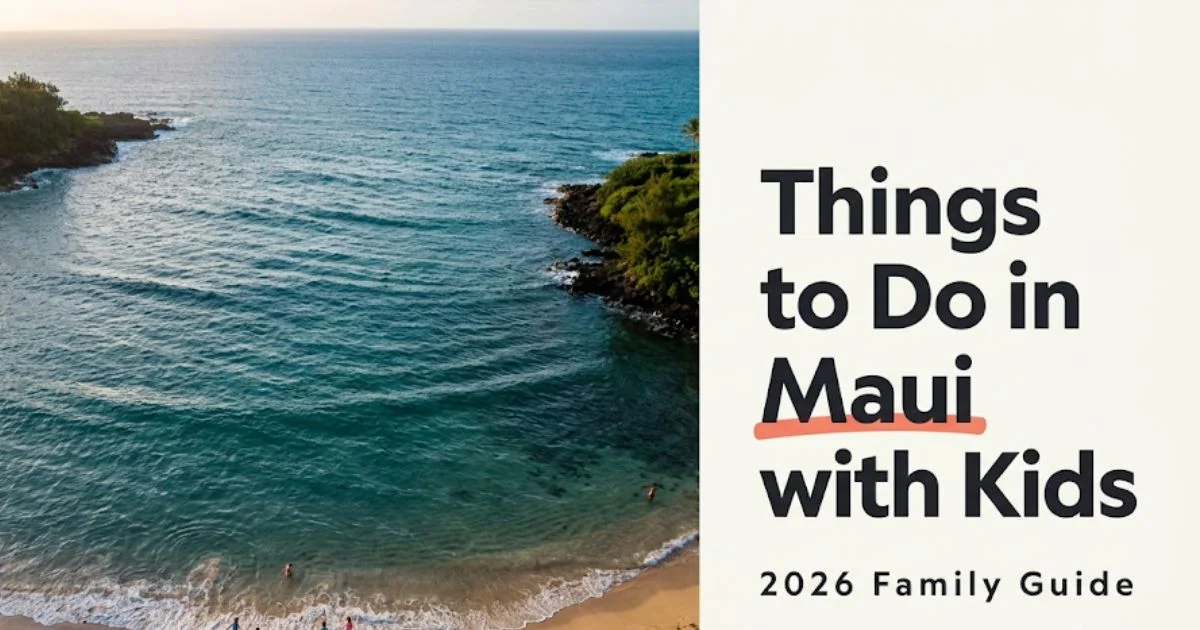
Best Things to Do in Maui with Kids: 2026 Family Guide

Maui genuinely delivers for families, but the best things to do in Maui with kids depend heavily on your children’s ages and your base location.
Plan around geography first. Families who choose the wrong side of the island for their activities lose hours in traffic on a road with no alternatives.
This guide covers every major family activity on Maui. It includes honest age-bracket guidance, a 7-day itinerary framework, and the experiences that sound great in brochures but underdeliver in practice.
Things to Do in Maui with Kids: What to Know Before You Plan
Maui is one of the most genuinely family-suited destinations in the United States, but it rewards families who understand its geography before booking anything.
The island divides into four distinct regions. West Maui covers Kaanapali, Kapalua, and the Lahaina area. South Maui covers Kihei and Wailea. Upcountry Maui covers Makawao, Kula, and the Haleakala slopes. East Maui covers the Road to Hana corridor.
Families base in West or South Maui for resort infrastructure. Upcountry and East Maui are day trip territory, not practical overnight bases for families with young children.
The Maui Visitors and Convention Bureau notes that Kahului Airport (OGG) serves as the island’s main arrival point. From there, West Maui is approximately 45 minutes and South Maui approximately 20 minutes by car.
Renting a car is non-negotiable for families. The Maui Bus system covers only limited routes and runs too infrequently for itinerary flexibility.
Book ocean activity tours, luau tickets, and Haleakala timed-entry permits before arriving. These sell out weeks in advance, especially during summer and holiday windows.
Insider Tip:
- Book Haleakala National Park sunrise timed-entry permits on Recreation.gov as soon as your travel dates are confirmed. Availability opens 60 days in advance and is gone within hours for popular dates.
- Book luau tickets at least 3 to 4 weeks ahead in peak season (June through August, December through January).
- Families with children under 5 should prioritize South Maui beaches, which are calmer and closer to medical facilities in Kihei.
Best Things to Do in Maui with Kids by Age Group
The best things to do in Maui with kids vary so significantly by age that a single recommendation list genuinely fails most families.
| Age Group | Top Activity Picks | Activities to Skip | Key Note |
|---|---|---|---|
| Toddlers (1 to 4) | Kamaole Beach I, tide pools, Maui Ocean Center | Molokini snorkel tours, Road to Hana | Calm water and shade access are priorities |
| Young Kids (5 to 9) | Kapalua Bay snorkeling, whale watching, Old Lahaina Luau | Haleakala sunrise (2 a.m. departure), long hikes | Structured tours with clear end times work best |
| Tweens (10 to 12) | Surf lessons, Maui Tropical Plantation, Road to Hana | Passive beach days only | Active and novel experiences hold interest |
| Teens (13 plus) | Haleakala sunrise, ziplines, Honolua Bay snorkeling | Toddler-paced itineraries | Independence within activities increases satisfaction |
Toddlers thrive at Maui’s calm south-facing bays. Young children aged 5 to 9 can participate in most snorkel tours if comfortable in the water.
Tweens and teens are the age groups who get the most from Maui’s adventure activity range. Surf lessons, ziplines, and Haleakala create genuinely memorable experiences at these ages.
Families mixing age groups need to plan activity sequences deliberately. Alternating high-energy days with beach-rest days prevents the exhaustion spiral that ruins the back half of many family vacations.
Families with children aged 5 and under should be aware that stroller access is limited on Maui’s more popular nature trails, including the Pipiwai Trail and most Road to Hana stops.
Kid-Friendly Things to Do in Maui Beyond the Tourist Checklist
Kid-friendly things to do in Maui extend well beyond the activities that appear on every tourism board list. The most-photographed experiences are not always the best fit for actual children.
Iao Valley State Monument in Wailuku is a 15-minute drive from Kahului Airport. It offers a dramatic green valley, a stream children can wade in, and the iconic Iao Needle rock formation. Admission is minimal (verify current fees at Hawaii DLNR before visiting), and the main trail is paved and stroller-accessible.
Ululani’s Hawaiian Shave Ice, with locations in Lahaina, Kihei, and Kahului, is a legitimate Maui institution. A large shave ice with cream and azuki beans runs a few dollars and occupies children happily after any activity. This is not a generic tourist stand. It has placed consistently among the best shave ice on the island per Honolulu Magazine’s annual rankings.
Maui Tropical Plantation in Wailuku offers a tram tour through working agricultural fields, a zipline, and a farm-to-table restaurant. The tram tour takes approximately 40 minutes and genuinely holds children’s interest. Admission covers the tram tour; zipline is priced separately.
The honest overrated assessment: many families book helicopter tours expecting children to be amazed. Children under age 10 generally find helicopter tours disorienting rather than exciting. The experience is genuinely spectacular for adults and older teens but is not well-suited to younger children and carries significant expense for a return that many children do not register as memorable.
Profile Note: Budget families should note that Iao Valley, most beach parks, and shave ice stops represent strong value. Helicopter tours and snorkel catamaran trips represent the opposite end of the cost spectrum.
Key Takeaway: Book Haleakala timed-entry permits on Recreation.gov the day they open, 60 days before your visit. They disappear within hours on peak dates.
Best Beach in Maui for Kids
The best beach in Maui for kids is Kapalua Bay, consistently rated as one of the calmest and most protected swimming bays on the island.
| Beach | Location | Water Calmness | Facilities | Best Age Group |
|---|---|---|---|---|
| Kapalua Bay | West Maui (Kapalua) | Very calm, protected reef | Parking, restrooms, rinse stations | All ages including toddlers |
| Kamaole Beach Park I | South Maui (Kihei) | Moderate, lifeguarded | Full facilities, lifeguard | Ages 4 and up |
| Napili Bay | West Maui (Napili) | Calm, crescent bay | Limited facilities | Ages 3 and up |
| Kaanapali Beach | West Maui (Kaanapali) | Moderate, open ocean sections | Full resort facilities | Ages 6 and up |
| Hamoa Beach | East Maui (Hana) | Active surf, bodysurfing | Minimal facilities, remote | Teens only |
Kapalua Bay’s reef structure breaks incoming swell effectively. Even on days when ocean conditions elsewhere are rough, Kapalua Bay typically remains swimmable for young children.
Kamaole Beach Parks I, II, and III in Kihei are the best option for families based in South Maui. Kamaole I has lifeguard service during park hours and a large grass area where children can run freely between ocean sessions.
Napili Bay is a strong local alternative to the more-visited Kaanapali Beach. It sits within a residential area of Napili rather than a resort strip, which means far fewer crowds on most days.
Families with toddlers and infants should target Kapalua Bay or Napili Bay over Kaanapali. Kaanapali’s open beach faces more ocean swell and has resort activity operators launching equipment from the waterline throughout the day.
Pack SPF 50 reef-safe sunscreen for all Maui beach visits. Hawaii law restricts certain chemical sunscreen ingredients to protect coral reefs, and this is enforced.
Snorkeling in Maui with Kids
Snorkeling in Maui with kids is one of the island’s defining family experiences, but the right site depends entirely on your children’s swimming confidence and age.
Kapalua Bay is the best entry-level snorkel site for children. The bay holds healthy coral heads close to shore, sea turtles are regularly sighted along the right side of the bay, and the calm water makes mask clearing manageable for nervous beginners.
Honolua Bay Marine Life Conservation District, a short drive north of Kapalua, offers more advanced snorkeling with larger fish populations and dramatic coral formations. This site suits children aged 10 and older who are comfortable swimmers. Current can be present at the bay entrance.
Molokini Crater snorkel tours depart from Maalaea Harbor and reach an offshore volcanic crater that functions as a marine sanctuary. Visibility often exceeds 100 feet. However, the boat ride takes 45 minutes each way, and open-ocean conditions can cause significant motion sickness in children. Reserve this for children aged 8 and older who have demonstrated ocean comfort.
According to the Pacific Whale Foundation, Maui’s near-shore waters host more than 100 species of reef fish, as well as green sea turtles (honu) that are federally protected under the Endangered Species Act.
Insider Tip:
- Trilogy Excursions and Pride of Maui both operate family-friendly snorkel catamaran tours with snorkel instruction included. Both provide snorkel gear including child-sized masks.
- Book morning tours, not afternoon departures. Wind and chop increase significantly in the afternoon on most Maui ocean routes.
- Families with children who have never snorkeled before should practice mask clearing in a pool before the trip. This single preparation step prevents most snorkel tour disappointments.
Whale Watching in Maui with Kids
Whale watching in Maui with kids is genuinely one of the best wildlife experiences available anywhere in the United States, specifically from December through mid-April.
Humpback whales migrate from their Alaskan feeding grounds to Hawaiian waters to breed and calve every year. The Hawaiian Islands Humpback Whale National Marine Sanctuary, which encompasses much of the Maui coastline, creates some of the most accessible whale viewing in the Pacific.
The Pacific Whale Foundation operates research-informed whale watching tours from Maalaea Harbor. Naturalists on board provide live educational commentary, which keeps children engaged beyond the sighting moments. Tour lengths typically run 2 to 2.5 hours. Verify current pricing and booking windows directly at pacificwhale.org before visiting.
January and February represent peak whale density in Maui waters. Families visiting in December or March will still see whales but with lower frequency. Families visiting outside the December to April window will not encounter humpbacks in Maui waters.
Children aged 5 and older typically have the attention span and physical stamina for a standard whale watching tour. Toddlers find the waiting periods between sightings difficult. Plan accordingly.
Profile Note: Budget families should note that most whale watching operators guarantee a sighting or offer a complimentary return trip. This eliminates the risk of paying full price for a low-activity day on the water.
An honest local alternative to structured whale watching tours: park at McGregor Point scenic lookout on the Honoapiilani Highway between December and April. Humpbacks breach within visible distance from shore on many mornings. This is free. The view is legitimately remarkable and costs nothing.
Key Takeaway: McGregor Point scenic lookout on Honoapiilani Highway offers free humpback whale viewing from shore between December and April. It requires no booking and no boat ride.
Maui Ocean Center with Kids
Maui Ocean Center in Maalaea Harbor is the best indoor family activity on the island and one of the most well-executed aquariums in the United States focused entirely on Hawaiian marine life.
The aquarium’s 750,000-gallon open-ocean tank is the centerpiece. Children walk through an acrylic tunnel surrounded by sharks, rays, and large pelagic fish. The Hawaiian green sea turtle exhibits and the living reef gallery both hold children’s attention far longer than standard aquariums typically do.
Admission runs approximately $35 to $45 per adult and $25 to $30 per child as of recent years. Verify current pricing directly at mauioceancenter.com before visiting. A family of four will spend approximately $120 to $150 on admission.
Allow 2 to 3 hours for a thorough visit. The aquarium is not large enough to feel overwhelming, but it is comprehensive enough to reward unhurried exploration.
Maui Ocean Center is an ideal choice for families with children under age 5. All exhibits are stroller-accessible, climate-controlled, and shaded. It is also the island’s best rainy-day backup plan.
The location at Maalaea Harbor makes it a logical stop when combining a morning snorkel tour with an afternoon aquarium visit. Both departure and return to the harbor are simple from the Center’s parking lot.
Profile Note: Families with toddlers should note the aquarium’s nursing room and family restroom facilities are well-maintained and conveniently located near the main entrance. This is a genuinely practical detail most families discover only after arrival.
Road to Hana with Kids
The Road to Hana is one of Maui’s most famous drives, but taking the Road to Hana with kids is a genuinely different undertaking than tourist marketing suggests.
The Hana Highway covers approximately 52 miles from Paia to Hana town with more than 620 curves and 59 one-lane bridges. Children prone to car sickness will struggle significantly. This is not a coastal highway with wide views. It is a dense rainforest tunnel with limited stopping opportunities.
Twin Falls, approximately 2 miles past Paia on the Hana Highway, is the most family-accessible stop on the route. The short trail leads to multiple waterfall tiers and a swimming hole. Children aged 4 and older can handle the trail. This stop alone takes 45 to 60 minutes.
Wai’anapanapa State Park near Hana offers a black sand beach, sea caves, and dramatic coastal scenery. Advance reservations are required through the Hawaii DLNR reservation system. Book these before your trip. The park limits daily visitors and walk-ins are not guaranteed entry.
The honest assessment: the Road to Hana is worth doing with children aged 8 and older who are good travelers in confined spaces. With children under 6, it is a long, winding drive with periodic stops that may satisfy adults more than children. Many families find Twin Falls plus Wai’anapanapa as targeted stops more satisfying than attempting to drive the entire route in a single day.
Families attempting the full Road to Hana should plan to stay overnight in Hana rather than return the same day. The Travaasa Hana (now operating under updated management; verify current name and booking availability) is the primary lodging option in Hana.
Profile Note: Car sickness medications for children are available at Lahaina and Kihei pharmacies. Pack them before this drive regardless of your child’s typical car-sickness history.
Haleakala with Kids
Haleakala National Park offers one of Maui’s most powerful landscape experiences, but visiting Haleakala with kids requires significant planning honesty most travel guides omit.
The park’s summit sits at 10,023 feet. Temperature at the summit averages 30 to 40 degrees Fahrenheit in the early morning, even in summer. Families arriving for sunrise at 5:30 to 6:00 a.m. are leaving accommodation by 3:00 to 3:30 a.m.
Haleakala sunrise timed-entry permits are required for entry between 3:00 a.m. and 7:00 a.m. These must be booked on Recreation.gov. They open 60 days before the visit date and sell out within minutes for popular dates. This is not an exaggeration.
For families with children under 8, the Kipahulu District of Haleakala National Park near Hana offers a more child-appropriate alternative. The Pipiwai Trail leads through a bamboo forest to the 400-foot Waimoku Falls. The trail is approximately 4 miles round-trip with 800 feet of elevation gain. Children aged 7 and older can manage this hike. The Kipahulu District does not require a sunrise timed-entry permit and is a genuinely spectacular experience.
The National Park Service recommends dressing in warm layers for the summit regardless of season. Wind chill at the summit crater rim can make 40-degree temperatures feel significantly colder.
Profile Note: Teens find Haleakala sunrise genuinely transformative. The experience of watching sunrise above the clouds from the volcano summit is one of the few experiences that consistently delivers on its reputation for this age group. For children under 8, the 3 a.m. departure combined with cold temperatures and long waiting times creates more hardship than wonder.
Key Takeaway: Families with young children should visit Haleakala’s Kipahulu District for the Pipiwai Trail rather than the summit. No timed-entry permit required, and the bamboo forest genuinely holds children’s interest.
Upcountry Maui with Kids
Upcountry Maui, encompassing Makawao, Kula, and the agricultural slopes of Haleakala below the summit, offers some of the most genuinely locally-lived experiences on the island.
Maui Tropical Plantation in Wailuku sits at the gateway to Upcountry and operates a narrated tram tour through fields of coffee, macadamia, pineapple, papaya, and sugarcane. The tour runs approximately 40 minutes and is genuinely interesting for children aged 5 and older. A zipline and farm-to-table restaurant occupy the grounds. Verify current tour pricing directly with the plantation before visiting.
Ali’i Kula Lavender Farm on the Haleakala slopes grows lavender at 4,000 feet elevation. The farm is terraced and walkable with children. Views across the island to the ocean are clear on most mornings. The farm store sells lavender-infused foods that children find genuinely interesting to sample.
Makawao town is a former paniolo (Hawaiian cowboy) community with an art gallery district and a handful of independently owned restaurants. Komoda Store and Bakery on Baldwin Avenue has operated since 1916 and is one of Maui’s most genuine culinary landmarks. Their cream puffs and stick donuts sell out by late morning. Arrive before 10 a.m.
Profile Note: Upcountry Maui is specifically underrated for families with tweens and teens who have begun losing interest in standard beach days. The agricultural landscape, the elevation, and the genuine town character of Makawao offer a completely different read on Hawaii than the resort coast.
Budget families should note that Upcountry drives, Makawao town browsing, and Komoda pastries represent a genuinely low-cost day relative to Maui’s ocean activity pricing.
Best Luau in Maui for Families
The best luau in Maui for families depends on whether your priority is cultural authenticity or production-level entertainment.
Old Lahaina Luau has operated as Maui’s most culturally authentic luau experience for decades, recognized consistently by travel publications including Condé Nast Traveler and Travel + Leisure as the island’s best. It is held on the Lahaina waterfront at sunset and keeps its guest count deliberately limited. Tickets sell out weeks in advance. Pricing typically runs $125 to $160 per adult and $65 to $90 for children; verify current pricing directly before booking.
The 2023 Lahaina wildfires significantly changed the Lahaina area. Verify the current operating status, location, and booking availability of Old Lahaina Luau directly before planning your 2026 visit. The luau landscape in West Maui has been subject to changes following the August 2023 disaster.
Drums of the Pacific Luau at the Hyatt Regency Maui in Kaanapali represents the production-scale alternative. The Hyatt property has full resort infrastructure, so parking, restrooms, and family logistics are easier than at standalone luau venues. The show is more theatrical and less intimate than Old Lahaina.
Children aged 5 and older generally engage with luau performances well. The combination of fire dancing, drumming, and food keeps most children occupied for the 2 to 2.5 hour duration. Children under 4 typically struggle with the seated evening format and the late start time (usually 5:30 to 6:00 p.m.).
Profile Note: Budget families should factor luau costs carefully. A family of four at a premium luau represents $350 to $550 in a single evening. This is often the single most expensive activity line item on a Maui family itinerary.
Maui Surf Lessons for Kids
Maui surf lessons for kids are available across multiple skill levels, and Maui’s consistent wave breaks at specific south-facing beaches make it one of the most reliable surf instruction locations in Hawaii.
Cove Park in Kihei is the primary learning beach for surf lessons in South Maui. The break here is small and consistent, the bottom is sandy, and the water is protected enough that instructors can work with children as young as 5 years old. Multiple operators run group and private lessons from this beach.
Maui Surfer Girls runs women-and-girls-focused instruction and is one of the most respected surf schools on the island. For families with daughters aged 8 and older, their curriculum is specifically designed to build water confidence alongside surf skills. Mixed-family lessons are available from numerous operators in Kihei and Lahaina.
Group surf lessons typically run $75 to $100 per person for a 2-hour session including board rental. Private lessons run $150 to $200 per person. Verify current pricing with specific operators before booking.
Children aged 5 and older can participate in beginner group lessons if comfortable in the water. Children under 5 require private instruction and instructor judgment about readiness.
Insider Tip:
- Book morning lessons, not afternoon sessions. Kihei winds increase significantly after noon, making lesson conditions harder for beginners.
- North Shore Maui at Hookipa Beach is famous among experienced surfers but entirely inappropriate as a spectator or family surf area. The waves are powerful and the beach is not set up for casual family beach time.
- First-time surfer children typically stand on the board within the first lesson. Managing expectations beforehand prevents disappointment if they don’t.
Key Takeaway: Cove Park in Kihei is Maui’s dedicated beginner surf beach. Book morning lessons to avoid afternoon wind chop that makes learning harder for children.
Free Things to Do in Maui with Kids
Free things to do in Maui with kids are plentiful enough that budget-conscious families can fill multiple days without spending on paid attractions.
Kamaole Beach Parks I, II, and III in Kihei are public parks with lifeguard service, restrooms, picnic areas, and grass lawns. Entry is free. These beaches represent the best-equipped free family beach parks in South Maui.
Iao Valley State Monument charges a minimal state park entry fee (verify current rates at Hawaii DLNR before visiting) and delivers dramatic scenery, a paved nature walk, a stream, and the 2,250-foot Iao Needle within 20 minutes of Kahului Airport.
Free and low-cost family activities in Maui:
- Tide pool exploration at Kapalua Bay’s north rock shelf (best at low tide; check tide tables before visiting)
- McGregor Point lookout for whale watching (December to April, free, no reservation required)
- Paia town walking (North Shore surf culture, art galleries, galleries, and lunch at Flatbread Company)
- Makawao town walking (paniolo heritage, galleries, and Komoda Bakery)
- Maui Swap Meet at UH Maui College in Kahului (operates Saturday mornings; small admission, local produce, crafts, food)
- Ho’okipa Beach Park (watch professional windsurfers and kitesurfers from the cliff-top viewpoint; not a swimming beach for children)
Profile Note: Budget families can structure an excellent Maui trip around beach days at Kamaole, tide pool exploration at Kapalua, one or two paid ocean activity days, and free cultural stops. The island’s paid activities are spectacular, but the free options are genuinely strong.
Rainy Day Activities in Maui with Kids
Rainy day activities in Maui with kids are worth planning in advance because Maui does experience rainfall, particularly in winter months and on the wetter windward (north and east) side of the island.
Maui Ocean Center in Maalaea is the island’s best rainy-day destination. It is fully indoors, climate-controlled, and requires 2 to 3 hours to cover thoroughly. It is worth noting that rain on the south-facing Kihei and Wailea coast is much rarer than rain on the windward coast. Many families who experience rain at Hana or Paia find it dry and sunny at Kaanapali simultaneously.
Rainy day options that genuinely work for families:
- Maui Ocean Center (Maalaea): Indoors, 2 to 3 hours, best for ages 3 and up
- Maui Arts and Cultural Center (Kahului): Live performances, cinema, and gallery exhibitions when shows are scheduled; verify current calendar directly
- Bailey House Museum (Wailuku): Small but well-curated Hawaiian history collection in a 19th-century missionary home; better for ages 10 and up
- Maui Tropical Plantation (Wailuku): Covered areas and indoor restaurant make it partially rain-functional
- Bowling at the Kihei location of Maui’s sole bowling alley: low-cost, genuinely enjoyed by children aged 4 and up (verify current operating status before visiting)
- Shopping at Queen Kaahumanu Center (Kahului): Maui’s main regional mall; not culturally specific but a practical option during sustained rain
Profile Note: Families staying in Wailea or Kihei should know the south coast receives significantly less rain than anywhere else on Maui. A day that feels catastrophically rainy in Hana may be partly sunny in Kihei. Check the South Maui forecast specifically, not the general island forecast, before scrapping outdoor plans.
Maui Itinerary with Kids: A 7-Day Framework
A 7-day Maui itinerary with kids works best when it alternates active days with rest days and organizes activities by geographic zone to minimize driving.
This framework assumes accommodation in South Maui (Kihei or Wailea). Families based in West Maui should swap the geographic priorities for Days 2 and 4.
Day 1: Arrival and South Maui Orientation
- Land at Kahului Airport (OGG) and collect rental car immediately
- Grocery shop at Safeway or Foodland in Kihei for breakfast supplies and sunscreen
- Check into accommodation and assess your children’s energy levels honestly
- Afternoon beach time at Kamaole Beach Park I (5-minute drive from most Kihei rentals)
- Dinner at Kihei Caffe for an early, casual, family-friendly meal
Day 2: Snorkeling and West Maui
- Early start to Kapalua Bay (45 minutes from Kihei)
- Morning snorkeling session, 8 a.m. to 11 a.m., before wind increases
- Lunch at Honolua Store in Kapalua (low-key, inexpensive, excellent plate lunches)
- Drive through Lahaina town (verify current accessibility post-2023 wildfires)
- Return via Honoapiilani Highway; McGregor Point stop if December through April
Day 3: Maui Ocean Center and Rest Day
- Morning at Maui Ocean Center, Maalaea Harbor (plan 2.5 hours)
- Lunch at Maalaea Harbor Shops
- Afternoon rest, pool time at accommodation
- Early dinner at home base using groceries
Day 4: Upcountry Maui Day
- Maui Tropical Plantation tram tour (Wailuku, opens at 9 a.m., verify hours)
- Drive up to Makawao town; Komoda Bakery by 10 a.m. if possible
- Ali’i Kula Lavender Farm mid-morning (cooler than coast, spectacular views)
- Return via Kula and Pukalani; stop for shave ice at Ululani’s in Kahului
Day 5: Whale Watching or Active Adventure
- Morning whale watching tour from Maalaea Harbor (December to April only; replace with surf lesson if outside season)
- Afternoon surf lesson at Cove Park, Kihei (book both in advance)
- Late afternoon beach rest at Kamaole I or II
- Early evening; family luau if booked (verify luau schedule aligns with this day)
Day 6: Road to Hana (Selective)
- Early departure by 7 a.m.
- Twin Falls stop (2 miles past Paia; 45 to 60 minutes)
- Wai’anapanapa State Park (reservation required; advance booking essential)
- Hana town lunch and rest
- Return via same highway or via Upcountry route if road conditions allow (verify before choosing)
Day 7: Final Beach Day and Departure Prep
- Final morning at your preferred beach
- Ululani’s shave ice as a closing ritual
- Pack and airport return; OGG security lines can be significant; allow 2 hours minimum
Profile Note: Families with toddlers should replace Day 6 (Road to Hana) with a second upcountry day or a full beach day at Napili Bay. The 620-curve drive is not worth the motion sickness risk for children under 5.
Key Takeaway: Organize your Maui itinerary by geographic zone, not by activity type. Driving across the island and back on the same day costs families 2 to 4 hours of usable time.
Safety and Practical Warnings for Maui Family Travel
Ocean conditions in Maui are the primary safety consideration for families. Rip currents, shore break, and unexpected swells injure visitors every year.
Key safety and practical facts every family should know:
- Swim only at lifeguarded beaches when visiting with children under 10. Lifeguarded beaches in Maui include Kaanapali Beach, Kamaole Beach Parks I through III, and several Wailea resort beaches. Verify lifeguard schedules before swimming at any beach.
- Never turn your back on the ocean at any Maui beach. Even calm-looking shores produce periodic large sets. This is Hawaii’s most consistently violated safety guideline.
- Sun exposure at elevation is severe. At Haleakala summit (10,023 feet), UV exposure is significantly higher than at sea level. Apply SPF 50 reef-safe sunscreen before the summit visit, not after arriving.
- Cold temperatures at Haleakala summit require jackets and warm layers even in summer. Families in shorts and t-shirts at the summit are common. They are also miserable.
- Car sickness on the Road to Hana is predictable, not exceptional. Pack appropriate medication. Ginger candies and keeping children looking at the horizon during rare open views both help.
- Reef-safe sunscreen is legally required in Hawaii state waters. Sunscreens containing oxybenzone and octinoxate are banned. Use mineral-based SPF 50 formulas.
- Sea turtle and monk seal interactions are regulated by federal law. The minimum required distance from Hawaiian green sea turtles is 10 feet. Touching is illegal.
- Cell service is limited or absent along significant stretches of the Road to Hana and in Iao Valley. Download offline maps before leaving your accommodation.
The Maui Memorial Medical Center in Wailuku is the island’s primary hospital and emergency care facility. The Kihei location of Kaiser Permanente and several urgent care clinics serve South Maui.
Frequently Asked Questions About Things to Do in Maui with Kids
What is the best age to take kids to Maui?
Children aged 5 and older get the most from a Maui family trip.
At 5 and up, children can participate in beginner snorkeling, surf lessons, luaus, and most hiking stops along the Road to Hana.
Families with toddlers can still have a strong trip centered on beach days at Kapalua Bay or Kamaole Beach Park, the Maui Ocean Center, and Iao Valley, but they will miss the ocean activity range that defines Maui for most families.
How many days do you need in Maui with kids?
Seven days is the practical minimum for a family to experience Maui’s main activity categories without feeling rushed.
Five days is possible but forces trade-offs between West Maui, South Maui, Upcountry, and East Maui that most families later regret.
Ten days allows a genuinely unhurried pace with rest days that prevent the exhaustion many families experience by Day 5 of a packed itinerary.
Is the Road to Hana worth it with young kids?
The Road to Hana is worth it for families with children aged 8 and older who are comfortable on winding roads.
For children under 6, the 620-curve drive creates significant car sickness risk, and the rainforest scenery that makes the route spectacular for adults registers differently for young children.
A targeted approach visiting Twin Falls and Wai’anapanapa State Park without driving the full corridor satisfies most families with young children.
What is the best beach in Maui for toddlers and young children?
Kapalua Bay is the best beach in Maui for toddlers and young children.
Its reef structure creates exceptionally calm water conditions, the beach entry is gradual, and the bay is small enough for parents to maintain close visual contact with children.
Napili Bay is a close second and is less frequently crowded than Kapalua Bay on most days.
Do you need to book activities in advance for a Maui family trip?
Yes. Haleakala National Park sunrise timed-entry permits, Wai’anapanapa State Park reservations, luau tickets, and whale watching tours all require advance booking.
Haleakala sunrise permits open 60 days before your visit date on Recreation.gov and sell out within hours on peak dates.
Luau tickets for Old Lahaina Luau or Drums of the Pacific should be booked 3 to 4 weeks ahead during summer and holiday periods.
Is Maui affordable for families on a budget?
Maui is not a budget destination, but budget-conscious families can reduce costs significantly with the right approach.
Free beach days at Kamaole Beach Parks, self-catered breakfasts and some dinners, and limiting paid activities to two or three anchor experiences can bring a Maui family vacation within reach of a moderate travel budget.
The biggest budget levers are accommodation choice (vacation rental condos with kitchens versus resort hotels) and cooking breakfast and lunch most days versus eating every meal at restaurants.
Plan Your Maui Family Trip with Confidence
Maui rewards families who plan with geographic intelligence. Book your Haleakala timed-entry permits and luau tickets immediately after confirming your travel dates. These two logistics steps resolve the most common Maui family planning frustrations before they happen.
Choose your accommodation base based on where most of your planned activities are located. South Maui suits families prioritizing snorkeling, surf lessons, and the Maui Ocean Center. West Maui suits families prioritizing Kapalua Bay, North Shore access, and the Lahaina area.
Travel conditions, pricing, operating hours, and access requirements for attractions across Maui change regularly. Verify all logistics directly with venues, the National Park Service, Hawaii DLNR, and the Maui Visitors and Convention Bureau before departure. With the right planning, Maui delivers some of the most genuinely memorable family travel experiences available in the United States.