Things to Do in Paducah KY: The 2026 Local Guide

Paducah, Kentucky consistently delivers more than its size suggests, earning a UNESCO Creative City of Crafts and Folk Art designation that puts it in the same global category as Edinburgh and Fabriano, Italy.
The best things to do in Paducah KY span a nationally significant quilt museum, one of the most ambitious public mural projects in the American South, and a working artists’ neighborhood most visitors never find.
This guide covers every distinct zone, the honest seasonal picture, specific restaurants locals prefer, and a practical two-day itinerary. Use it to build a real trip, not a highlights reel.
Things to Do in Paducah KY: What Makes This City Worth Your Time
Paducah sits at the confluence of the Ohio and Tennessee Rivers, a geographic fact that shaped its entire commercial and cultural history.
The city’s arts identity is not a rebranding exercise. Its UNESCO Creative City designation, awarded through the United Nations Educational, Scientific and Cultural Organization, reflects a genuine, sustained investment in craft heritage and working artist infrastructure.
According to the Paducah Visitors Bureau, more than 70 working artists have relocated to the Lower Town Arts District through the city’s artist relocation program, one of the first municipal programs of its kind in the United States.
That relocation program is worth understanding before you visit. It explains why Lower Town feels genuinely inhabited by working creatives rather than galleries arranged for tourist consumption.
The city is also accessible in a way that larger arts destinations are not. Parking is free. Walking distances are short. Hotel rates outside of AQS QuiltWeek week are reasonable by any regional standard.
Insider Tip:
- Paducah’s Historic Downtown and Lower Town Arts District are two distinct neighborhoods separated by about a 10-minute walk. Visit both on the same day, starting with Lower Town in the morning.
- The riverfront murals are best photographed in morning light before 10 a.m.
- Solo travelers will find Paducah particularly easy to navigate on foot; the walkable core is compact and well-signed.
Best Things to Do in Paducah Kentucky for Every Travel Style
The best things to do in Paducah Kentucky organize cleanly by traveler type.
No single activity dominates the way the Space Needle dominates Seattle or the French Quarter dominates New Orleans. Paducah’s appeal is distributed across several distinct experiences.
| Activity | Best For | Cost Range | Time Required | Insider Note |
|---|---|---|---|---|
| National Quilt Museum | Couples, seniors, culture travelers | Approx. $12 to $16 per adult | 1.5 to 2.5 hours | Go on weekday mornings to avoid tour groups |
| Lower Town studio walk | Art lovers, couples, solo travelers | Free to browse; purchases optional | 2 to 3 hours | Studios are open unevenly; check schedules in advance |
| Floodwall murals walk | Families, photographers, all profiles | Free | 45 to 90 minutes | Start at the Ohio River end and walk south |
| Land Between the Lakes | Outdoor travelers, families | Vehicle entry fee applies | Full day required | Leave Paducah by 8 a.m. for a full day |
| Market House Theatre | Couples, culture travelers | Ticket prices vary by production | 2 to 3 hours | Check the 2026 season schedule before booking travel |
| Paducah Brewing Company | Solo travelers, couples, groups | Budget-friendly | 1 to 2 hours | Rotating tap list; go mid-week for elbow room |
| Wickliffe Mounds | History travelers, seniors | Modest admission | Half day | Often overlooked; low crowds year-round |
Couples will find Paducah best suited for a long weekend. Two full days cover the museum, Lower Town, the riverfront, and a good dinner with no rushing.
Families with children under 8 will benefit from supplementing the museum-heavy core with the floodwall murals walk and a day at Land Between the Lakes for outdoor variety.
Paducah KY Attractions and Museums Beyond the Obvious
Paducah’s most prominent attraction is the National Quilt Museum, but the city’s secondary museum offerings repay attention from travelers who are not focused on textile arts.
The Paducah Railroad Museum, located at the historic Illinois Central Railroad Station on Washington Street, documents the city’s significant role in American railroad history through a collection of model trains, railroad artifacts, and preserved signage.
Admission to the Railroad Museum runs at a very modest rate, typically in the free-to-small-donation range, though conditions can change. Verify current status with the museum directly before visiting.
The Whitehaven Welcome Center, located on U.S. Highway 45 on Paducah’s south side, occupies a restored 19th-century mansion and serves as both a state welcome center and a historic property with period-furnished rooms open for tours.
The mansion’s scale and preservation quality are considerably higher than its welcome center function suggests. Most travelers drive past it without stopping.
According to Kentucky State Parks, the Wickliffe Mounds State Historic Site, approximately 22 miles southwest of Paducah near Wickliffe, preserves a Mississippian-era Native American ceremonial site occupied between 1100 and 1350 CE. Its scale and research quality significantly exceed expectations for a site of its regional prominence.
Insider Tip:
- Seniors and visitors with mobility considerations will find the Railroad Museum and Whitehaven entirely flat and accessible.
- The Wickliffe Mounds site involves some uneven outdoor terrain; wear appropriate footwear.
- History-focused travelers should schedule Wickliffe Mounds as a half-day excursion combined with a drive along the Mississippi River bluffs.
National Quilt Museum Paducah KY: The Real Visitor’s Breakdown
The National Quilt Museum on Jefferson Street is Paducah’s most significant cultural institution and the largest quilt museum in the world.
Its permanent and rotating galleries display quilts as precision textile art, not decorative craft. The technical complexity and visual scale of the works routinely reframe what visitors expect a quilt to look like.
Admission runs approximately $12 to $16 per adult as of recent years, with discounts typically available for seniors, students, and military. Children under a certain age often enter free. Verify current pricing directly before visiting.
The museum is typically open Tuesday through Saturday, with reduced or modified hours on Sundays and Mondays, and seasonal hour adjustments apply. Confirm 2026 hours with the museum before your trip.
Plan to allow 1.5 to 2.5 hours. Visitors who rush through in 45 minutes consistently miss the detail that makes the collection meaningful.
The honest assessment of who this is and is not for: The museum genuinely works for travelers with no quilting background whatsoever. The works are presented as fine art, and the curation is strong enough to hold attention independent of craft interest. Travelers who find textile arts completely unengaging will likely want to spend about 45 minutes here rather than the full suggested time.
Traveler profile notes:
- Seniors consistently rate this one of the most satisfying small-city museum experiences in the region. The space is fully accessible, climate-controlled, and organized for leisurely viewing.
- Couples report that the museum works well as a shared experience even when one partner is significantly more interested in quilts than the other.
- Families with children under 10 may find the experience limits to about 30 to 40 minutes of genuine engagement before attention drifts.
Insider Tip:
- Weekday mornings before 11 a.m. are the least crowded. Tour groups tend to arrive mid-morning on weekends.
- During AQS QuiltWeek in April 2026, the museum will be operating under special event conditions with expanded exhibitions. Book tickets in advance.
Key Takeaway: The National Quilt Museum earns its visit for almost every traveler type, but plan 1.5 to 2 hours and go on a weekday morning to get the experience it actually delivers.
Lower Town Arts District Paducah: The Neighborhood Most Visitors Miss
Lower Town Arts District is where Paducah’s UNESCO Creative City designation actually lives, and most first-time visitors never reach it.
The district sits northeast of Historic Downtown, roughly bounded by Jefferson Street and the Ohio River. Its residential streets are lined with renovated Victorian and Craftsman-style homes, many operating as working artist studios, galleries, and live-work spaces.
The Paducah Wall to Wall mural project has added large-scale exterior murals throughout Lower Town, which creates an outdoor gallery walk that complements the studio experience.
Most studios post their open hours on their doors and on the Lower Town Arts District website. Hours vary significantly by artist. Plan to visit Thursday through Saturday for the broadest studio access.
The neighborhood’s character is genuinely different from a commercial gallery district. You are visiting working studios, not retail spaces. Artists are often present and working. The conversation quality between visitor and artist is part of the experience.
Traveler profile notes:
- Solo travelers consistently find Lower Town the most genuinely engaging part of Paducah. The studio format invites conversation without social pressure.
- Couples find the neighborhood best as a morning activity followed by lunch in Historic Downtown.
- Families with young children will find the studio setting requires management of small hands; supervise closely around artwork displays.
Local alternative: The commercial galleries along Broadway in Historic Downtown are polished and accessible, but they do not replicate what Lower Town delivers. The difference is a working creative neighborhood versus a retail art district.
Insider Tip:
- Park on Madison Street for easy access to the central studio cluster.
- First Friday events in Lower Town typically draw artists, neighbors, and visitors together in an informal open-studio format. Check 2026 dates with the Paducah Visitors Bureau.
Paducah Floodwall Murals and Riverfront: What to Know Before You Go
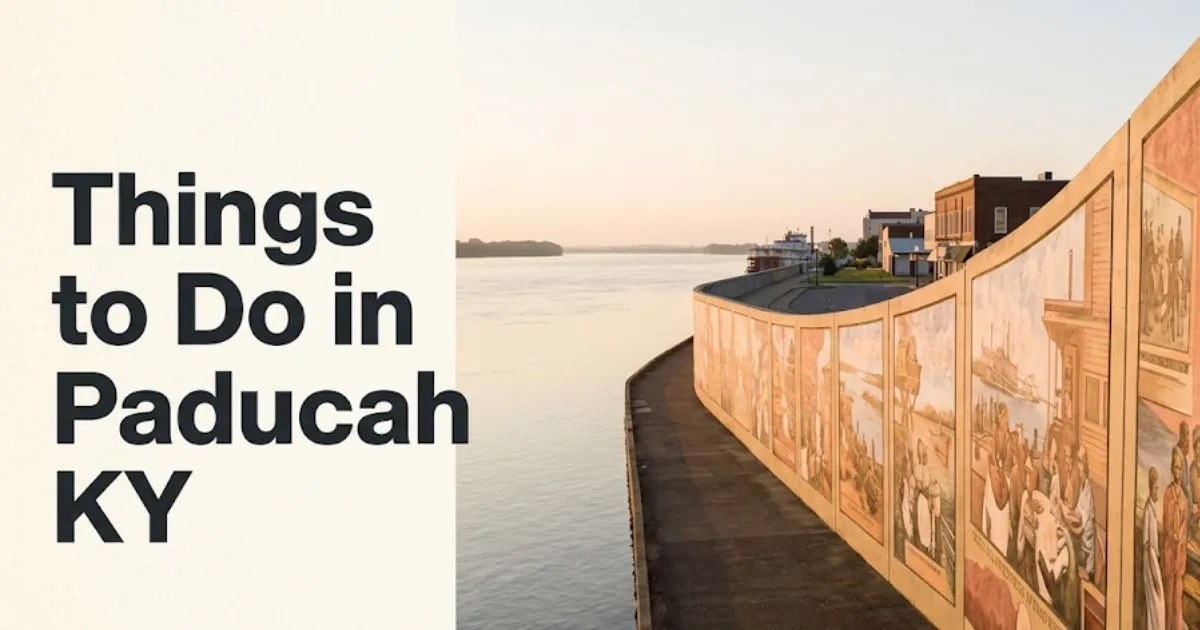
The Paducah floodwall murals line the city’s Ohio River floodwall along Water Street and constitute one of the most significant public art projects in the American Southeast.
The project, known formally as Paducah Wall to Wall, covers more than 50 panels depicting Paducah’s history, river culture, and community identity across a continuous painted surface that runs for more than a mile along the floodwall.
The murals are free to view at all hours. No entry required. The full walk covers approximately 1 mile end to end, though most visitors cover the most visually significant panels in a 45-minute circuit starting near the Convention Center.
Morning light, specifically between 7 and 10 a.m., produces the best photographic conditions. Afternoon sun creates glare and flat lighting on the south-facing panels.
The Paducah Riverfront adjacent to the murals includes a paved walking path, riverfront seating, and views of the Ohio River barge traffic. The river is not accessible for swimming; it is an active commercial waterway with dangerous currents.
Traveler profile notes:
- Families with children will find the mural walk engaging as a storytelling walk through Paducah’s history. The flat, paved surface is stroller-friendly.
- Seniors and accessibility travelers will find the riverfront path flat and accessible. Heat exposure is significant from June through August; plan for early morning or late afternoon visits.
- Budget travelers get significant visual payoff here at zero cost.
Seasonal note: The riverfront experience is considerably more pleasant from March through May and September through November. Summer midday visits involve significant heat and humidity with limited shade along the floodwall.
Key Takeaway: Walk the floodwall murals before 10 a.m., start at the northern end near the Convention Center, and plan 45 to 90 minutes depending on how long you stop to read the panel narratives.
Paducah KY History and Culture: Context That Makes the City Make Sense
Paducah’s history operates on a scale larger than its current population of roughly 27,000 suggests.
The city was established in 1827 by General William Clark of the Lewis and Clark Expedition. Its position at the Ohio and Tennessee River confluence made it a critical Union supply depot and strategic military target during the Civil War.
The Whitehaven Welcome Center mansion documents the domestic prosperity the river trade generated in Paducah’s 19th-century peak. The period rooms give concrete context for what the city looked like at the height of its commercial power.
The area’s atomic history adds a modern layer. The Paducah Gaseous Diffusion Plant, operated from 1952 until 2013, was one of three uranium enrichment facilities built during the Cold War arms buildup. It employed thousands of western Kentucky residents for six decades.
The cultural identity that most defines Paducah today grew from strategic civic investment rather than organic tourism growth. The artist relocation program launched in 2000 was a deliberate response to economic transition after the industrial base shifted. It worked.
According to the UNESCO Creative Cities Network, Paducah joined the network in 2013, becoming one of the first American cities recognized specifically for craft and folk art. The designation reflects both the museum infrastructure and the working artist community.
Traveler profile notes:
- History travelers should pair the Whitehaven tour with a visit to the Paducah Railroad Museum and the Wickliffe Mounds for a complete arc from prehistoric settlement through 20th-century industry.
- Senior travelers consistently engage most deeply with Paducah’s Cold War and river trade history, which is well-documented and accessibly presented throughout the city’s interpretive sites.
AQS QuiltWeek Paducah 2026: Who Should Go and How to Plan It
AQS QuiltWeek Paducah is one of the largest quilt events in the world, drawing tens of thousands of visitors to the Paducah Convention Center each April.
The American Quilters Society event fills the Convention Center with hundreds of competition quilts, vendor booths selling fabrics and tools, workshops led by master quilters, and special exhibitions. The scale consistently surprises first-time attendees.
For quilting enthusiasts, QuiltWeek is a pilgrimage-level event. For general travelers who are not deeply engaged with the craft, attending during QuiltWeek means paying significantly higher hotel rates and navigating a city running at capacity, with fewer reservations available at popular restaurants.
2026 planning logistics:
- Check the AQS website for confirmed 2026 QuiltWeek dates, typically held in late April.
- Book Paducah-area hotels immediately upon confirming your travel dates. Rooms within 15 miles of the city sell out 6 to 12 months in advance during QuiltWeek.
- If Paducah hotels are sold out, check accommodations in Murray, Kentucky (approximately 50 miles east) or Marion, Illinois (approximately 45 miles northwest) as practical overflow bases.
- Purchase QuiltWeek event tickets in advance through the AQS website. Day-of availability is unreliable during peak attendance years.
- Allow at least two full days if you intend to attend workshops, view the competition quilts, and browse the vendor floor comprehensively.
Traveler profile notes:
- Solo travelers attending QuiltWeek will find the event highly social. The quilting community is welcoming and conversation-rich throughout the convention floor.
- Couples where one partner quilts will find QuiltWeek logistically manageable if the non-quilting partner uses the time to explore Lower Town and the National Quilt Museum independently.
Key Takeaway: Book QuiltWeek 2026 accommodations at least 8 months in advance. The event is worth the planning effort for quilting enthusiasts but adds crowd and cost friction for general travelers visiting at the same time.
Paducah KY Outdoor Activities and Nature: What’s Realistic Within City Limits
Paducah’s own outdoor activity profile is honest and limited: the city is not an outdoor adventure destination within its own boundaries.
The Paducah Riverfront and floodwall walk provide the primary outdoor experience within the city. Bob Noble Park on Park Avenue and Stuart Nelson Park on the riverfront offer green space for casual recreation, picnicking, and river views.
The Ohio River at Paducah is strictly a viewing and boating resource. Swimming is not permitted and would be dangerous given the river’s commercial barge traffic and currents.
For kayakers and boaters, the Paducah boat ramps provide Ohio River access. Boat rentals are not reliably available within the city itself; visitors with their own kayaks or canoes have the most flexibility.
Bob Noble Park hosts youth sports fields, walking paths, and picnic areas. It is a genuine neighborhood park, not a tourist destination, but it provides useful green space for travelers who want outdoor time without driving.
The outdoor experience most Paducah visitors are actually seeking requires a day trip. Land Between the Lakes National Recreation Area, approximately 50 miles east, delivers the hiking, wildlife viewing, and water recreation that Paducah’s city limits cannot.
Traveler profile notes:
- Outdoor-first travelers should plan Paducah as a base for a Land Between the Lakes day trip rather than as a standalone outdoor destination.
- Families with active children will benefit from pairing the city’s arts activities with a half-day at Stuart Nelson Park’s riverfront area for open space and river views.
- Seniors will find the riverfront walk flat, paved, and comfortable in spring and fall conditions.
Land Between the Lakes Day Trip from Paducah: How to Do It Right
Land Between the Lakes National Recreation Area, managed by the USDA Forest Service, sits approximately 45 to 55 miles east of Paducah between Kentucky Lake and Lake Barkley.
The recreation area covers more than 170,000 acres of forested land, offers more than 200 miles of trails, and hosts the Golden Pond Planetarium and Observatory, the Elk and Bison Prairie, and the Homeplace 1850s Working Farm. No single day covers all of it.
To do a Land Between the Lakes day trip from Paducah correctly:
- Leave Paducah no later than 8 a.m. via the Purchase Parkway (KY-80) east, then US-68 toward Aurora and the LBL entrance.
- Enter at the Visitor Center near Golden Pond to get a current map and check which attractions are open for your 2026 visit.
- Start with the Elk and Bison Prairie on the north end for morning wildlife activity; bison and elk are most active in early morning hours.
- Drive the Trace (the main north-south highway through LBL) south to the Homeplace 1850s Working Farm for a living history experience that genuinely engages most age groups.
- Stop at Golden Pond Planetarium for a midday show if timing aligns; check the current show schedule in advance.
- Allow time for one short trail walk. The North/South Trail connector near the Visitor Center is accessible and manageable for most fitness levels.
- Return to Paducah by 6 p.m. for dinner with time to spare.
Traveler profile notes:
- Families with children get the most from this day trip. The Elk and Bison Prairie, Homeplace Farm, and nature center content genuinely engage children ages 5 and up.
- Seniors should note that the LBL Visitor Center and Homeplace Farm are accessible, but many trails involve uneven terrain.
According to the USDA Forest Service, a vehicle access fee applies to Land Between the Lakes. Fee amounts are subject to change; verify current rates on the LBL official website before visiting.
Key Takeaway: Land Between the Lakes requires a full day from Paducah; treat it as its own destination with a planned sequence rather than a casual detour.
Paducah KY Restaurants and Local Dining: Where Locals Actually Eat
Paducah’s restaurant scene is small, independent, and considerably better than its city size would predict.
Kirchhoff’s Bakery and Deli on Jefferson Street is Paducah’s most enduring independent food institution, operating since 1873. The breakfast and lunch deli format suits a mid-morning break from museum visits. Lines move efficiently even on busy weekends.
Freight House near the riverfront occupies a converted rail freight building and serves a menu that draws on regional ingredients. The space is visually distinct. Reservations are advisable on weekend evenings.
For casual lunch in the Historic Downtown, Paducah Beer Werks and Jasmine’s at the Market represent two ends of the spectrum: pub-format casual and market-fresh light fare, respectively.
The Grain Train Natural Foods Co-op on Jefferson Street serves as both a natural grocery and a deli counter. It is a legitimate local lunch option for vegetarian and dietary-specific travelers who may find the broader Paducah restaurant scene thin on those options.
The honest assessment: Paducah’s restaurant scene rewards wandering within the Historic Downtown and Lower Town corridors. It does not reward high expectations for late-night dining; most kitchens close by 9 p.m.
Traveler profile notes:
- Budget travelers will find Kirchhoff’s and the Beer Werks format significantly more cost-efficient than the sit-down dinner options along Jefferson Street.
- Couples will find Freight House the most appropriate dinner option for a genuine evening-out experience in Paducah.
- Solo travelers are well-served by the casual counter-service format at several Historic Downtown spots, where eating alone carries no awkwardness.
Insider Tip:
- Make Friday or Saturday dinner reservations at Freight House at least a week in advance during spring and fall travel seasons.
- The downtown restaurant concentration within a 4-block area means you can walk your options before deciding.
Paducah KY Craft Beer and Distilleries: The Beverage Scene Explained
Paducah’s craft beverage scene is modest in scale but genuine in character.
Paducah Brewing Company on Jefferson Street is the city’s primary craft brewery, offering a rotating tap list that leans toward approachable styles suited to the broad Paducah visitor demographic. The taproom format works for solo drinkers and groups equally.
Dry Ground Brewing provides a second craft brewery option in the Historic Downtown area, with a somewhat smaller tap rotation and a neighborhood-bar atmosphere that differs from Paducah Brewing’s larger space.
Both breweries are within easy walking distance of the National Quilt Museum and Historic Downtown, making an afternoon taproom visit a natural post-museum activity. Midweek visits offer a more relaxed experience; weekend afternoons can fill up during peak travel months.
Paducah does not currently have a dedicated distillery with a tasting room inside the city itself. Western Kentucky’s bourbon trail connections are more accessible from Bardstown (approximately 2.5 hours east) or Louisville (approximately 3 hours east) for travelers specifically seeking distillery experiences.
Traveler profile notes:
- Solo travelers will find both taprooms welcoming to solo visitors; bar seating is available and bartenders are typically knowledgeable about the local scene.
- Couples can use a taproom stop as a casual early-evening activity before dinner. Both spaces are comfortable for two.
- Budget travelers note that a taproom visit is one of the most cost-efficient adult social experiences in Paducah, with pints typically running well under regional city pricing.
Insider Tip:
- Ask about collaboration beers at both breweries; regional craft partnerships with other Kentucky and Tennessee breweries occasionally produce limited runs worth seeking out.
Paducah KY Free and Budget Activities: What You Can Do Without Spending Much
Paducah is one of the most budget-friendly arts-focused small cities in the American South.
Free activities that deliver genuine value:
- Paducah floodwall murals walk: Free at all hours. One of the most significant public art installations in the region.
- Lower Town Arts District browse: Free to walk and visit studios during open hours. Purchases are optional and never pressured.
- Paducah Riverfront walk: Free. Views of the Ohio River, barge traffic, and the riverfront park are accessible without any entry fee.
- Whitehaven Welcome Center exterior and grounds: Free as a Kentucky welcome center facility; tour pricing for the interior historic rooms applies.
- Market House Square: Free outdoor plaza. The surrounding Historic Downtown architecture is worth walking without spending anything.
- Bob Noble Park and Stuart Nelson Park: Free green spaces for walking, picnicking, and outdoor time.
Budget logistics:
The National Quilt Museum’s admission (approximately $12 to $16 per adult) represents the most significant single entry cost in the Paducah experience. For budget travelers, this admission is the one paid experience that consistently delivers value at its price point.
Dining costs in Paducah run meaningfully below comparable restaurant spending in Louisville, Nashville, or Memphis.
Traveler profile notes:
- Budget travelers can build a very satisfying Paducah day trip spending under $30 per person including the museum and a casual lunch.
- Families with children get significant free activity coverage from the murals walk, riverfront, and park access, which reduces the per-person cost of a family day considerably.
Key Takeaway: A full Paducah day costs less than an equivalent arts day in Louisville or Nashville; budget a range of $25 to $60 per person including the museum, lunch, and a taproom stop.
Paducah KY Family Activities and Things to Do With Kids
Paducah works for families but requires honest activity selection based on children’s ages.
For children ages 8 and up:
The National Quilt Museum engages older children better than most parents expect, particularly the large-scale competition quilts with complex geometric patterns. Frame it as “math art” and many kids engage genuinely.
The floodwall murals walk functions as a history lesson in outdoor format. The panel narratives cover Paducah’s river culture, Civil War history, and community stories. Children who engage with narrative respond well to this format.
Land Between the Lakes is the strongest family activity within easy driving range of Paducah. The Elk and Bison Prairie consistently delivers genuine wildlife encounters with bison and elk. The Homeplace 1850s Working Farm provides hands-on historical context that engages children significantly better than traditional museum formats.
For children under 8:
The city’s arts-heavy core activity profile is less consistently engaging for very young children. The riverfront parks, Stuart Nelson Park open space, and the outdoor mural walk provide the most appropriate pacing for young children’s attention spans.
The Paducah Railroad Museum on Washington Street, with its model train displays, engages train-interested children of most ages.
Practical family logistics:
- The Historic Downtown and riverfront are stroller-accessible on flat paved surfaces.
- Family-friendly restaurant options in Paducah are available but limited. Kirchhoff’s Bakery is the most reliably kid-comfortable lunch option near the museum district.
- Plan the National Quilt Museum for a morning visit when children’s energy is highest.
Traveler profile notes:
- Families with mixed-age children can divide the day: morning at the museum and Lower Town for older children and accompanying adults, afternoon at the riverfront and parks for younger children.
Best Time to Visit Paducah KY: Honest Seasonal Guidance
The best time to visit Paducah, Kentucky is April through early June or September through October.
| Season | Weather | Crowd Level | Highlights | Considerations |
|---|---|---|---|---|
| Spring (March to May) | Mild, 55 to 75°F typical | High in April (QuiltWeek), moderate otherwise | AQS QuiltWeek, blooming riverfront, optimal mural walk conditions | Book hotels 6 to 12 months ahead for QuiltWeek week |
| Summer (June to August) | Hot and humid, 85 to 95°F highs | Moderate | Riverfront events, outdoor festivals | Midday heat makes outdoor walks uncomfortable |
| Fall (September to November) | Mild, 55 to 75°F typical | Low to moderate | Fall color along the riverfront, comfortable outdoor conditions | Best value season for hotel rates |
| Winter (December to February) | Cold, 30 to 50°F typical | Low | Quiet, uncrowded, holiday events in December | Reduced hours at some attractions; verify before visiting |
Spring offers the optimal combination of comfortable outdoor temperatures and the city at its most active. Late September and October are Paducah’s quietest and most underrated travel months.
Summer heat in western Kentucky is genuine and humid. The floodwall murals walk and Lower Town studio browse become significantly less pleasant between 11 a.m. and 4 p.m. from June through August. Early morning visits mitigate this, but the seasonal reality is real.
The crowd reality during QuiltWeek: The city transforms completely during AQS QuiltWeek in late April. Hotels sell out. Restaurant waits lengthen. The energy is high and genuinely festive, but it is a different experience from off-season Paducah.
Traveler profile notes:
- Budget travelers will find the best hotel rates and most relaxed dining experience in September through October and January through February outside of holiday weekends.
- Seniors will find spring and fall significantly more comfortable than summer given the heat and humidity of western Kentucky summers.
Insider Tip:
- The week immediately after QuiltWeek (late April to early May) offers near-empty streets, residual exhibition content still running at the museum, and hotels returning to standard rates.
Paducah KY One Day Itinerary and Weekend Guide
A one-day Paducah itinerary covers the city’s essential core efficiently. A two-day weekend adds depth, a day trip, and the dining experiences the one-day version has to skip.
One-Day Paducah Itinerary:
- 8:00 a.m. Begin at the Paducah Riverfront for the morning-light mural walk along the floodwall. Allow 45 to 60 minutes. Bring water and wear comfortable shoes.
- 9:15 a.m. Walk north through Historic Downtown along Jefferson Street. Stop at Kirchhoff’s Bakery for breakfast before 10 a.m. when the morning rush clears.
- 10:00 a.m. Open your visit to the National Quilt Museum on Jefferson Street. Allow 1.5 to 2 hours. This is the centerpiece of the morning.
- 12:00 p.m. Walk or drive to Lower Town Arts District for the studio browse. Allow 1.5 to 2 hours for a thorough circuit of open studios. This is non-negotiable if you want to understand what Paducah actually is.
- 2:00 p.m. Lunch at a Historic Downtown option of your choice. Paducah Beer Werks for casual pub format; Jasmine’s at the Market for lighter fare.
- 3:00 p.m. Explore Market House Square and the surrounding Historic Downtown architecture. The square itself and the surrounding blocks repay a 45-minute walking survey.
- 4:30 p.m. Stop at Paducah Brewing Company or Dry Ground Brewing for a late-afternoon taproom visit. This is the most relaxed social hour in the city.
- 6:30 p.m. Dinner at Freight House near the riverfront. Reserve in advance.
Two-Day Weekend Addition:
Day 2: Dedicate to a Land Between the Lakes day trip. Leave by 8 a.m. Follow the sequence in the Land Between the Lakes section of this guide. Return to Paducah by 6 p.m. for a second dinner in the Historic Downtown.
Traveler profile notes:
- Couples should add a Market House Theatre evening performance if the 2026 season schedule aligns. Check the theatre’s 2026 season calendar before booking travel.
- Solo travelers can compress the one-day itinerary comfortably and use the evening for a longer taproom sit and conversation with locals.
- Families with children should move the Land Between the Lakes day trip to Day 1 when children’s energy is highest, and save the city’s arts itinerary for Day 2.
Safety and Practical Warnings for Paducah KY
Paducah is a low-risk travel destination with a few specific practical considerations worth knowing before arrival.
Key safety and practical facts every visitor should know:
- The Ohio River at Paducah’s waterfront is not a swimming resource. It is an active commercial barge route with unpredictable currents. Keep children away from unprotected riverbank edges.
- Summer heat is real. Western Kentucky’s July and August heat index regularly exceeds 95°F with high humidity. Outdoor activities including the mural walk should be planned before 10 a.m. or after 5 p.m. Carry water.
- Paducah has no meaningful public transit for visitors. A car is required for the Land Between the Lakes day trip, the Wickliffe Mounds visit, and any accommodation outside the walkable downtown core.
- Parking is free and plentiful in the Historic Downtown and Lower Town Arts District. There is no parking infrastructure challenge in Paducah comparable to larger cities.
- QuiltWeek hotel rates spike dramatically. Booking at standard rates for a QuiltWeek week stay is not possible without 6 to 12 months advance planning.
- Cell service in Land Between the Lakes is limited. Download offline maps before leaving Paducah for the LBL day trip. The Trace has extended stretches with weak signal.
Contact the Paducah Visitors Bureau at paducah.travel for current event information, attraction hours, and accommodation availability before finalizing 2026 travel plans.
Frequently Asked Questions About Things to Do in Paducah KY
What is Paducah Kentucky known for?
Paducah is known for the National Quilt Museum, AQS QuiltWeek, its UNESCO Creative City of Crafts and Folk Art designation, and the Lower Town Arts District.
The city’s position at the Ohio and Tennessee River confluence also defines its historic identity as a river trade center and Civil War strategic point.
Its artist relocation program, one of the first of its kind in the United States, has given the city a working creative community that sets it apart from similarly sized small cities in the region.
How many days do you need in Paducah KY?
Two days is the ideal length for a Paducah visit that covers the city’s core experience plus a Land Between the Lakes day trip.
One day covers the National Quilt Museum, Lower Town Arts District, the floodwall murals, and a good meal comfortably.
Three days allows for the full LBL day trip, the Wickliffe Mounds excursion, and a more relaxed pace through the city’s restaurants and taprooms.
Is Paducah KY worth visiting?
Paducah is worth visiting for travelers who appreciate arts culture, craft heritage, independent dining, and a genuinely distinctive small-city character.
It is not the right destination for travelers primarily seeking nightlife, major outdoor adventure within city limits, or theme-park-style entertainment.
For the right traveler profile, a Paducah weekend delivers outsized value relative to the cost and effort of getting there.
What is the best time of year to visit Paducah Kentucky?
The best time to visit Paducah is April through early June or September through October for comfortable outdoor temperatures and manageable crowds.
AQS QuiltWeek in late April is the city’s peak event and worth planning around if quilting is your interest, but it requires hotel reservations 6 to 12 months in advance.
Summer brings heat and humidity that limits outdoor activity comfort; winter offers low hotel rates but some attractions operate on reduced schedules.
Is the National Quilt Museum worth visiting even if I don’t quilt?
The National Quilt Museum is worth visiting for most travelers without quilting backgrounds because the works are displayed and curated as precision textile art rather than craft.
The scale and visual complexity of the competition quilts consistently reframe what non-quilting visitors expect.
Allow 1.5 to 2 hours and plan a weekday morning visit for the least crowded and most satisfying experience.
What are the best free things to do in Paducah KY?
The best free things to do in Paducah include the floodwall murals walk along the Ohio River waterfront, browsing the Lower Town Arts District studios, and walking the Paducah Riverfront path.
Market House Square and the Historic Downtown architectural streetscape are worth a walking survey at no cost.
Bob Noble Park and Stuart Nelson Park provide free green space and river views for travelers wanting outdoor time without driving to Land Between the Lakes.
Plan Your Paducah Visit With Confidence
Paducah rewards the traveler who does the planning. Book the National Quilt Museum in advance during spring and fall peak periods. Reserve Freight House for dinner on Friday or Saturday. If Land Between the Lakes is part of your plan, confirm current entry fees and attraction hours directly with the USDA Forest Service site before your 2026 trip.
Travel conditions, attraction hours, admission prices, and seasonal event schedules change. Verify key logistics directly with the Paducah Visitors Bureau at paducah.travel and with individual venues before you depart.
The single most useful action you can take before arriving: find out whether your visit overlaps with AQS QuiltWeek. That one fact determines everything from hotel availability to crowd levels and changes the entire character of the city for that week