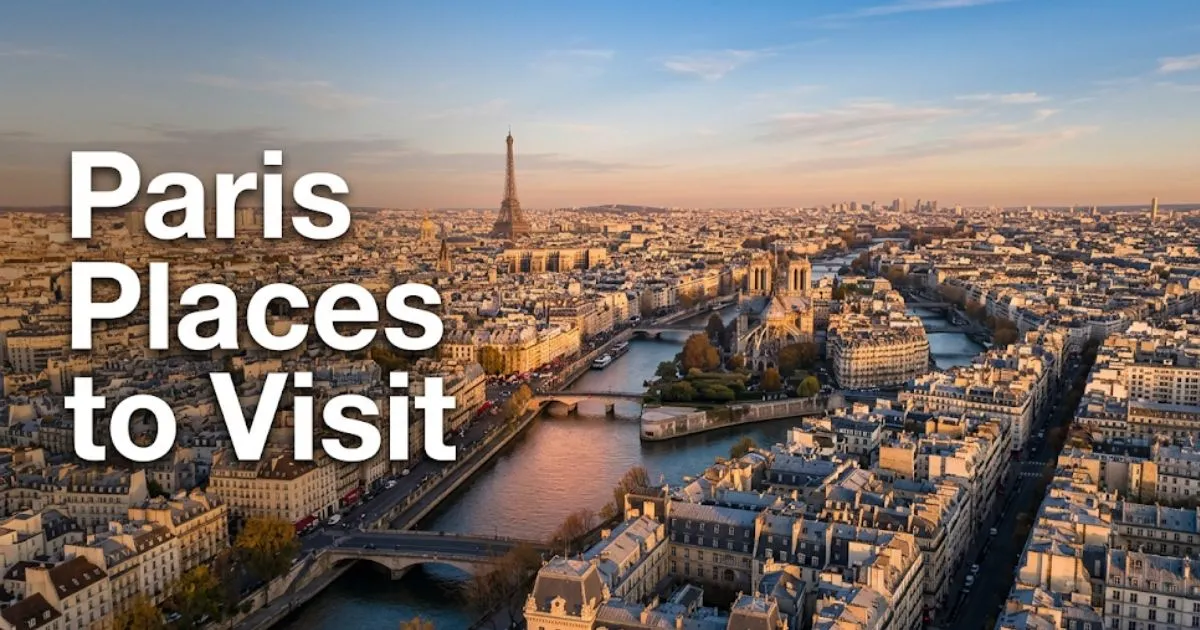
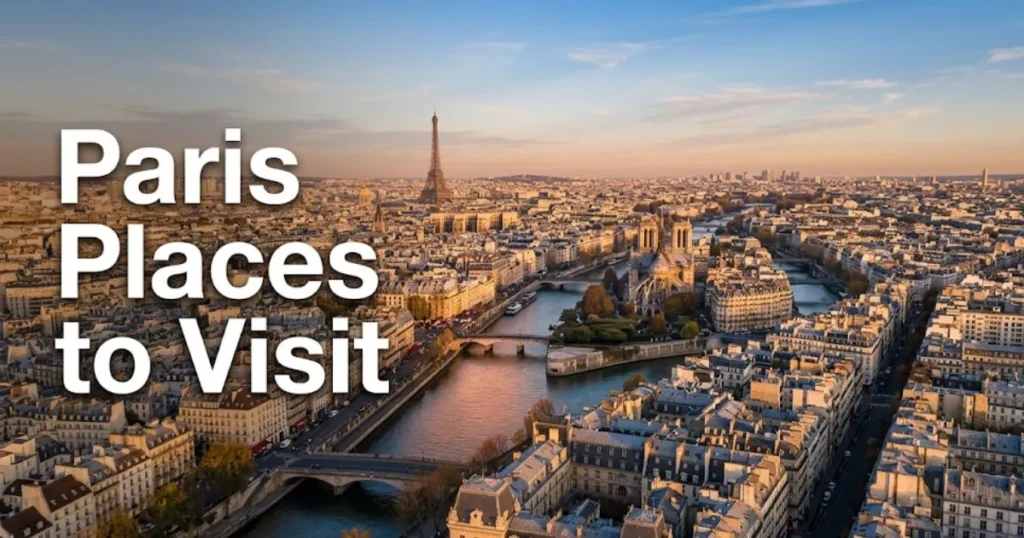
Paris Places to Visit: The Best 16 Spots to See in 2026

The best paris places to visit range from the world’s most visited art museum to quiet canal-side streets that most first-timers never find.
Paris holds more UNESCO World Heritage-recognized architectural and cultural landmarks per square kilometer than almost any other European capital. According to the Office du Tourisme et des Congrès de Paris, the city welcomed over 30 million visitors annually before 2020, a figure climbing steadily back toward those levels in 2025 and 2026.
This guide covers 16 specific places to see and visit in Paris, with honest crowd assessments, booking realities, neighborhood-by-neighborhood breakdowns, and practical logistics for every traveler type.
Paris Places to Visit: An Honest Overview of the City in 2026
Paris rewards travelers who plan ahead and penalizes those who arrive expecting to wing it.
The city is organized around 20 arrondissements, numbered 1 through 20, spiraling outward from the Louvre in the 1st. Knowing which arrondissement an attraction sits in tells you approximately how central, how crowded, and how expensive the surrounding area will be.
Paris in 2026 is more reservation-dependent than ever. The Louvre, Musée d’Orsay, Sainte-Chapelle, and Versailles all require advance timed-entry tickets. Arriving without them at peak times means wasted hours outside gates.
The city divides naturally into the Left Bank (south of the Seine, roughly the 5th, 6th, and 7th arrondissements) and the Right Bank (north of the Seine, covering most major landmarks). Neither side is comprehensively better. They simply have different characters.
Insider Tip:
- Buy a Navigo Découverte weekly Métro pass at any station if you are staying five or more days. It covers all zones and costs significantly less than individual tickets.
- Book museum timed-entry tickets a minimum of two weeks ahead for any April through October visit.
- For seniors and accessibility travelers: the Paris Métro has limited elevator access. Stations with full elevator service include Châtelet-Les Halles, Gare du Nord, and La Défense. Budget extra transfer time on mobility aid routes and verify elevator status directly with RATP before your trip.
Best Places to Visit in Paris: The Landmark Tier That Earns Its Reputation
The three Paris landmarks that genuinely earn every word written about them are the Eiffel Tower, Notre-Dame Cathedral, and Sainte-Chapelle.
The Eiffel Tower summit is worth doing once. But the experience most visitors remember is standing on the Trocadéro esplanade across the Seine, watching the tower’s hourly light show after dark. That view, from across the water, is the postcard. The summit itself is an elevator ride with a crowded observation deck.
Notre-Dame reopened in December 2024 after the 2019 fire. Access protocols and interior visit schedules continue to evolve as restoration phases complete. Verify current entry procedures directly with the Cathedral de Notre-Dame de Paris before your visit.
Sainte-Chapelle, tucked into the Île de la Cité just behind Notre-Dame, is the honest answer to “what is the single most visually extraordinary interior in Paris.” Its 15th-century stained glass covers nearly every wall surface. It is smaller than most visitors expect, which makes it more intimate and more powerful than any photographs suggest.
| Landmark | Best For | Advance Booking | Time Required | Crowd Peak |
|---|---|---|---|---|
| Eiffel Tower | Couples, first-timers | Required, 3+ weeks ahead | 2 to 3 hours | July to August, weekends |
| Trocadéro view | All profiles, free | None | 30 to 60 minutes | Evening light show times |
| Notre-Dame exterior | All profiles | Check current access | 30 to 45 minutes | Midday year-round |
| Sainte-Chapelle | Culture travelers, couples | Required | 45 to 90 minutes | Midday, spring/summer |
For budget travelers: The Trocadéro view of the Eiffel Tower is entirely free. The light show runs for several minutes at the top of each hour after dark. It costs nothing and delivers more than the summit view.
Places to Visit in Paris France: The Louvre and Musée d’Orsay Done Right
The Louvre Museum is the largest art museum in the world by floor area. Plan for a minimum of four hours.
Most first-timers spend two hours at the Louvre and leave having seen the Mona Lisa queue, the Winged Victory of Samothrace, and a hallway or two of Flemish paintings. That is a 10% experience of a museum that deserves a full day. Identify three or four specific collection wings before you arrive: the Richelieu Wing for French and Northern European art, the Denon Wing for Italian masters and Greek antiquities, the Sully Wing for Egyptian antiquities.
Admission to the Louvre runs approximately 17 euros per adult as of recent years, with free entry on the first Friday evening of each month for visitors under 26. Book timed-entry tickets through the Louvre’s official site. Verify pricing before your visit.
The Musée d’Orsay, housed in a converted 1900 railway station on the Left Bank, holds the world’s finest collection of Impressionist and Post-Impressionist art. Monet’s water lilies, Van Gogh’s self-portraits, and Renoir’s major canvases are all here. Admission runs approximately 16 euros per adult. Book timed-entry in advance.
Local alternative: Most visitors skip the Musée de l’Orangerie in the Tuileries Garden, which holds Monet’s massive eight-panel Water Lilies installation in purpose-built oval rooms. It is one of the most quietly powerful art experiences in Paris and has a fraction of the Orsay’s crowd level.
For families: The Louvre holds children’s attention unevenly. The Egyptian antiquities and Greek sculpture galleries typically engage children. The room-after-room painting galleries lose most kids under 10 within 30 minutes. The Musée de l’Orangerie is shorter and more immediately visual, making it better suited to families with young children.
Beautiful Places to Visit in Paris: Architecture and Neighborhoods That Define the City
The most consistently beautiful stretch of Paris is the walk from Île Saint-Louis east along the Seine’s Left Bank toward the Musée d’Orsay.
Île Saint-Louis, the smaller of Paris’s two central islands, is essentially unchanged in architectural character from the 17th century. It has no major museums and no landmark attractions. What it has is Haussmann-era apartment buildings, one main street (Rue Saint-Louis en l’Île) lined with cheese shops and ice cream counters, and a quiet that feels impossible given how central it sits in the city.
The Palais-Royal gardens, just north of the Louvre in the 1st arrondissement, are another genuinely beautiful space that most first-timers walk past without entering. The arcaded galleries enclosing the garden house independent boutiques, galleries, and one of the best-located quiet lunches in the city.
For couples: Île Saint-Louis at dusk, followed by dinner in the 4th arrondissement’s quieter streets east of Place des Vosges in Le Marais, delivers more romantic atmosphere than anything in the tourist-heavy restaurant corridors near the Champs-Élysées.
Insider Tip:
- The bouquiniste booksellers along the Seine’s Left Bank (between Pont Royal and Pont de Sully) are one of Paris’s most specific experiences. Green wooden stalls selling antique prints, old Paris maps, and secondhand books. Free to browse. A genuinely local Paris ritual.
- The best light in Paris for photography is the 45 minutes after sunrise over the Seine near Pont des Arts. Zero crowds. Clean light. No tour groups.
Key Takeaway: Book Louvre and Musée d’Orsay timed-entry tickets at least two weeks before your Paris arrival date. Walk-in access is increasingly difficult and sometimes impossible at peak periods.
Best Places to Visit in Paris for First-Timers: A 2-Day Starting Framework
First-time visitors to paris places to visit most need a logical geographic sequence, not a ranked list of attractions.
Paris’s major landmark sites cluster by geographic zone. Visiting them in geographic order eliminates backtracking and lets you experience the neighborhoods connecting them rather than spending the day on the Métro.
Suggested 2-Day First-Timer Framework:
Day 1: Right Bank Core
- Start at Trocadéro at 8:00 AM for the Eiffel Tower view before crowds arrive.
- Cross Pont d’Iéna to Champ de Mars for the base perspective.
- Take Métro Line 9 east to Alma-Marceau and walk north to the Arc de Triomphe on Avenue Kléber.
- Walk the Champs-Élysées east toward Place de la Concorde (treat it as a connecting walk, not a destination).
- Enter the Tuileries Garden through the western gate for a midday rest.
- Spend afternoon at the Louvre (booked in advance, 3 to 4 hours minimum).
- Walk north to Palais-Royal gardens at dusk.
- Dinner in the 1st or 3rd arrondissement.
Day 2: Left Bank and Islands
- Morning at Musée d’Orsay (booked in advance, open from 9:30 AM most days).
- Walk through Saint-Germain-des-Prés to Café de Flore or Les Deux Magots for midmorning coffee.
- Cross to Île de la Cité for Notre-Dame (verify current access) and Sainte-Chapelle (booked in advance).
- Walk east across Île Saint-Louis for lunch on Rue Saint-Louis en l’Île.
- Afternoon in Le Marais: Place des Vosges, Rue des Rosiers, Musée Picasso if time permits.
- Evening: Return to Trocadéro for the Eiffel Tower light show after dark.
Paris Landmarks Every Visitor Should Know: Beyond the Top Five
The Arc de Triomphe at the top of the Champs-Élysées is one of Paris’s six most recognized landmarks and one of its most underestimated viewpoints.
The summit of the Arc gives a 360-degree view of Haussmann’s radiating boulevard design. Twelve avenues spoke outward from the central roundabout. From above, the geometric logic of Paris’s urban design becomes immediately clear. Admission runs approximately 13 euros per adult. Verify current pricing.
Père Lachaise Cemetery in the 20th arrondissement is consistently underrated. It is the largest cemetery in Paris and the burial site of Oscar Wilde, Jim Morrison, Frédéric Chopin, Marcel Proust, and Édith Piaf. It functions as both a historical archive and a remarkably quiet green space.
For solo travelers: Père Lachaise is an excellent solo afternoon. It is safe, interesting, navigable with a printed map available at the main entrance gate, and genuinely off the primary tourist circuit.
The Centre Pompidou in the 4th arrondissement holds Europe’s largest collection of modern and contemporary art. Its inside-out architectural structure — with exposed structural systems painted in primary colors on the exterior — is as distinctive as anything inside. The permanent collection is free on the first Sunday of each month. Verify current free-access days before visiting.
Local alternative to the Champs-Élysées: The Rue du Faubourg Saint-Honoré (8th arrondissement) offers comparable luxury retail in a narrower, more walkable format. For a genuinely Parisian shopping experience, the Marché d’Aligre in the 12th arrondissement (open Tuesday through Sunday mornings) is where restaurant chefs and neighborhood residents shop alongside each other at outdoor produce stalls and a covered antique market.
Best Paris Neighborhoods to Explore: Arrondissement by Arrondissement
The six Paris neighborhoods most worth dedicating time to are Le Marais, Montmartre, Saint-Germain-des-Prés, Canal Saint-Martin, Bastille/Oberkampf, and Belleville.
| Neighborhood | Arrondissement | Best For | Walk Time | Crowd Level |
|---|---|---|---|---|
| Le Marais | 3rd and 4th | History, art, LGBTQ+ culture, Jewish heritage | 2 to 3 hours | High, peak season |
| Montmartre | 18th | Views, bohemian history, Sacré-Cœur | 2 to 4 hours | Very high, midday |
| Saint-Germain-des-Prés | 6th | Café culture, bookshops, gallery streets | 1 to 2 hours | Moderate to high |
| Canal Saint-Martin | 10th | Local Parisian life, independent shops | 1.5 to 2 hours | Low to moderate |
| Bastille/Oberkampf | 11th | Nightlife, restaurants, wine bars | Evening focus | Moderate |
| Belleville | 20th | Street art, Chinatown, views | 1 to 2 hours | Low |
Le Marais is the richest single neighborhood for first-time visitors. The Place des Vosges, Paris’s oldest planned square dating to 1612, anchors the south end. The Rue des Rosiers cuts through the historic Jewish quarter. The Musée Picasso occupies a 17th-century mansion on Rue de Thorigny.
Montmartre is the most photographed neighborhood and the one most damaged by its own fame. Place du Tertre — the square below Sacré-Cœur where artists traditionally displayed work — is now almost entirely occupied by portrait artists targeting tourists. The real Montmartre is the streets east of the Sacré-Cœur: Rue Lepic, Rue Abbesses, and the vineyard on the hillside that still produces actual wine.
Canal Saint-Martin in the 10th is what most visitors imagine when they picture “local Paris.” A tree-lined canal with iron footbridges, independent coffee roasters, record shops, and bookstores. Zero major landmarks. Entirely worth an afternoon.
Key Takeaway: Canal Saint-Martin gives you a truer experience of how Paris residents actually live than any attraction in the 1st or 7th arrondissements.
Top Paris Museums Worth Visiting: Honest Rankings by Experience Quality
The Musée d’Orsay delivers the highest return on time invested of any Paris museum for most visitors.
Its collection is specifically focused (Impressionism and Post-Impressionism, 1848 to 1914), its building is extraordinary, and its scale is human enough to absorb meaningfully in three to four hours. The Musée du Louvre is more historically significant but demands a longer commitment to experience properly.
Musée Rodin in the 7th arrondissement occupies the Hôtel Biron, Rodin’s former studio and residence. The sculpture garden behind the house holds “The Thinker,” “The Gates of Hell,” and Rodin’s study for the Burghers of Calais. Garden-only admission costs approximately 4 euros. Full museum admission runs approximately 14 euros. Both are among the best-value experiences in the city.
For budget travelers: The Musée de Cluny (National Museum of the Middle Ages) in the 5th arrondissement charges modest admission and holds the original Lady and the Unicorn tapestry series, one of the most extraordinary surviving medieval textiles in Europe. It is one of the most overlooked major collections in the city.
Insider Tip:
- The Paris Museum Pass (2, 4, or 6 consecutive days) covers the Louvre, Musée d’Orsay, Versailles, Sainte-Chapelle, Arc de Triomphe, Musée Rodin, Centre Pompidou, and most other major museums. It includes timed-entry queue priority at some sites.
- Purchase the Museum Pass before you leave the US through Atout France-affiliated booking partners to avoid on-site queues.
- For seniors: the Musée Rodin garden is largely flat and accessible. The Louvre has elevator access to all floors from the main pyramid entrance. Call ahead to confirm specific gallery elevator status.
Fun Places to Visit in Paris for All Interests
Père Lachaise Cemetery, the Canal Saint-Martin canal walk, and a Seine River evening cruise represent three of the most genuinely enjoyable Paris experiences for visitors who have already checked off the primary landmarks.
A Bateaux-Mouches cruise on the Seine costs approximately 15 to 20 euros per adult and runs 70 minutes. The evening departure, after the monuments light up, offers a different view of the city than any walking itinerary provides. It is one of the few classic Paris tourist experiences that consistently delivers on its promise.
For families with children: The Jardin d’Acclimatation in the Bois de Boulogne (16th arrondissement) is a family amusement park and garden that has operated since 1860. It has rides, a puppet theater, a farm area, and open lawns. It is the most reliably child-friendly afternoon in Paris for families with children under 12.
The Luxembourg Gardens in the 6th arrondissement are free to enter and home to the famous Luxembourg toy sailboats (wooden boats available to rent and sail on the central octagonal pond). Children have been doing this here for generations. It is a more memorable Paris afternoon for a 7-year-old than most museum visits.
For solo travelers: The Rue Mouffetard market street in the 5th arrondissement runs through one of the oldest continuously inhabited areas of Paris. Saturday and Sunday mornings bring produce vendors, cheese counters, and boulangerie queues that are a genuinely local Paris experience. Solo dining at the street food counters on Rue Mouffetard is entirely comfortable and unpretentious.
Cool Places to Visit in Paris Off the Main Tourist Trail
The most distinctively Parisian experiences are in neighborhoods that rarely appear in standard first-timer guides.
Belleville in the 20th arrondissement is where a large Parisian Chinese community, a thriving street art scene on Rue Dénoyez, and one of the best free city viewpoints in Paris (from Parc de Belleville) all exist within a 20-minute walk. It appears on almost no standard tourist itinerary. That is its primary recommendation.
Rue Dénoyez specifically: a one-block alley off Boulevard de Belleville where the entire street surface, every building, every doorway is covered in layers of street art. It changes constantly. It is one of the most visually dense single blocks in Paris.
The Passage des Panoramas in the 2nd arrondissement is one of Paris’s 19th-century covered arcades. These glass-roofed shopping passages were the world’s first shopping malls. Passage des Panoramas is the oldest surviving example (1800). It now holds philatelists, antique print dealers, and bistro tables. Free to enter. Almost nobody’s standard itinerary includes it.
For budget travelers: The Buttes-Chaumont Park in the 19th arrondissement is where Paris residents actually spend Sunday afternoons. It has a lake, a rocky island accessible by bridge, a working café, and sloping lawns. It is larger than Luxembourg Gardens, less crowded, and completely free. It functions as the honest local alternative to the tourist-weighted park scene in the central arrondissements.
Key Takeaway: Buttes-Chaumont Park on a Sunday afternoon is the most accurate window into how Paris residents actually live and spend leisure time. It requires zero admission and a single Métro stop from central Paris.
Paris Places to Visit for Couples: Romantic Experiences That Earn the Label
The most genuinely romantic Paris experience is not the Eiffel Tower elevator. It is a slow dinner at a traditional bistro in the 11th arrondissement on a Tuesday evening.
Septime on Rue de Charonne in the 11th is the restaurant that most experienced Paris travelers identify as the city’s most consistently rewarding contemporary bistro experience. It books out weeks in advance. Make reservations the moment they open (typically 30 days out, on the restaurant’s own booking platform). The tasting menu format is ideal for couples.
For couples who want the landmark experience done correctly: the Eiffel Tower light show viewed from Trocadéro at 10:00 PM in summer is one of Paris’s genuinely romantic moments. It is free. It requires no advance booking. It delivers every time.
Le Marais’s Place des Vosges at mid-morning, before tour groups arrive, is the second most romantic space in Paris after the Seine riverbanks at dawn. The covered arcades hold galleries and one excellent café (Ma Bourgogne, under the north arcade, has served wine and steak tartare under those arches since 1954).
Honest note for couples: The Champs-Élysées dinner corridor near the Arc de Triomphe is almost entirely tourist-oriented restaurants with inflated prices and average food. The romantic Paris restaurant scene is concentrated in the 6th, 7th, 10th, 11th, and 12th arrondissements, not the 8th.
Insider Tip:
- The wine bar Le Verre Volé on Rue de Lancry, directly adjacent to Canal Saint-Martin, serves natural wines by the glass and casual plates. It is where Parisian couples eat on weekday evenings. No reservation required for bar seating.
- A Batobus river shuttle pass allows couples to travel between eight Seine-side stops (including Musée d’Orsay, Notre-Dame, and the Eiffel Tower) by boat across multiple days. More atmospheric than the Métro.
Paris Places to Visit With Kids: Honest Guidance for Families
Paris with children requires different planning from Paris with adults. The good news: several genuinely excellent family experiences exist here.
Cité des Sciences et de l’Industrie in the 19th arrondissement (at Parc de la Villette) is a hands-on science museum built specifically for children. It holds an IMAX dome, a planetarium, and interactive science exhibits. It is consistently rated the best children’s museum in France. Budget approximately a half-day.
Parc de la Villette surrounding the Cité des Sciences is enormous and free to enter. It has open lawns, playgrounds, a canal, and enough space for children to run. On weekends in summer, it frequently hosts outdoor cinema screenings and free events. Verify the seasonal program with the Parc de la Villette website before visiting.
For families with children under 6: The Luxembourg Gardens toy sailboat pond and the Jardin des Plantes (the national natural history museum complex in the 5th, which includes a zoo, a vivarium, and multiple natural history galleries) are more appropriate than any major art museum. The Jardin des Plantes zoo is compact and walkable in two to three hours.
Honest assessment: The Louvre is genuinely difficult with children under 8. The Egyptian antiquities wing holds some interest. Every other major gallery requires sustained adult attention spans. Do not plan the Louvre as a family centerpiece unless your children have demonstrated genuine museum engagement at home.
For stroller navigation: The 1st and 4th arrondissements have the most cobblestone concentration. The Marais cobblestone streets require good stroller tires. The Canal Saint-Martin area in the 10th is almost entirely flat pavement and significantly easier to navigate with a stroller or mobility aid.
Paris Places to Visit on a Budget: What’s Free and What’s Worth Paying For
Paris on a budget is more achievable than most travel content acknowledges. The city’s free outdoor experiences are among its most memorable.
Free places to visit in Paris:
- Trocadéro esplanade (Eiffel Tower view): free, any time
- Champ de Mars (Eiffel Tower base area): free park, open daily
- Canal Saint-Martin canal walk: free, bring a picnic from a boulangerie
- Buttes-Chaumont Park: free, 19th arrondissement
- Luxembourg Gardens: free to enter (small rental charge for toy sailboats)
- Palais-Royal gardens: free, central location
- Père Lachaise Cemetery: free entry (maps available at the main gate)
- Seine riverbank walks: the Left Bank between Pont Royal and Pont de Sully is a UNESCO-designated riverbank
- Sacré-Cœur Basilica interior: free (funicular to the hill costs a standard Métro fare)
- Notre-Dame exterior and square: free (verify current interior access separately)
- Marché d’Aligre: free to browse (12th arrondissement, Tuesday through Sunday mornings)
According to the Office du Tourisme et des Congrès de Paris, the first Sunday of each month provides free entry to the permanent collections of the Louvre, Musée d’Orsay, and Centre Pompidou. These free Sundays are extremely crowded. Arrive at opening time.
For budget travelers staying longer than five days: The Navigo Découverte weekly Métro pass offers the best per-trip cost. A standard carnet (10-ticket booklet) is the second-best option. Avoid individual tickets if making more than four trips per day.
Key Takeaway: Paris’s free outdoor circuit — Trocadéro, Champ de Mars, Canal Saint-Martin, Buttes-Chaumont, the Seine riverbank walk — delivers as much genuine Paris atmosphere as any paid museum, particularly in spring and early fall.
Best Viewpoints and Outdoor Spaces in Paris
The best free viewpoint in Paris is the Sacré-Cœur esplanade in Montmartre, looking south over the entire city.
The best paid viewpoint — better than the Eiffel Tower summit for actual panoramic comprehension — is the roof of the Institut du Monde Arabe in the 5th arrondissement, which is less consistent in public access and should be verified before visiting. The Arc de Triomphe rooftop provides a uniquely geometric view of Haussmann’s boulevard design.
Parc de Belleville in the 20th arrondissement holds an underused terraced viewpoint looking west across the city toward the Eiffel Tower. No admission charge. No tour groups. Locals walking dogs and pushing strollers.
For outdoor enthusiasts: The Bois de Vincennes on the eastern edge of Paris (12th arrondissement) is larger than Central Park. It has a lake for rowing, cycling paths, a château, a Buddhist temple, and the Parc Floral de Paris, which holds seasonal garden exhibitions. It is almost entirely absent from standard tourist guides.
For couples: The Pont des Arts pedestrian bridge near the Institut de France was famous for “love locks” that were removed in 2015 for structural safety reasons. The bridge remains a pleasant crossing with a clear Eiffel Tower view. The real romantic outdoor experience in Paris is a bottle of wine purchased at a Nicolas wine shop (a reliable French chain) enjoyed on the steps of the Pont de la Tournelle overlooking Île Saint-Louis at dusk.
Seasonal note: Paris parks are at their best from mid-April through June, when chestnut trees bloom along major boulevards and the Luxembourg Gardens rose garden opens. July and August bring heat. Most parks remain open and pleasant in September and October, when crowds thin and temperatures drop to the most comfortable range.
Paris Food Markets and Culinary Experiences
The two Paris food markets that most reliably deliver a genuine experience are Marché d’Aligre in the 12th arrondissement and Marché des Enfants Rouges in the 3rd.
Marché d’Aligre (Tuesday through Sunday mornings, closing around 1:00 PM) combines an outdoor produce market with the covered Marché Beauvau inside, which holds specialist cheese, charcuterie, olive oil, and wine stalls. It is the market where professional cooks and neighborhood residents shop. Prices are consistently lower than tourist-facing markets.
Marché des Enfants Rouges in the 3rd arrondissement is Paris’s oldest covered market (operating since 1628). It holds food stalls serving Lebanese, Japanese, Moroccan, and French dishes alongside produce vendors. Lunch here on a Saturday is one of the most genuinely enjoyable midday experiences in the city.
Rue Mouffetard in the 5th arrondissement is a medieval market street that still functions as a daily food shopping destination. Fromageries, boucheries, boulangeries, and wine shops line the cobblestone descent. Saturday and Sunday mornings are the most active. It is excellent for a walking breakfast or picnic assembly.
For budget travelers: Assembling a picnic from any of these markets and eating in Luxembourg Gardens or Champ de Mars costs a fraction of a sit-down restaurant lunch and delivers a more authentic Paris afternoon.
Honest assessment of tourist-area restaurants: Restaurants within 200 meters of the Eiffel Tower, the Louvre, and the Champs-Élysées are, as a category, significantly less rewarding per euro than neighborhood bistros in the 10th, 11th, and 12th arrondissements. Price does not reflect quality in Paris’s tourist dining corridors. It reflects location rent.
Insider Tip:
- Le Verre Volé (10th arrondissement, Rue de Lancry) for natural wine and cheese plates.
- Café de la Nouvelle Mairie (5th arrondissement, Rue des Fossés Saint-Jacques) for an honest weekday lunch prix fixe at a genuinely local café.
- For solo travelers: counter seating at a traditional French brasserie is entirely normal and comfortable. Most brasseries along Boulevard Saint-Germain have counter seats where solo dining is common and unpressured.
Paris Day Trips and Practical Logistics
The single most rewarding Paris day trip is the Palace of Versailles (Château de Versailles), 30 to 40 minutes from Paris Montparnasse or Paris Saint-Lazare by RER C train.
Versailles requires advance timed-entry booking. The main palace, the Hall of Mirrors, and the Grand and Petit Trianon estates are each separately ticketed for some access combinations. Purchase a combined ticket through the official Château de Versailles booking platform before arrival. The gardens are free to enter outside of their choreographed fountain shows (Les Grandes Eaux Musicales), which run on specific dates spring through fall and carry an additional admission charge.
Claude Monet’s House and Gardens at Giverny (approximately 1.5 hours from Paris Gare Saint-Lazare by train plus shuttle bus) holds the actual garden and Japanese footbridge that Monet painted. It is seasonal, typically open April through October. Book ahead during peak season. Verify 2026 opening dates through the Fondation Claude Monet website.
Reims, approximately 45 minutes from Paris Gare de l’Est by TGV, holds the coronation cathedral of French kings and the Champagne house cellars of Moët et Chandon, Taittinger, and Veuve Clicquot, all offering guided cellar tours and tastings. Reserve cellar tours in advance.
For seniors and accessibility travelers: Versailles gardens cover enormous distances. Electric golf carts are available for rent within the garden grounds. Verify current rental availability and accessibility routes directly with Château de Versailles before booking.
Practical logistics summary for Paris 2026:
- Airport transfer from CDG: RER B train to central Paris, approximately 35 minutes, roughly 12 to 15 euros per person. Verify current pricing.
- Getting around Paris: Métro is the fastest. Batobus for scenic river transit. Walking is essential for neighborhood exploration.
- Currency: Euros. Credit cards accepted almost universally in Paris. ATMs widespread.
- Language: Basic French greetings are appreciated. Most Paris tourism infrastructure operates in English.
- Emergency contacts: 15 (medical emergency), 17 (police), 18 (fire), 112 (pan-European emergency number).
Safety and Practical Warnings for Paris Visitors
Pickpocket risk in Paris is real and concentrated at specific locations. It should not deter anyone from visiting but it requires specific awareness.
Key safety and practical facts every visitor should know:
- Eiffel Tower approach and Trocadéro: pickpocket teams operate here in high concentrations. Keep bags zipped and worn across the body.
- Sacré-Cœur steps and funicular area: another high-concentration zone for organized pickpocket groups and aggressive petition-signing solicitations.
- Métro Line 1 (running the tourist corridor from La Défense to Vincennes through central Paris): elevated pickpocket risk, particularly at Châtelet-Les Halles interchange.
- Champs-Élysées at night: generally safe but poorly lit side streets west of the avenue warrant normal urban awareness.
- Tap water is safe to drink throughout Paris. Requesting “une carafe d’eau” at any restaurant gets you free tap water. Restaurants are legally required to provide it.
- Heat: older Paris buildings, including most budget hotels, lack air conditioning. July and August heat waves have reached 40°C (104°F) in recent years. If visiting in summer, verify hotel air conditioning before booking.
- Notre-Dame and major construction zones: active cathedral restoration means variable pedestrian access near Île de la Cité. Check current access maps before visiting the area.
Contact the US Embassy in Paris for passport emergencies and consular services. The embassy is located on Avenue Gabriel in the 8th arrondissement.
Frequently Asked Questions About Paris Places to Visit
What are the best places to visit in Paris for first-time visitors?
The best places to visit in Paris for first-timers are the Eiffel Tower (viewed from Trocadéro), the Louvre, Musée d’Orsay, Sainte-Chapelle, Le Marais neighborhood, and the Seine riverbank walk between Pont Royal and Notre-Dame.
These six experiences cover Paris’s most rewarding landmarks, its finest art museum concentration, and its most walkable historic neighborhood.
Book timed-entry tickets for the Louvre, Musée d’Orsay, and Sainte-Chapelle before arrival. Walk-in access at peak times is limited.
How many days do you need to see the main places in Paris?
Five to seven days is the honest minimum to see Paris’s main places without rushing.
Three days covers the primary landmarks and one or two museums but leaves no time for neighborhoods, day trips, or the slower-paced café and market culture that defines the city.
Seven days allows two museum days, two neighborhood days, one day trip to Versailles, and two unscheduled days for the spontaneous Paris experiences that most visitors remember most.
What places in Paris are free to visit?
Many of Paris’s best places are free, including the Trocadéro Eiffel Tower view, Champ de Mars, Luxembourg Gardens, Père Lachaise Cemetery, Palais-Royal gardens, Canal Saint-Martin, Buttes-Chaumont Park, and the Sacré-Cœur Basilica interior.
The first Sunday of each month provides free access to the permanent collections of the Louvre, Musée d’Orsay, and Centre Pompidou.
Verify current free-Sunday eligibility and capacity limits through each museum’s official website, as reservation requirements even for free-entry days have increased.
What is the best time of year to visit Paris?
The best time to visit Paris is April through early June and September through mid-October.
Spring brings mild temperatures, long days, and shoulder-season crowds at major attractions. Early fall offers the most comfortable temperatures and the most active restaurant scene as Parisians return from August holidays.
July and August bring peak tourist crowds, higher hotel prices, and heat in buildings without air conditioning. Many traditional Parisian restaurants close for August.
Which Paris neighborhoods are worth exploring on foot?
The six Paris neighborhoods most worth exploring on foot are Le Marais, Montmartre, Saint-Germain-des-Prés, Canal Saint-Martin, the Bastille/Oberkampf area, and Belleville.
Le Marais and Saint-Germain are most compact and easiest to combine in a single walking day. Canal Saint-Martin and Belleville are adjacent and together form the best “local Paris” half-day for repeat visitors.
Montmartre requires the most physical effort due to the hill and steep streets. Seniors should budget extra time and consider the funicular for the ascent.
Do you need to book tickets in advance for Paris attractions?
Yes. The Louvre, Musée d’Orsay, Sainte-Chapelle, the Eiffel Tower summit, and the Palace of Versailles all require advance timed-entry tickets, particularly for visits between April and October.
Booking two to three weeks ahead is the minimum recommended lead time for peak season. Some popular time slots at the Louvre and Versailles sell out further in advance than that.
The Paris Museum Pass provides access to most major museums and can reduce queue time at some sites. Purchase it before departure or at official Paris tourist office locations.
Plan Your Paris Trip With Confidence
Paris rewards planning. Book timed-entry for the Louvre, Musée d’Orsay, and Sainte-Chapelle before anything else. Those three booking decisions shape the entire itinerary framework.
Beyond the landmarks, Paris’s real character lives in neighborhoods like Canal Saint-Martin, markets like Marché d’Aligre, and bistros in the 11th that no tourism board press release will name. Spend at least one full afternoon off the primary tourist circuit.
Travel conditions, admission prices, museum hours, and entry requirements change. Verify key logistics with the Office du Tourisme et des Congrès de Paris and individual attraction websites before departure. The reader who books smart, moves by neighborhood rather than by attraction list, and eats where the restaurant staff are speaking French to each other will have a Paris trip that earns every superlative the city has accumulated.