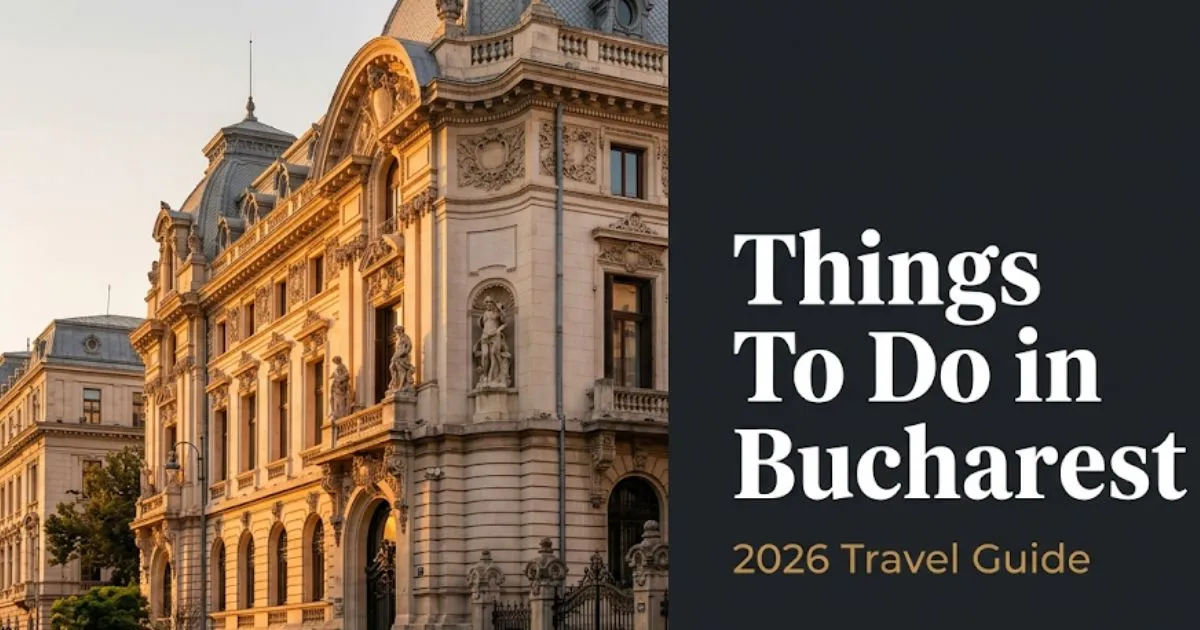
Things To Do in Bucharest: The 2026 Travel Guide

The things to do in Bucharest extend far beyond its communist-era monuments. Romania’s capital pairs art nouveau palaces, one of Europe’s most affordable dining scenes, and a nightlife culture that regularly draws international attention.
Bucharest sits inside the European Union but outside the eurozone. The Romanian leu exchange rate makes it significantly more affordable than Vienna, Prague, or Budapest for equivalent experiences.
This guide covers 15 specific topic areas. Each one gives you named places, honest crowd assessments, practical logistics, and traveler-profile guidance to build your actual itinerary.
Things To Do in Bucharest
Bucharest offers a genuine mix of communist-era architecture, interwar art nouveau, outdoor parks, and a café culture rivaling much of Western Europe. The city’s character is impossible to reduce to one experience.
The Palace of the Parliament, the Village Museum in Herastrau Park, and the Calea Victoriei boulevard form the backbone of any first visit. Around these anchors, the neighborhoods of Floreasca and Dorobanți provide the local life that sustains Bucharest beyond its monuments.
Cismigiu Garden, in the city center near the old university district, remains one of the most overlooked urban green spaces in Eastern Europe. It functions as Bucharest’s true public living room on weekend mornings.
Budget travelers find Bucharest especially rewarding. A full day of sightseeing including museum admission, two sit-down meals, and metro travel typically costs a fraction of comparable days in Western European capitals.
| Activity | Best For | Cost Range | Time Required | Insider Note |
|---|---|---|---|---|
| Palace of Parliament tour | History enthusiasts, couples | ~$12–$20 per adult | 1.5 to 2 hours | Advance booking required in peak season |
| Village Museum | Families, culture travelers | ~$5–$8 per adult | 2 to 3 hours | Monday closures apply |
| Calea Victoriei walk | All profiles | Free | 1.5 to 2 hours | Best in morning before heat |
| Herastrau Park cycling | Families, solo travelers | ~$5–$10 for bike rental | 2 to 3 hours | Lakeside circuit is flat and accessible |
| Centrul Vechi nightlife | Solo travelers, couples | Variable | Evening | Friday/Saturday crowds are extreme |
| Văcărești Nature Park | Nature seekers, solo travelers | Free | 1.5 to 2 hours | Undervisited; bring a map |
| Cismigiu Garden | Seniors, families | Free | 1 hour | Best on weekday mornings |
Best Things To Do in Bucharest Romania
The best things to do in Bucharest Romania combine its architectural legacy with its food culture and its surprisingly strong outdoor park system. No single experience captures the city alone.
Walking Calea Victoriei from Piața Victoriei southward to Piața Unirii passes through the National Art Museum, the Athenaeum, CEC Palace, and the George Enescu National Museum in one unbroken architectural corridor. This walk is free and takes approximately ninety minutes without stops.
For families, the Muzeul Satului (Village Museum) on the north shore of Herastrau Lake is one of the finest open-air ethnographic museums in Europe. It contains over 272 authentic rural structures transported from across Romania.
Solo travelers rank Bucharest’s café and coworking culture in the Floreasca and Dorobanți neighborhoods alongside cities like Lisbon and Berlin. The density of independently owned specialty coffee shops on streets like Strada Dorobanți is genuine, not tourism-curated.
Insider Tip:
- The Romanian Atheneum (Ateneul Român) on Calea Victoriei hosts the George Enescu Philharmonic year-round, with tickets significantly cheaper than equivalent performances in Vienna or Paris.
- The National Art Museum holds the largest collection of Romanian fine art in the world. It is consistently undervisited compared to the Palace of the Parliament.
- Seniors and mobility-limited visitors will find Calea Victoriei’s wide, paved sidewalks far easier than the cobblestone streets of Centrul Vechi.
Bucharest Old Town Things To Do
Centrul Vechi, Bucharest’s Old Town, sits within a walkable zone bounded roughly by Calea Victoriei to the west, Bulevardul Brătianu to the east, and Piața Unirii to the south. It concentrates the city’s densest collection of historic facades, bar terraces, and dining options in one navigable area.
Caru’ cu Bere, the 1879 beer hall on Strada Stavropoleos, is one of the finest historic restaurant interiors in Eastern Europe. The neo-Gothic stained glass and carved woodwork are worth seeing even if you only stop for a coffee.
The Stavropoleos Monastery, immediately adjacent to Caru’ cu Bere, is one of Bucharest’s most architecturally significant Orthodox churches. Built in 1724, it’s quiet, free to enter, and almost always less crowded than its famous restaurant neighbor.
The honest assessment: Centrul Vechi on Friday and Saturday nights from June through August becomes extremely congested. The bar terraces overflow, noise levels rise significantly, and the experience shifts from cultural exploration to a standard European bar district. Visit on Tuesday through Thursday evenings for the same atmosphere at a fraction of the crowd.
Local Alternative: First-time visitors queue for rooftop bar views in the Old Town. Locals prefer the terrace at Lacrimi și Sfinți restaurant on Strada Arthur Verona in the Dorobanți area for evening drinks with a genuinely local crowd and better food.
Palace of the Parliament Bucharest
The Palace of the Parliament (Casa Poporului) is the second-largest administrative building in the world by floor area, completed under Nicolae Ceaușescu’s directive in 1984. Visiting it is one of the most genuinely significant things you can do in Bucharest to understand 20th-century Romanian history.
Tours depart from the northern entrance on Calea 13 Septembrie. Standard guided tours run approximately 45 to 60 minutes and cover the main reception halls, the grand throne room, and a rooftop terrace with panoramic city views. Admission typically runs in the $12 to $20 per adult range as of recent years; verify current pricing directly with the Palace’s official booking office before visiting.
Advance booking is required during peak season (May through September). Walk-up availability exists in winter months but is not guaranteed on weekends. Book directly through the Palace of the Parliament’s official website, ideally two to three weeks in advance during peak season.
The most common visitor mistake here is booking the standard guided tour without considering the specialized thematic tours. The communist history tour goes deeper into the building’s political context and Ceaușescu’s decision-making than the standard tour, which focuses primarily on the architecture.
Insider Tip:
- Photography is restricted in certain interior rooms. Confirm current photography policies when booking.
- The rooftop terrace access depends on weather conditions and may be unavailable during your visit. Do not build your itinerary around it as a guaranteed element.
- Families with children under 10 generally find the Palace tour too long and logistically demanding. The Village Museum is a far better fit for young children.
Key Takeaway: Book the Palace of the Parliament tour at least two weeks in advance during May through September. Walk-ups are frequently turned away in peak season.
Calea Victoriei Bucharest
Calea Victoriei is Bucharest’s primary architectural boulevard, running north-south through the historic center. Walking its full length gives you more context about Romania’s 20th century than any museum visit alone.
The boulevard passes the National Art Museum of Romania (housed in the former Royal Palace), the George Enescu National Museum (housed in the Cantacuzino Palace, a 1906 art nouveau masterpiece), the CEC Palace, and the Romanian Athenaeum within a single walkable stretch. Each facade tells a different chapter of Romanian architectural history.
At Piața Victoriei (Victory Square) to the north, the boulevard meets the government district and the Grigore Antipa National Museum of Natural History, one of the finest natural history collections in southeastern Europe. It’s significantly undervisited by international tourists.
For architecture travelers and couples, this walk is the highest-density experience Bucharest offers per square kilometer. The interwar buildings, particularly the Cantacuzino Palace, rival anything in Vienna’s first district for ornate detail.
Seasonal note: The walk is best in April, May, October, and November. July and August midday heat on the exposed boulevard is significant. Morning starts before 9 AM are the practical solution for summer visits.
Budget note: The street-level walk is entirely free. Museum admission along the route is individually priced. The National Art Museum typically charges in the $5 to $10 per adult range; verify before visiting.
Bucharest Neighborhoods To Explore
Bucharest’s most rewarding experiences consistently happen outside Centrul Vechi. The neighborhoods of Floreasca, Dorobanți, Cotroceni, and Văcărești each offer a distinct character that the Old Town cannot replicate.
Floreasca sits north of Herastrau Park. Its streets contain Bucharest’s highest concentration of independently operated specialty coffee shops, boutique restaurants, and design studios. Strada Dorobanți and its surrounding blocks form the practical walking circuit for visitors who want to understand how affluent Bucharest actually lives.
Cotroceni, west of the city center near the eponymous palace, is one of the best-preserved interwar residential districts in Romania. Tree-lined streets of 1920s and 1930s villas stretch through a surprisingly quiet neighborhood that most tourists never reach. The Cotroceni Palace, now a presidential residence museum, anchors the area.
Văcărești is Bucharest’s genuinely improbable: a 183-hectare urban nature reserve inside the city, created accidentally in an abandoned communist-era reservoir. It hosts over 100 bird species and is free to enter. This is the specific named local experience that no tourism board press release adequately describes.
For solo travelers: Floreasca’s café circuit is one of the best in the region for solo working and spontaneous social interaction. The area functions as a de facto creative district with a genuine local-to-tourist ratio heavily in locals’ favor.
Herastrau Park and Outdoor Activities in Bucharest
Herastrau Park (officially renamed King Mihai I Park) is Bucharest’s largest public park, wrapping around Herastrau Lake in the northern part of the city. Bike rentals, rowing boats, and lakeside restaurant terraces operate throughout the warmer months.
The park’s cycling circuit around the lake runs approximately 3.5 kilometers and is almost entirely flat. Bike rentals are available at multiple points along the southern entrance near Piața Presei Libere. Rental costs typically run in the $5 to $10 per hour range; verify current pricing with rental operators.
The Muzeul Satului (Village Museum) occupies the park’s western shore. Over 272 authentic buildings, mills, churches, and farmsteads from Romania’s rural regions were disassembled and reconstructed here starting in 1936. It is one of the finest open-air museums in Europe.
For families: Herastrau Park is the single best family destination in Bucharest. Strollers navigate the main paths without difficulty. The Village Museum holds children’s attention for two to three hours. The lakeside playground areas provide natural rest stops.
For seniors: The park’s main paths are paved and accessible. The Village Museum’s interior paths between structures are mostly gravel and compacted earth, manageable for most mobility levels but worth noting for wheelchair users.
Insider Tip:
- The park’s north shore restaurants are consistently priced higher and more tourist-oriented than the southern entrance cafes near the residential streets.
- The Village Museum is typically closed on Mondays. Confirm current operating days before planning your visit.
- Floreasca Lake, a few kilometers east, offers a quieter cycling circuit with fewer tourists and a more residential lakeside atmosphere.
Key Takeaway: Herastrau Park’s Village Museum closes Mondays. Plan your park day for any other day of the week to avoid arriving at a closed gate.
Bucharest Museums and Cultural Attractions
The National Art Museum of Romania on Calea Victoriei holds the largest collection of Romanian fine art in existence, alongside an international section with works from the 14th through 20th centuries. It occupies the former Royal Palace, giving the building itself equal interest to its contents.
The George Enescu National Museum inside the Cantacuzino Palace on Calea Victoriei covers the life and work of Romania’s most celebrated composer. The palace’s art nouveau interior is arguably more impressive than the museum’s exhibits; the two combine into one of Bucharest’s best single stops.
The Grigore Antipa National Museum of Natural History near Piața Victoriei has undergone significant renovation in recent years. According to the Romanian Ministry of Culture, it is one of the largest natural history collections in southeastern Europe, with over 2 million specimens.
| Museum | Location | Best For | Typical Admission | Closed |
|---|---|---|---|---|
| National Art Museum | Calea Victoriei | Architecture enthusiasts, art travelers | ~$5–$10 | Monday |
| George Enescu National Museum | Calea Victoriei (Cantacuzino Palace) | Music history, architecture lovers | ~$5–$8 | Monday |
| Grigore Antipa Natural History Museum | Piața Victoriei | Families, science travelers | ~$5–$10 | Monday |
| Village Museum (Muzeul Satului) | Herastrau Park | Families, cultural travelers | ~$5–$8 | Monday |
| Cotroceni Palace Museum | Cotroceni district | History enthusiasts, couples | ~$5–$10 | Varies; verify |
For budget travelers: Most Bucharest museums offer reduced admission on specific days or for students and seniors. Check with individual museum ticketing offices, as policies change seasonally. Admission costs across all major museums are far below comparable institutions in Western European capitals.
Bucharest Food and Dining
Bucharest’s dining scene covers traditional Romanian cuisine, contemporary European cooking, and an increasingly serious specialty coffee culture that rewards travelers who leave the Old Town terraces. The honest summary: the best meals in Bucharest are almost never in the most photographed restaurants.
Caru’ cu Bere on Strada Stavropoleos is genuinely worth visiting for the interior architecture. The food is good but priced higher than comparable Romanian cooking elsewhere. It functions best as a lunch stop rather than a special-occasion dinner.
Lacrimi și Sfinți on Strada Arthur Verona in the Dorobanți area is consistently cited by Bucharest food writers as the city’s most compelling contemporary Romanian restaurant. Chef Joseph Hadad’s menu reinterprets traditional Romanian ingredients with French technique. Reservations are strongly recommended, particularly for weekend evenings.
Vatra, a wood-fire focused contemporary Romanian restaurant, represents the newer generation of Bucharest dining that has drawn international food press attention. The menu changes seasonally; the focus on regional Romanian ingredients distinguishes it from generic European menus.
For traditional quick meals, mici (small grilled meat rolls) from sidewalk vendors near Cismigiu Garden or the Obor market area cost a fraction of sit-down prices and deliver one of Romania’s most authentic street food experiences.
For budget travelers: Bucharest’s covered markets, particularly Piața Obor in the eastern part of the city, offer produce, cured meats, Romanian cheeses, and fresh pastries at local pricing. A full self-catered lunch from Piața Obor typically costs under $5 per person.
Key Takeaway: Book Lacrimi și Sfinți at least a week in advance for weekend evenings. Walk-ins work Tuesday through Thursday at lunch.
Bucharest Nightlife
Bucharest’s nightlife is one of the most consistently praised in Eastern Europe, built around a genuine club and live music culture rather than purely a tourist bar strip. The distinction matters for planning which part of the city to be in after 10 PM.
Centrul Vechi concentrates the bar terraces, pub crawls, and volume-based nightlife that cater heavily to international visitors and younger weekend tourists. Streets like Strada Lipscani and Strada Franceză are loud, crowded on Friday and Saturday nights, and genuinely fun if you want that specific experience. They are not representative of where Bucharest residents actually go.
The actual local club scene operates in venues outside the Old Town. Control Club on Strada Constantin Mille has hosted independent music and club nights for years with a Romanian-majority crowd. Expirat in the Floreasca area runs a mixed indoor-outdoor format. Both require checking current programming, as Bucharest clubs rotate events and lineups regularly.
For live jazz and acoustic music, Green Hours Jazz Café on Calea Victoriei operates as a long-running venue with a consistent local following and programming that does not depend on tourist foot traffic.
For solo travelers: Bucharest’s nightlife is particularly well-suited for solo visitors. The city’s bar culture is social, English is widely spoken in most venues, and the density of options in Centrul Vechi means connecting with other travelers is straightforward.
For couples: The Old Town terraces work well for early evenings. For a genuinely romantic late dinner setting, the garden terraces of Dorobanți-area restaurants beat anything in the Old Town for atmosphere and noise level.
Bucharest for Different Traveler Types
Bucharest serves different traveler profiles in meaningfully different ways. Understanding which profile matches yours determines which parts of the city to prioritize.
Solo travelers find Bucharest one of Eastern Europe’s best solo destinations. English proficiency is high among under-35 residents. The café culture in Floreasca and the nightlife across multiple districts create natural social environments. Safety concerns are real but manageable with standard urban awareness; see the safety section below.
Couples get the most from Bucharest through its architecture walks, upscale Romanian dining in Dorobanți, and the relatively quiet cultural circuit of Calea Victoriei. The city lacks the overt romantic infrastructure of Paris or Prague but rewards couples who find authenticity more compelling than polish.
Families with children have three strong anchors: the Village Museum in Herastrau Park, the cycling circuit around Herastrau Lake, and the Antipa Natural History Museum near Piața Victoriei. The Old Town’s cobblestone streets and nightlife concentration make it a poor choice for family evenings.
Budget travelers find Bucharest among the most favorable destinations in Europe. The leu exchange rate from the US dollar stretches further here than in any EU eurozone capital. A full day of quality experiences including museum admissions, two restaurant meals, and transit rarely approaches $50 per person.
Seniors and accessibility travelers face genuine challenges on Bucharest’s uneven cobblestone streets in Centrul Vechi. The broad, paved sidewalks of Calea Victoriei and the main paths in Herastrau Park are significantly more accessible. The metro has elevators at some stations but not all; surface transportation via Uber is more reliably accessible than navigating which stations have working lifts.
Getting Around Bucharest
Getting around Bucharest efficiently requires combining two primary options: the Bucharest Metro (Metrorex) for longer cross-city trips and Uber for neighborhood-to-neighborhood flexibility. Both are inexpensive by Western European standards.
The Metro operates four lines covering the city center, airport connections, and the northern park district. A single journey typically costs under $0.50 USD at current leu exchange rates; a multi-day card is available and worth purchasing for stays of three days or more. Verify current fares and pass options on the Metrorex official site before your visit.
Uber operates reliably across Bucharest and is the strongly recommended option from Henri Coandă International Airport (OTP). Do not use unmarked taxi stands at OTP. Documented overcharging of arriving tourists at the airport taxi ranks is a consistent problem. Use Uber from the arrivals hall or book a hotel transfer in advance.
Cycling is practical in the northern parks district around Herastrau and Floreasca. City-wide cycling infrastructure is inconsistent; street cycling in the center requires comfort with mixed urban traffic.
Insider Tip:
- The M2 Metro line connects the city center to Piața Victoriei (for Antipa Museum and northern district) and continues to Băneasa and Henri Coandă Airport via bus connection.
- Walking is viable within specific zones (Calea Victoriei corridor, Centrul Vechi, Cismigiu area) but less practical across the city’s larger northern districts.
- Bucharest’s traffic is genuinely heavy during weekday morning and evening rush periods. Uber estimates can be unreliable between 8 to 9 AM and 5 to 7 PM. Plan accordingly.
Key Takeaway: Use Uber exclusively from OTP Airport. Do not approach unmarked taxi stands at arrivals. The overcharging risk is real and well-documented.
Best Time To Visit Bucharest
The best time to visit Bucharest is April through early June or September through October. These windows combine comfortable temperatures, fully operational outdoor attractions, and manageable crowd levels in Centrul Vechi.
April and May bring Bucharest’s parks to full bloom. Cismigiu Garden and Herastrau Park are particularly compelling in late April. Average temperatures in this window run 15°C to 22°C (roughly 59°F to 72°F), making outdoor walking circuits genuinely pleasant throughout the day.
September is one of the strongest single months. The George Enescu International Festival, one of classical music’s most significant European events, runs in Bucharest every odd-numbered year (2025, 2027). In non-festival Septembers, the city remains active with a milder climate and reduced summer tourist volume.
July and August are the most visited months and the least recommended. Temperatures regularly exceed 35°C (95°F) in midday. The Old Town crowds are at their peak. Outdoor activity beyond early morning or late evening becomes physically uncomfortable.
December is underrated. Christmas markets at Piața Constituției and in the Old Town operate through the holiday period, and hotel rates drop significantly below summer levels. Cold temperatures (average 2°C to 5°C in December) require appropriate layering but do not prevent outdoor sightseeing.
January and February offer the lowest prices of any month. The city is fully functional, museums operate normally, and restaurants are significantly less crowded. Travelers who prioritize value over ideal weather find these months excellent.
Bucharest Day Trips
Bucharest’s position in the Wallachian plain makes it a practical base for day trips into the Carpathian Mountains and the surrounding region. The most rewarding options are Sinaia, Bran Castle, and Snagov Monastery.
Sinaia sits approximately 130 kilometers north of Bucharest via the DN1 highway and is reachable by train from Gara de Nord (Bucharest’s main railway station) in roughly 90 minutes to 2 hours depending on the service. The Peleș Castle in Sinaia, a neo-Renaissance royal palace completed in 1883, is one of the finest royal residences in Central Europe. Admission to Peleș typically runs in the $10 to $20 per adult range; verify current pricing before visiting.
Bran Castle, approximately 170 kilometers from Bucharest near Brașov, is marketed heavily as “Dracula’s Castle.” The honest assessment: the Bram Stoker association is largely invented for tourism. The actual castle is a handsome medieval fortification with legitimate historical significance as a Transylvanian border post. It earns a visit on its genuine merits. The Brașov old town, a 10-minute drive from Bran, is a more rewarding destination overall and warrants combining into the same day.
Snagov Monastery, approximately 40 kilometers north of Bucharest on Snagov Lake, is reachable by car or arranged tour in under an hour. It is reportedly the burial site of Vlad the Impaler. The monastery sits on an island requiring a short boat crossing. This is a half-day option, not a full-day commitment.
For budget travelers: The Sinaia train option is the most cost-efficient day trip from Bucharest. Brașov and Bran Castle require either a rental car or a guided tour; guided day tours to Bran typically run $40 to $70 per person; verify current operator pricing.
Bucharest Tips for First-Time Visitors
The single most common mistake first-time visitors make in Bucharest is spending their entire trip in Centrul Vechi. The Old Town is a legitimate starting point. It is not the complete picture of the city.
Build your first day around the Calea Victoriei corridor. Start at the Romanian Athenaeum in the morning, walk south to north (or north to south) past the National Art Museum and the George Enescu National Museum, and end at Piața Victoriei before taking the metro north to Herastrau Park for the afternoon.
Save the Old Town for evening dining and one daytime cultural stop at Caru’ cu Bere and Stavropoleos Monastery. Do not fill entire days with the Old Town unless your priority is the bar and terrace scene.
Practical first-visit checklist:
- Book Palace of the Parliament tours at least 2 weeks in advance in May through September.
- Download Uber before arrival. Set it up in the airport departure hall.
- Purchase a Metrorex multi-day card at the airport metro connection or at any central station.
- Note that most major museums are closed on Mondays. Structure Monday as your outdoor, park, and neighborhood day.
- Carry small-denomination leu for markets, street food, and some smaller cafes.
- Confirm museum hours directly before visiting. Seasonal hour changes are common.
Suggested 2-Day Weekend Itinerary:
Day 1:
- Morning: Walk Calea Victoriei from the Athenaeum to Piața Victoriei (allow 2 hours with stops).
- Midmorning: Visit the National Art Museum or George Enescu National Museum (1.5 hours).
- Lunch: Dorobanți area (Strada Dorobanți restaurant strip, 45 minutes to 1 hour).
- Afternoon: Metro to Herastrau Park. Bike rental and Village Museum (2 to 3 hours).
- Evening: Old Town for dinner at Caru’ cu Bere. Walk Strada Lipscani after dark.
Day 2:
- Morning: Cotroceni neighborhood walk and Cotroceni Palace Museum (allow 2 hours).
- Midmorning: Cismigiu Garden for coffee and a break (45 minutes).
- Lunch: Piața Obor market area for traditional market food (1 hour).
- Afternoon: Palace of the Parliament guided tour (1.5 to 2 hours with booking confirmed).
- Evening: Floreasca area for dinner. Green Hours Jazz Café or neighborhood bar for evening drinks.
Safety and Practical Warnings for Bucharest
Bucharest is generally a safe destination for tourists, but several specific risks affect travelers in predictable and preventable ways.
Key safety and practical facts every visitor should know:
- OTP Airport taxi scams are the most documented risk for new arrivals. Use Uber exclusively from arrivals or pre-book a hotel transfer. Do not approach unmarked taxi stands.
- Centrul Vechi on Friday and Saturday nights becomes extremely crowded. Pickpocket risk increases in high-density bar areas. Keep valuables in front pockets or secured bags.
- Cobblestone streets in the Old Town are uneven. Falls are a genuine risk for seniors and mobility-limited visitors, particularly after rain. Wear flat, grip-sole shoes.
- Street dogs have been significantly reduced in recent years but isolated encounters are still possible in outer districts. Do not approach unknown animals.
- Traffic aggression is higher than in Western European cities. Exercise caution at pedestrian crossings even when signals indicate right-of-way.
- Summer heat in July and August regularly exceeds 35°C. Schedule outdoor walking for before 10 AM or after 5 PM. Carry water at all times.
The US Embassy in Bucharest is located on Strada Tudor Arghezi 7-9. The US State Department maintains a Romania-specific travel advisory page; check it before your departure for any updated security or entry guidance.
Frequently Asked Questions About Things To Do in Bucharest
What are the best things to do in Bucharest for first-time visitors?
The best things to do in Bucharest for first-time visitors are walking Calea Victoriei, touring the Palace of the Parliament, visiting the Village Museum in Herastrau Park, and exploring the Old Town (Centrul Vechi) for evening dining.
Save Centrul Vechi for dinner and one daytime stop at Caru’ cu Bere rather than using it as your primary daytime base.
The neighborhoods of Floreasca and Dorobanți add the local context that the Old Town alone cannot provide.
How many days do you need in Bucharest to see everything?
Two to three days covers Bucharest’s core experiences comfortably without rushing.
Day one works best for the Calea Victoriei corridor and Herastrau Park. Day two covers the Palace of the Parliament, Old Town, and neighborhood exploration. A third day allows for a half-day Sinaia or Snagov day trip.
Bucharest rewards slower travel; a fourth day in the city without rushing is a better use of time than cramming four days of content into two.
Is Bucharest safe for tourists in 2026?
Bucharest is generally safe for tourists, with the primary documented risks being airport taxi scams at OTP, pickpocket risk in the Old Town on busy weekend nights, and uneven cobblestone streets creating fall hazards.
Use Uber exclusively from the airport, apply standard urban vigilance in crowded nightlife areas, and wear appropriate footwear for Old Town walking.
Check the US State Department’s Romania travel advisory page before departure for any current guidance that may affect your visit.
What is the best time of year to visit Bucharest?
The best time to visit Bucharest is April through early June or September through October.
These months combine comfortable temperatures in the 15°C to 22°C range, fully operational outdoor attractions, and significantly lower crowd levels in the Old Town compared to July and August.
July and August are the most visited months and the least comfortable, with midday heat regularly exceeding 35°C and peak tourist volume in Centrul Vechi.
How do you get from Bucharest’s airport to the city center?
The most reliable option from Henri Coandă International Airport (OTP) to central Bucharest is Uber, available from the arrivals hall.
Pre-booked hotel transfers are the second most reliable option. The Express 783 airport bus connects OTP to Piața Unirii in central Bucharest and is a viable budget option with a typical journey time of 45 to 60 minutes depending on traffic.
Avoid unmarked taxi stands at the airport. Overcharging is a documented, persistent problem at OTP arrivals.
Is Bucharest worth visiting compared to other European capitals?
Bucharest is worth visiting for travelers who prioritize authenticity, affordability, and cultural depth over polished tourist infrastructure.
The leu exchange rate makes it significantly more affordable than Prague, Budapest, or Vienna for equivalent quality experiences. The architecture corridor along Calea Victoriei, the Village Museum, and the city’s evolving food scene are genuinely competitive with the best of Central Europe.
Travelers expecting the walkable, immediately accessible charm of Lisbon or Amsterdam will find Bucharest’s rougher edges require more investment. Those willing to make that investment will find a city that consistently exceeds expectations.
Plan Your Bucharest Trip With Confidence
Bucharest rewards travelers who commit to moving beyond the Old Town. The Calea Victoriei walk, the Village Museum, the Floreasca café circuit, and the Palace of the Parliament together form an itinerary that no tourism board checklist fully captures.
Book the Palace of the Parliament tour before you book your flights in peak season. It is the single logistical step most likely to derail a first visit if left to arrival. Confirm museum hours and Monday closures directly with each venue before your visit.
Travel conditions, pricing, and entry requirements in Bucharest change regularly. Verify admission fees, operating hours, and any booking requirements directly with venues and through the Romanian National Tourist Office before departure. The itinerary in this guide gives you the framework; direct confirmation gives you the certainty to execute it.