Things To Do in Downtown LA: Your 2026 Complete Guide

Downtown Los Angeles packs more genuine variety into a walkable urban grid than almost any other American city core. Things to do in downtown LA range from world-class contemporary art to late-night tacos in a converted warehouse district.
Discover Los Angeles, the city’s official tourism and convention board, identifies DTLA as one of the fastest-evolving urban districts in the United States. The neighborhood-by-neighborhood transformation since 2015 has created a genuinely compelling destination.
This guide covers every major neighborhood, the best museums, the honest food scene, practical transit logistics, safety reality, and a complete one-day itinerary. Bring a plan and this district will genuinely deliver.
Things to Do in Downtown LA: What DTLA Actually Delivers in 2026
Downtown Los Angeles in 2026 is a destination of genuine contrasts. Towering Art Deco architecture stands next to converted industrial gallery spaces. Philippe the Original has been serving French-dipped sandwiches since 1908, while Bestia opened in 2012 and became one of the most-booked restaurants in California.
The Broad and MOCA anchor a museum mile along Grand Avenue. Angels Flight Railway, the world’s shortest railway, has connected Bunker Hill to Hill Street since 1901.
DTLA genuinely suits art-focused travelers, food-driven visitors, and anyone interested in architectural history. It is a harder sell for travelers expecting a polished resort atmosphere or families with children under 6.
The district is compact enough to cover significant ground on foot. From Grand Central Market on Broadway to Hauser and Wirth on Traction Avenue is approximately 1.5 miles.
Insider Tip:
- Most visitors plan a Grand Central Market visit at noon on Saturday. Arrive at 10 a.m. on a Wednesday to experience the market without the crowd.
- The Spring Street Historic Financial District between 3rd and 9th Streets contains some of the finest early 20th-century bank architecture in the country. Almost no one walks it.
- Solo travelers: the Smorgasburg LA Sunday market at ROW DTLA is one of the best single-visit food experiences in DTLA with consistent local foot traffic.
Best Things to Do in Downtown LA for Every Type of Traveler
The best things to do in downtown LA differ significantly by traveler type, budget, and physical comfort with urban environments.
| Activity | Best For | Cost Range (Approx.) | Time Needed | Insider Note |
|---|---|---|---|---|
| The Broad Museum | Couples, solo travelers | Free (timed entry required) | 2 to 3 hours | Book 2 to 4 weeks ahead |
| Grand Central Market | All profiles | $8 to $20 per person | 1 to 2 hours | Weekday mornings far less crowded |
| Arts District walking tour | Solo, couples | Free (self-guided) | 2 to 3 hours | 6th Street Viaduct for best photos |
| Grammy Museum | Music fans, teens | ~$18 to $25 per adult | 1.5 to 2 hours | Interactive exhibits suit ages 10 and up |
| Angel City Brewery | Solo, groups | $6 to $14 per drink | 1 to 2 hours | Dog-friendly outdoor space |
| MOCA | Art-focused visitors | Free general admission | 1.5 to 3 hours | Verify free admission before visiting |
| Little Tokyo walk | Families, all profiles | Free to low cost | 1.5 hours | Japanese Village Plaza for food stalls |
| Perch rooftop bar | Couples | $18 to $24 per drink | 1 to 2 hours | Arrive before 6 p.m. on weekends |
Budget travelers have a genuine case for DTLA over many American city centers. MOCA’s free general admission, the self-guided street art circuit through the Arts District, and the free entry to California State Historic Park adjacent to Union Station represent hours of quality experience at essentially zero cost.
Seniors and accessibility travelers should note that Bunker Hill’s grade is steep. The Angels Flight funicular provides the most accessible route between Hill Street and the top of Bunker Hill. Confirm current operating status before visiting, as Angels Flight has had periodic maintenance closures.
Downtown Los Angeles Neighborhoods Worth Exploring
Downtown Los Angeles is not a single neighborhood but a cluster of distinct districts. Each has its own character, its own primary draw, and its own ideal visitor profile.
| Neighborhood | Primary Draw | Best For | Walking Distance from Grand Central Market |
|---|---|---|---|
| Arts District | Galleries, restaurants, street art | Couples, solo travelers, food focused | 20-minute walk, 5-minute rideshare |
| Little Tokyo | Japanese culture, food, history | Families, culturally focused visitors | 10-minute walk |
| Chinatown | Dim sum, galleries, heritage | Budget travelers, repeat visitors | 15-minute walk or DASH bus |
| Bunker Hill | Museums, concert hall, architecture | Art focused, couples | 10-minute walk uphill |
| Historic Core / Broadway | Theaters, vintage shopping, food | Architecture fans, budget travelers | 2 minutes (Grand Central is on Broadway) |
| South Park | Crypto.com Arena, hotel district | Sports fans, convention travelers | 10-minute walk |
| El Pueblo / Olvera Street | Mexican heritage, oldest LA buildings | History focused, families | 12-minute walk from Grand Central |
The single most common DTLA planning mistake is treating these neighborhoods as one undifferentiated zone. Plan your day around one or two neighborhoods per visit block. Trying to hit all seven in one day produces a scattered experience that does justice to none.
According to the Downtown Center Business Improvement District (DCBID), DTLA encompasses approximately 5.84 square miles. Moving efficiently between its outer edges requires a transit strategy, not just walking.
Arts District DTLA: Galleries, Restaurants, and Street Art
The Arts District is the single most compelling neighborhood in DTLA for repeat visitors and experienced urban travelers. It runs roughly along Traction Avenue, Alameda Street, 4th Street, and the Los Angeles River.
Hauser and Wirth (901 E. 3rd St) is the neighborhood’s gallery anchor. It shows internationally significant contemporary art at no admission cost. The bookshop and cafe inside are worth a visit independently.
Bestia (2121 E. 7th Pl) and Bavel (500 Mateo St), both from the same chef team, represent the neighborhood’s serious dining credentials. Reservations at both are released online and book out weeks in advance.
Angel City Brewery (216 Alameda St) is the neighborhood’s most accessible casual gathering point. It operates a large outdoor space that is dog-friendly and consistently active on weekend afternoons.
The street art circuit along Traction Avenue, Hewitt Street, and Colyton Street constitutes a genuine outdoor gallery. The walls feature commissioned murals from internationally recognized artists, not amateur tagging.
Insider Tip:
- The 6th Street Viaduct along the LA River edge of the Arts District has become the neighborhood’s most photographed location. Go early morning (before 8 a.m.) for the best light and no crowds.
- Guerrilla Tacos (2000 E. 7th St) is the neighborhood’s best-value high-quality food option. Chef Wesley Avila’s rotating market-based menu has earned national recognition.
- Couples: the walk from Hauser and Wirth to Bestia along 3rd Street at dusk is one of DTLA’s most genuinely atmospheric urban experiences.
The Arts District is best for solo travelers and couples with interest in food, art, and design. Families with young children will find stroller navigation challenging on the uneven sidewalks and in Bestia’s dense interior.
Little Tokyo and Chinatown in Downtown LA
Little Tokyo is one of the three remaining officially recognized Japantowns in the United States. The Japanese American National Museum (369 E. First St) anchors the district’s cultural identity with exhibits documenting the Japanese American experience, including incarceration during World War II.
Japanese Village Plaza on 2nd Street is the neighborhood’s pedestrian heart. Food stalls, ramen shops, and Japanese grocery options line the covered walkway. The plaza is accessible by stroller and genuinely manageable with young children.
Chinatown sits approximately 15 minutes north on Alameda Street or accessible via the DASH A bus. The neighborhood has evolved into a hybrid of traditional Cantonese restaurants and contemporary galleries. Far Bar on Ord Street and several small gallery spaces along Chung King Road represent the contemporary layer.
The traditional dim sum culture at restaurants like Full House Restaurant on Broadway gives Chinatown its culinary identity. Weekend dim sum service typically begins around 9 a.m. and runs through early afternoon.
Families with children: Little Tokyo is one of the most family-accessible neighborhoods in DTLA. The Japanese Village Plaza is stroller-friendly, the food options are varied for picky eaters, and the Japanese American National Museum has programming specifically designed for younger visitors.
Budget travelers: Both neighborhoods offer some of DTLA’s most affordable dining. Ramen at Little Tokyo runs approximately $14 to $20 per bowl. Dim sum per person at Chinatown runs approximately $15 to $25 for a generous meal.
Key Takeaway: Plan Little Tokyo in the morning and the Arts District in the evening. The neighborhood rhythms align perfectly: Little Tokyo peaks at lunch, the Arts District comes alive after 5 p.m.
Best Museums in Downtown LA
Downtown Los Angeles has the highest concentration of significant museums of any district in the city. The range runs from free contemporary art to interactive music history to deep natural history collections.
| Museum | Admission (Approx.) | Best For | Advance Booking Required? |
|---|---|---|---|
| The Broad | Free (timed entry) | Contemporary art, couples, solo travelers | Yes, book 2 to 4 weeks ahead |
| MOCA | Free general admission | Contemporary art, art-focused visitors | No, but verify before visiting |
| Grammy Museum | $18 to $25 per adult | Music fans, teens, interactive learners | Recommended on weekends |
| Japanese American National Museum | $16 to $20 per adult | History focused, families | No |
| Natural History Museum (Exposition Park) | $15 to $22 per adult | Families with children | No, but timed entry for special exhibits |
| California Science Center (Exposition Park) | Free general admission | Families, all ages | Required for Space Shuttle Endeavour exhibit |
The Broad (221 S. Grand Ave) requires the most advance planning of any DTLA museum. Timed-entry reservations open on a rolling schedule online. Walk-up availability exists but is limited, particularly on weekends.
MOCA (250 S. Grand Ave) has operated with free general admission. Confirm this status directly with MOCA before visiting, as institutional funding arrangements can change.
According to Discover Los Angeles, The Broad’s permanent collection includes more than 2,000 works spanning the postwar period to the present. Jeff Koons, Cindy Sherman, Jean-Michel Basquiat, and Kara Walker are among the artists with significant holdings.
Solo travelers get the most out of The Broad. Its contemplative spaces and individual engagement format suits solo visits far better than the Grammy Museum’s group-energy interactive format.
Seniors and accessibility travelers: Both The Broad and MOCA are fully accessible with elevator access throughout. The Natural History Museum in Exposition Park is similarly accessible, though parking in Exposition Park requires a fee.
Grand Central Market and the DTLA Food Scene
Grand Central Market (317 S. Broadway) is the best single food destination in downtown Los Angeles. It has operated continuously since 1917 and houses more than 30 stalls serving everything from Guatemalan street food at Sarita’s Pupuseria to egg sandwiches at Eggslut to handmade pasta at Knead and Co.
The market runs approximately 9 a.m. to 9 p.m. on most days, though individual stall hours vary. Arrive before 11:30 a.m. on weekdays to avoid the downtown lunch crowd, which compresses the interior significantly.
The broader DTLA food scene extends well beyond the market. Bar Ama (118 W. 4th St) serves Tex-Mex-influenced food in a Prohibition-era bank space. Philippe the Original (1001 N. Alameda St) invented the French dip sandwich in 1918 and still serves it for approximately $10 to $13, one of DTLA’s best value meals.
Smorgasburg LA operates Sundays at ROW DTLA (777 S. Alameda St). The outdoor market brings together approximately 80 food vendors, rotating weekly. It runs approximately 10 a.m. to 4 p.m., with seasonal hours, so verify before visiting.
Budget travelers: Grand Central Market is the most cost-effective high-quality food experience in DTLA. Most stalls price individual items between $8 and $16.
Families with children: Grand Central Market is excellent for picky eaters. The variety of stalls means multiple cuisines are available simultaneously. The interior can be crowded on weekends, and strollers become difficult to navigate after 12:30 p.m.
Insider Tip:
- Wexler’s Deli inside Grand Central Market is the local alternative to the nationally famous Eggslut lines. The quality is comparable and the wait typically a fraction of the time.
- The rooftop of the Bradbury Building (304 S. Broadway), adjacent to the market, is one of the most architecturally significant interiors in California. Entry is free during public lobby hours. Verify current access before visiting.
Free Things to Do in Downtown LA
Downtown Los Angeles has more genuinely free experiences than most major American urban destinations. The list goes well beyond “walk around and look at buildings.”
Free experiences worth your time in DTLA:
- MOCA general admission: Currently free. Verify before visiting as funding arrangements change.
- The Broad lobby and exterior: The free art-adorned lobby is accessible without a timed-entry ticket. Several significant works are visible from public spaces.
- Arts District street art circuit: Traction Avenue, Hewitt Street, and Colyton Street murals are entirely free and can be self-guided in 90 minutes.
- California State Historic Park: The 32-acre park adjacent to Union Station and Chinatown is free, open daily, and one of the most underused outdoor spaces in DTLA.
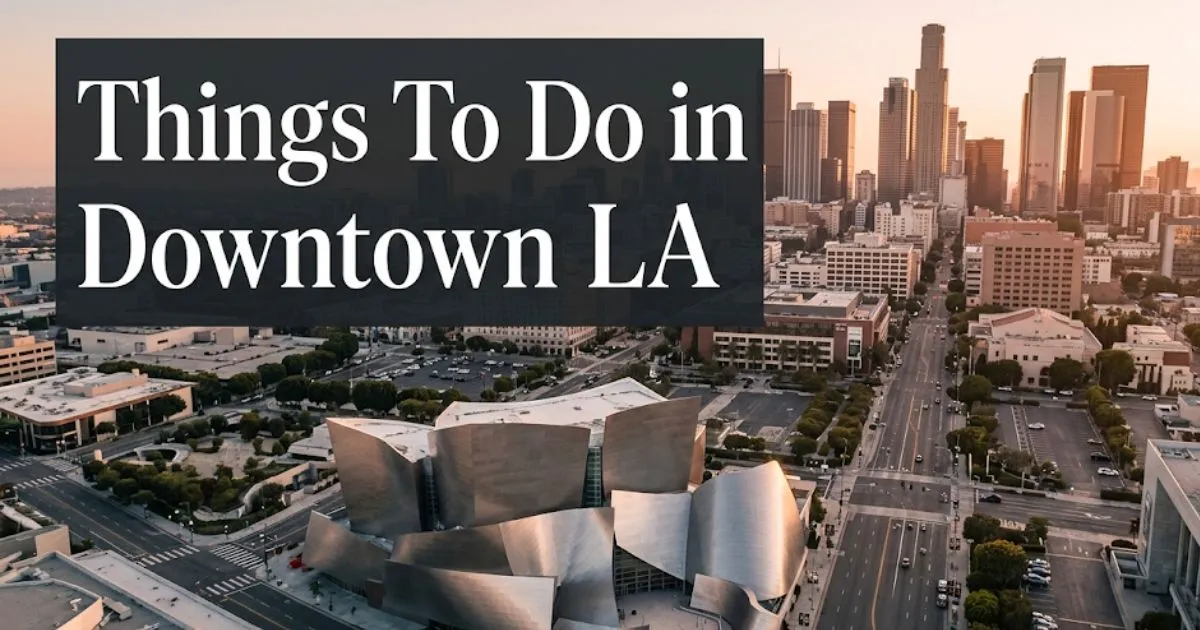
- Walt Disney Concert Hall exterior: Frank Gehry’s stainless steel exterior is one of the most significant pieces of architectural design in the country. Free to walk around. Interior access varies by performance schedule.
- Bradbury Building lobby: Free access during public hours to one of the finest Victorian commercial interiors in the United States. Used as a film location in Blade Runner and Chinatown.
- Olvera Street: Free to walk. The historic marketplace and adobe buildings of El Pueblo de Los Angeles Historical Monument represent the oldest surviving structures in Los Angeles.
- 6th Street Viaduct walk: Free. The newest bridge on this list and the most photographed.
- Angels Flight vista point: The top of Bunker Hill near California Plaza offers a free city view and free outdoor seating. The funicular itself charges a small fare (approximately $1 each way, verify current pricing).
Budget travelers can spend a full, genuinely rewarding day in DTLA without spending more than $25 total, not counting food.
Key Takeaway: The Bradbury Building lobby is the most overlooked free experience in all of downtown LA. Most visitors walk past it entirely while standing in line for Grand Central Market next door.
Things to Do in DTLA at Night
DTLA at night is a genuinely different city than DTLA during the day. The most interesting after-dark experiences are concentrated in the Arts District, on Bunker Hill, and along Spring Street.
Perch (448 S. Hill St) is a rooftop bar and French brasserie with a 360-degree downtown view. Arrive before 6 p.m. on weekends to avoid the wait for rooftop seating. Drinks run approximately $18 to $24.
The Walt Disney Concert Hall hosts the Los Angeles Philharmonic from September through June. Tickets range from approximately $25 to $200-plus depending on seating. The experience of hearing the LA Phil in this acoustically extraordinary hall is one of the genuinely world-class performing arts experiences in the United States. This attribution comes from the Los Angeles Philharmonic Association itself, which has identified the hall’s acoustic design as the primary factor behind its international reputation.
Clifton’s Republic (648 S. Broadway) is a multi-floor bar and restaurant inside a historic cafeteria building. The building’s history is genuine: it opened in 1935 and served as a social institution during the Depression era. Today it operates as a bar with several distinct themed floors.
Angel City Brewery (216 Alameda St) closes later on weekends and draws a consistent mix of locals and visitors. It is one of the most accessible nighttime options for solo travelers.
Couples: The combination of a performance at Walt Disney Concert Hall followed by a late dinner at Bavel in the Arts District represents one of the most genuinely impressive date itineraries in the city.
Solo travelers: The Broadway bar corridor between 5th and 9th Streets has the highest concentration of late-night single-bar options accessible on foot.
Safety note: Walk the main corridors (Spring Street, Broadway, Hill Street) rather than less-trafficked side streets after 10 p.m. Rideshare pickup is recommended over extended nighttime street walking.
Unique Things to Do in Downtown LA
The most genuinely distinctive DTLA experiences are the ones that exist nowhere else. These are not the top-10 tourist list entries.
Angels Flight Railway (251 S. Hill St) is the oldest funicular railway in continuous operation in North America. It covers exactly 298 feet at a 33-degree angle, connecting Hill Street to Bunker Hill. The fare is approximately $1 each way. The ride lasts under two minutes. It is completely worth doing.
The Last Bookstore (453 S. Spring St) occupies the ground floor of a former bank building. The used and new book inventory is arranged through a maze of tunnels made from stacked novels. The second floor has a horror section in a vault and an art gallery. It is one of the most original retail spaces in any American city.
Hauser and Wirth gallery (901 E. 3rd St) shows work at the level of major New York galleries, entirely for free. Its bookshop carries art publications from publishers most US bookstores don’t carry.
The Los Angeles River Walk along the eastern edge of the Arts District offers a rarely visited perspective on the industrial history and contemporary redevelopment of the city. Access from the 4th Street bridge provides the clearest views of the concrete channel and the emerging green infrastructure projects along its banks.
The Bradbury Building’s atrium staircase (304 S. Broadway) is so recognizably cinematic that seeing it in person produces a specific kind of architectural recognition. The ironwork and light atrium design from 1893 remain extraordinary.
Insider Tip:
- The Museum of Neon Art (MONA) in Glendale is a 25-minute drive from DTLA. It provides context for the neon sign culture that defined downtown LA’s Broadway corridor for decades.
- For the most genuinely local DTLA experience, attend a free Los Angeles Conservancy walking tour of the Broadway Theater District. These tours run on weekends and cover the architectural and cultural history of the largest collection of intact historic theaters in the US.
Things to Do in DTLA with Kids
DTLA with children is manageable with specific planning. It is not ideal for all ages in all neighborhoods.
The best DTLA experiences for families with children:
- Natural History Museum of Los Angeles County (Exposition Park, just south of downtown): Dinosaur fossils, live insect exhibits, and dedicated children’s programs. Admission runs approximately $15 to $22 per adult, with children’s pricing available. Confirm current family ticket options directly with the museum.
- California Science Center (Exposition Park): Free general admission to the main galleries. The Space Shuttle Endeavour requires a separate timed-entry ticket, booked well in advance. This is one of the most popular family attractions in Southern California.
- Japanese American National Museum (369 E. First St): Exhibits are engaging for older children (ages 10 and up) and have dedicated family programming on weekends. Stroller-accessible throughout.
- Japanese Village Plaza (Little Tokyo): Food, small shops, and a pedestrian-friendly format that works well for families. Young children can handle the pace without difficulty.
- Grand Central Market: Best for families on weekday mornings. Weekend crowds make stroller navigation genuinely difficult after noon.
- California State Historic Park: Open outdoor space with room for children to move freely. Adjacent to Union Station and accessible by Metro.
Families with children under 6: Exposition Park (Natural History Museum and California Science Center) is the better primary destination over the downtown core. The outdoor spaces, dedicated family programming, and stroller-accessible campus make for a far more manageable family day than navigating DTLA’s urban grid.
Seniors and accessibility travelers: The Natural History Museum and California Science Center are both fully accessible. California State Historic Park has paved paths throughout.
Key Takeaway: Exposition Park, located 2 miles south of DTLA via the Metro E Line (Expo), gives families with young children a far better structured day than the downtown core. Save DTLA’s urban grid for children aged 8 and older.
Getting Around Downtown LA
Getting around downtown Los Angeles without a car is entirely practical. It is, in fact, often faster than driving and far less expensive than parking.
The LA Metro B Line (Red) runs from Union Station through downtown with stops at Pershing Square (nearest to Grand Central Market and The Last Bookstore) and 7th St/Metro Center (nearest to the Grammy Museum and South Park hotels). Fares run approximately $1.75 per ride; verify current fare structure with Metro before traveling.
The DASH bus system (operated by the Los Angeles Department of Transportation) runs five routes through downtown for approximately 50 cents per ride. DASH Route D connects Union Station to Little Tokyo to the Arts District. This is the most useful intra-DTLA transit option and the one almost no visitor knows about.
Getting from LAX to downtown:
- Take the LAX Shuttle to the Aviation/LAX Metro Station (free shuttle, runs continuously).
- Board the LA Metro C Line (Green) toward Redondo Beach or Norwalk.
- Transfer at Willowbrook/Rosa Parks Station to the A Line (Blue) toward Downtown LA.
- Ride to 7th St/Metro Center or Pershing Square depending on your hotel.
- Total journey runs approximately 60 to 75 minutes and costs approximately $1.75.
The FlyAway bus (operated by LAX) runs directly from the airport to Union Station for approximately $9.75 per person. It is faster and more direct than the Metro route, particularly with luggage.
Parking reality: Weekend surface lot parking in DTLA runs approximately $15 to $30. Metered street parking is extremely limited. The garage on 3rd and Spring Streets and the lot beneath the Broad are useful references, but pricing changes seasonally. Verify before driving.
Seniors and accessibility travelers: Metro stations at Pershing Square and 7th St/Metro Center are elevator-equipped. Verify current elevator status on the Metro website before travel, as elevator maintenance affects specific stations periodically.
Is DTLA Safe for Tourists?
Downtown Los Angeles is safe for tourists in its primary visitor corridors. It requires more situational awareness than most American tourist destinations.
Honest context every visitor should have:
- Skid Row is geographically adjacent to popular attractions. It occupies roughly the area between 3rd and 7th Streets and between Main Street and Alameda Street. Grand Central Market sits on Broadway, one block west of Main Street. The Last Bookstore is on Spring Street. Being aware of this geography allows you to navigate without difficulty.
- The Arts District, Bunker Hill, Little Tokyo, and the Broadway Historic Core are active, visitor-comfortable areas throughout daylight hours and into the evening.
- Nighttime on well-trafficked streets (Spring Street, Broadway, Hill Street) is generally comfortable. Poorly lit side streets in the area east of Main Street toward Alameda require more caution.
- Rideshare services work efficiently in DTLA. Using rideshare for evening transport rather than walking extended distances is a practical choice, not an overreaction.
- The Crypto.com Arena district (South Park) is heavily policed on event nights and very active with foot traffic.
According to the Downtown Center Business Improvement District (DCBID), DTLA has seen significant ongoing investment in public safety programs and ambassador services throughout the district’s commercial and visitor corridors.
Solo travelers: Be street-aware rather than street-fearful. DTLA’s visitor areas are active and safe. Walking with purpose and avoiding extended engagement with individuals who approach aggressively applies here as in any major American urban center.
Families with children: Plan routes in advance using the neighborhood map above. Staying on Broadway, Spring Street, Hill Street, and Grand Avenue avoids the corridors that require more awareness.
Best Time to Visit Downtown LA
The best time to visit downtown Los Angeles is October through November or March through May. These months offer the most comfortable temperatures, the least crowding at major attractions, and the most outdoor-friendly conditions.
October and November are the local favorite. Temperatures consistently run in the 70s°F. Summer crowds have cleared. The Los Angeles Philharmonic season has just opened at Walt Disney Concert Hall.
June brings the notorious “June Gloom,” a marine layer that keeps the downtown core overcast and cool through midday. It burns off by afternoon but limits morning photography at outdoor landmarks. July and August bring inland heat, with downtown temperatures regularly reaching the upper 80s to low 90s°F.
December and January are DTLA’s quietest period. Hotel rates drop noticeably. Museum lines shrink. The trade-off is occasional rain and temperatures in the 50s to 60s°F range, which limits rooftop bar appeal.
| Month Range | Temperature (Approx.) | Crowd Level | Best For |
|---|---|---|---|
| March to May | 65 to 78°F | Moderate | All activities, outdoor dining |
| June to August | 72 to 92°F (afternoons) | High | Museums, indoor dining |
| September to November | 68 to 82°F | Moderate to Low | All activities, best overall |
| December to February | 55 to 65°F | Low | Budget visits, uncrowded museums |
Budget travelers: January and February offer the lowest hotel rates in DTLA without sacrificing the quality of indoor experiences like museums, restaurants, and gallery visits.
Couples: October is the optimal month. Hotel rates are still accessible compared to peak summer, evenings are warm enough for rooftop bars, and the city’s cultural calendar is at full strength.
Key Takeaway: October in DTLA is the best single month to visit. The crowds are lower than summer, the weather is better than winter, and the cultural calendar from the LA Phil to gallery openings is at peak activity.
One-Day Downtown LA Itinerary
A focused one-day approach to DTLA, built around the natural rhythms of each neighborhood:
Morning Block (8 a.m. to 12 p.m.)
- Start at Union Station (800 N. Alameda St). Walk its 1939 Art Deco interior before the daily crowd arrives. The building is free to enter and one of the finest train stations in the United States.
- Walk south along Alameda Street to Philippe the Original (1001 N. Alameda St) for a French dip breakfast. Open from around 6 a.m. Budget approximately $12 to $15 per person.
- Head west on 1st Street toward Little Tokyo. Walk Japanese Village Plaza and browse the shops on 2nd Street.
- Continue to the Japanese American National Museum (369 E. First St). Allow 60 to 90 minutes. Purchase tickets online to avoid the box office line.
Midday Block (12 p.m. to 3 p.m.)
- Walk or rideshare to Grand Central Market (317 S. Broadway). Arrive around noon. Budget 60 to 90 minutes for lunch across multiple stalls.
- After lunch, walk one block north on Broadway to the Bradbury Building (304 S. Broadway). Spend 20 minutes in the lobby.
- Walk north on Spring Street through the Historic Financial District. Note the building facades between 3rd and 6th Streets.
Afternoon Block (3 p.m. to 6 p.m.)
- Head to Bunker Hill via the Angels Flight Railway on Hill Street. Ride up for approximately $1. Walk the top of Bunker Hill past California Plaza to the Walt Disney Concert Hall exterior.
- Cross Grand Avenue to The Broad (221 S. Grand Ave). If you have a timed-entry reservation (book 2 to 4 weeks ahead), enter now. If not, view the lobby and exterior sculpture court, which are free.
- End the afternoon at MOCA (250 S. Grand Ave) across the street. Verify free admission status before visiting.
Evening Block (6 p.m. onward)
- Rideshare to the Arts District. Walk Traction Avenue and Hewitt Street to see the murals at dusk.
- Dinner at Bestia or Bavel (reservation required far in advance) or without reservations at Guerrilla Tacos (2000 E. 7th St).
- End the night at Angel City Brewery (216 Alameda St) for a drink in the outdoor space.
Transit note: This itinerary is fully achievable without a car using Metro and rideshare between blocks. The Metro B Line from Pershing Square covers the gap between Broadway and Bunker Hill.
Day Trips from Downtown Los Angeles
Downtown LA’s position at the center of the Los Angeles basin makes it one of the best day-trip base camps in the American West. Within 60 to 90 minutes by car or Metro, the options are genuinely varied.
| Destination | Distance from DTLA | Travel Time | Best For | Transit Option |
|---|---|---|---|---|
| Santa Monica | 16 miles | 45 to 75 minutes (traffic-dependent) | Beach, Pier, Third Street Promenade | Metro E Line (Expo) direct |
| Pasadena | 10 miles | 25 to 40 minutes | Old Town, Norton Simon Museum, Rose Bowl | Metro A Line (Gold) |
| Long Beach | 22 miles | 35 to 60 minutes | Aquarium, Pike Outlets, Queen Mary | Metro A Line (Blue) |
| Griffith Park / Observatory | 8 miles | 25 to 40 minutes | Hiking, skyline views, planetarium | DASH Observatory bus from Los Feliz Metro |
| Getty Center | 12 miles | 30 to 45 minutes | World-class art collection, gardens | Rideshare or car only |
| Joshua Tree National Park | 130 miles | 2.5 to 3 hours by car | Desert landscape, rock climbing, stargazing | Car required |
| Malibu | 30 miles | 45 to 75 minutes | Beaches, PCH drive, El Matador State Beach | Car recommended |
Santa Monica is the most practical day trip for travelers without a car. The Metro E Line (Expo) runs directly from 7th St/Metro Center station in DTLA to Downtown Santa Monica. The journey takes approximately 50 minutes and costs the standard Metro fare.
The Getty Center is one of the most compelling day trips from DTLA for art-focused visitors. Admission to the main galleries is free, parking runs approximately $20 per car, and the building itself is a significant architectural work by Richard Meier. There is no transit option that serves it directly from DTLA.
Families with children: Long Beach’s Aquarium of the Pacific is a full-day family destination reachable by Metro. Budget approximately $35 to $45 per adult for aquarium admission. Verify current pricing before visiting.
Budget travelers: Santa Monica via the E Line costs only the Metro fare. The beach, the Santa Monica Pier, and the Third Street Promenade are all free to visit. It is the most cost-effective full-day outing from DTLA.
Safety and Practical Warnings for Downtown Los Angeles
The single most important practical fact for DTLA visitors in 2026 is geographic awareness of the Skid Row corridor and its proximity to popular attractions. This is not a reason to avoid DTLA. It is a reason to arrive with a map and a plan.
Key safety and practical facts every visitor should know:
- Navigate by named street: Stay on Broadway, Spring Street, Hill Street, and Grand Avenue for the most visitor-active corridors. Avoid the 5th Street corridor east of Main Street after dark.
- Keep valuables secure: Pickpocketing is a minor but real concern at Grand Central Market during peak weekend hours. Keep bags closed and phones pocketed in crowded interior spaces.
- Heat awareness: From July through September, afternoon temperatures in downtown LA regularly reach the upper 80s to low 90s°F. Carry water. Limit extended outdoor walking between noon and 3 p.m. during hot months.
- Parking garage awareness: Avoid leaving valuables visible in parked cars anywhere in DTLA. Smash-and-grab incidents occur in surface lots, particularly near tourist corridors.
- Metro safety: The Metro system is safe during daytime hours. Late-night Metro travel (after 10 p.m.) benefits from platform awareness and rideshare as an alternative for the final leg home.
- Emergency access: LAPD non-emergency line: 877-275-5273. For emergencies, 911 as standard.
Seniors and accessibility travelers: Bunker Hill’s steep grade is the primary physical challenge in DTLA. The Angels Flight funicular (when operational) addresses the main elevation change. Confirm Angels Flight operating status before planning around it.
Frequently Asked Questions About Things to Do in Downtown LA
What are the best things to do in downtown LA for first-time visitors?
First-time visitors to DTLA get the most value from Grand Central Market, The Broad, the Arts District, and the Angels Flight Railway.
These four experiences cover food, contemporary art, street-level culture, and historic transit in a manageable geographic cluster.
Add a walk through the Spring Street Historic Financial District for architectural context and the complete first-visit picture of what DTLA actually is.
Is downtown Los Angeles walkable?
Downtown Los Angeles is walkable within individual neighborhoods but requires transit or rideshare to move efficiently between them.
The distance from Grand Central Market on Broadway to Hauser and Wirth in the Arts District is approximately 1.5 miles, which is a comfortable walk for most travelers.
Moving between the Arts District and Little Tokyo to Bunker Hill is more efficiently done via the DASH bus or a rideshare than walking.
How do I get from LAX to downtown LA without a car?
Take the free LAX Shuttle to the Aviation/LAX Metro Station, then board the C Line (Green) and transfer to the A Line (Blue) at Willowbrook/Rosa Parks Station toward downtown.
The journey runs approximately 60 to 75 minutes and costs the standard Metro fare, approximately $1.75 each way as of recent years.
The FlyAway bus from LAX runs directly to Union Station for approximately $9.75 per person and is the faster and more direct option for travelers with luggage.
What is the best neighborhood to stay in downtown Los Angeles?
The South Park neighborhood, adjacent to Crypto.com Arena, has the highest concentration of major hotel brands in DTLA and the most walkable access to the Metro 7th St/Metro Center station.
Bunker Hill and the Historic Core on Broadway are also strong bases, with proximity to Grand Central Market, The Broad, and the Spring Street restaurant corridor.
The Arts District has limited hotel options currently, making it better as a dining and activity destination than a lodging base.
Are there free things to do in downtown LA?
Downtown LA has an extensive list of genuinely free experiences, including MOCA (verify current free admission status before visiting), the Arts District street art circuit, the Bradbury Building lobby, California State Historic Park, the Walt Disney Concert Hall exterior, and Olvera Street.
The self-guided walking tour of the Spring Street Historic Financial District costs nothing and covers some of the finest early 20th-century bank architecture in the United States.
Budget approximately $0 to $25 total for a full free-focused day in DTLA, not counting food.
What time of year is best to visit downtown Los Angeles?
The best time to visit downtown Los Angeles is October through November or March through May, when temperatures run comfortably in the 65 to 80°F range.
October is the single optimal month: crowds are lower than summer, the Los Angeles Philharmonic season is open, and the city’s gallery and restaurant scene is at full strength.
December through February offers the lowest hotel rates and smallest museum crowds, with comfortable indoor weather for museums and restaurants, though evening outdoor activity is limited by cooler temperatures.
Plan Your DTLA Trip Before You Leave Home
Downtown Los Angeles rewards visitors who arrive with a specific plan. Book The Broad timed-entry 2 to 4 weeks before your visit. Reserve Bestia or Bavel the moment your travel dates are confirmed. Check MOCA’s current admission status and the California Science Center’s Space Shuttle Endeavour timed-entry availability before departure.
The single logistics step that makes the biggest difference: download the LA Metro app and load your TAP card before landing. The Metro A and B Lines and the DASH bus system give you full DTLA mobility for under $5 a day.
Travel conditions, hours, admission prices, and Metro fares change. Verify all key logistics directly with venues and the Los Angeles County Metropolitan Transportation Authority website before your trip. The information in this guide reflects general 2026 conditions and ongoing research, but specifics at individual venues should be confirmed close to your travel date.