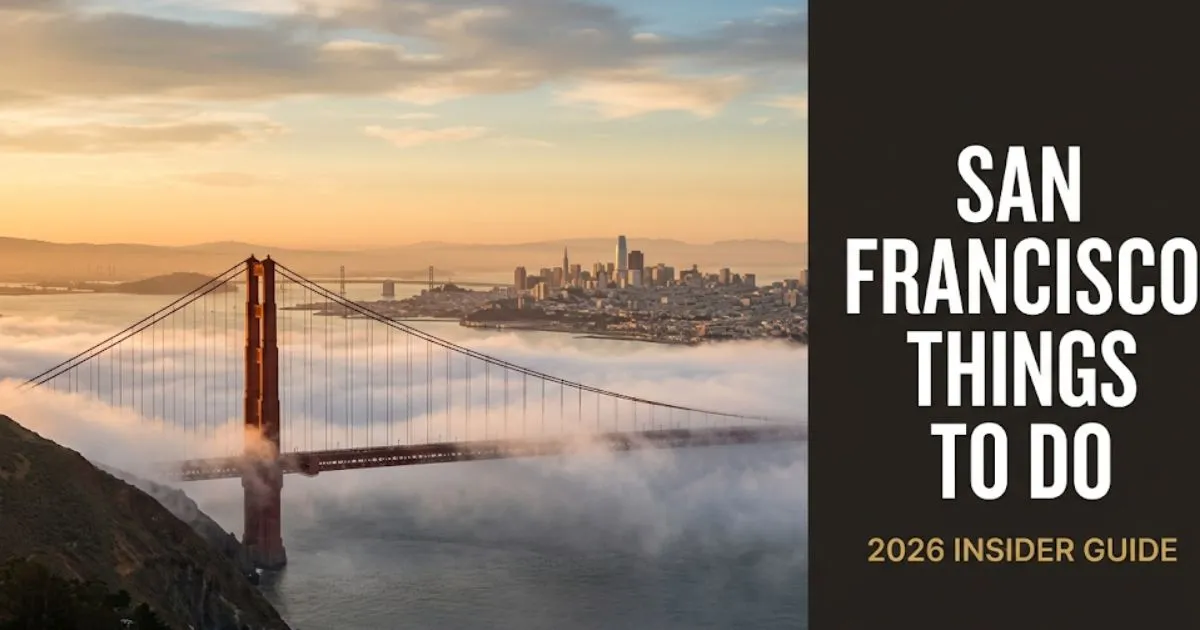
San Francisco Things To Do: The 2026 Insider Guide

San Francisco things to do span everything from ferrying to Alcatraz to eating Mission burritos at 11pm. Most visitors see 20 percent of the city and miss the best 80 percent entirely.
The San Francisco Travel Association identifies the city as one of the most visited urban destinations in the United States. Its 49 square miles contain more distinct neighborhood identities per block than almost any comparable American city.
This guide covers the iconic, the local, and the practical. You will leave knowing which attractions genuinely earn their reputation and exactly how to build a real trip around them.
San Francisco Things To Do: What Makes This City Worth Your Time
San Francisco rewards travelers who treat it like a collection of small towns rather than a single destination. Each neighborhood has its own character, food culture, and daily rhythm.
The city sits on a 7-by-7-mile peninsula. Every neighborhood from North Beach to the Mission District to Japantown functions almost independently.
No other American city concentrates this level of culinary diversity, street art, waterfront drama, and outdoor access in such a compact area. That density is the city’s greatest asset.
The challenge is knowing where to focus. Without a specific plan, visitors default to Fisherman’s Wharf, which serves the tourist economy well but tells you almost nothing true about the city.
What most visitors get wrong: Spending the first two days at Fisherman’s Wharf and then wondering why San Francisco felt impersonal. The real city starts three blocks inland.
The city also has a legitimate microclimate reality. The Sunset District can be completely fogged in while the Mission District, two miles east, basks in full sun on the same afternoon.
| Factor | Reality |
|---|---|
| Size | 49 square miles, walkable in distinct zones |
| Neighborhoods | 30+ distinct areas with different character |
| Climate | Varies significantly by neighborhood and time of day |
| Best for | Food, culture, outdoor access, arts, architecture |
| Not ideal for | Beach vacations, budget-first travelers, families with toddlers |
Best Things To Do in San Francisco for First-Time Visitors
The best things to do in San Francisco for first-time visitors are the Golden Gate Bridge, Alcatraz Island, Golden Gate Park, the Ferry Building Marketplace, and at least one full afternoon walking a real neighborhood like the Mission or North Beach.
Every one of these is genuinely worth the time and holds up against its reputation. The key is sequencing them correctly.
Book Alcatraz first. The official ferry operator, Alcatraz Cruises, operates the only boats to the island. Tickets routinely sell out three to four weeks in advance. Day tours and evening tours both book fast.
The Golden Gate Bridge walk takes approximately 90 minutes round trip on the pedestrian path. Start from the Welcome Center on the San Francisco side for parking and transit access.
Ferry Building Marketplace on a Saturday morning operates the city’s best farmers market. The building itself is open daily with permanent food vendors including Cowgirl Creamery and Hog Island Oyster Co.
| Activity | Best For | Cost Range | Book in Advance |
|---|---|---|---|
| Alcatraz Island Tour | All profiles | $40 to $45 per adult | Yes, 3 to 4 weeks |
| Golden Gate Bridge Walk | All profiles | Free | No |
| Ferry Building Saturday Market | Food lovers, couples | Free entry | No |
| Golden Gate Park | Families, outdoors travelers | Free | No |
| Cable Car Ride | First-timers, families | $8 per ride approx. | No, but expect lines |
For solo travelers: The Ferry Building on Saturday morning is an excellent first morning in the city. You can eat well for under $20 and get a genuine feel for how locals move through the city.
Top Iconic San Francisco Attractions Worth Visiting
The top iconic San Francisco attractions that genuinely earn their reputation are the Golden Gate Bridge, Alcatraz Island, the cable car system, and Golden Gate Park. Lombard Street and Fisherman’s Wharf are iconic but significantly overrated for the time they demand.
Lombard Street, the famously crooked block on Russian Hill, draws enormous crowds for a 200-foot stretch of road. It is worth a look in passing. It is not worth 45 minutes of searching for parking.
Alcatraz is the city’s single most intellectually engaging tourist attraction. The self-guided audio tour, narrated by former guards and inmates, is genuinely excellent. Allow three to four hours including ferry time.
The Powell-Hyde cable car line offers better scenery than the Powell-Mason line. It runs from Powell and Market Streets up through Nob Hill and down to Hyde Street Pier near Ghirardelli Square.
The honest assessment of Fisherman’s Wharf: It exists to serve tourists, and it does that efficiently. The clam chowder in a sourdough bread bowl at Boudin Bakery is genuinely good. The rest is gift shops and seafood restaurants priced for captive visitors.
The local alternative to Fisherman’s Wharf for fresh seafood is Swan Oyster Depot on Polk Street. It is a counter-only seafood bar that has operated since 1912. Expect a line. It is worth it.
Insider Tip:
- The best Golden Gate Bridge view is from Battery Spencer in the Marin Headlands, not from the bridge itself or from Crissy Field.
- Alcatraz evening tours offer a completely different atmosphere from the day tour. Fewer crowds and dramatically different lighting on the cell blocks.
- Seniors and travelers with mobility concerns should note that Alcatraz involves steep inclines and uneven surfaces. The island’s audio tour is accessible, but the physical terrain requires awareness.
Best Neighborhoods in San Francisco To Explore
The best neighborhoods in San Francisco for genuine exploration are the Mission District, North Beach, the Richmond District, Hayes Valley, and Haight-Ashbury. Each one tells a fundamentally different story about the city.
The Mission District is the most kinetic neighborhood in San Francisco. Clarion Alley between 17th and 18th Streets contains one of the city’s most concentrated collections of politically charged murals.
North Beach is the city’s Italian neighborhood and the birthplace of the Beat Generation. City Lights Bookstore on Columbus Avenue, founded by Lawrence Ferlinghetti, still operates as a working independent bookstore and cultural landmark.
Hayes Valley between Civic Center and the Western Addition is where the city’s most interesting small restaurants and design shops cluster. Souvla on Gough Street for Greek food is a local benchmark.
The Richmond District along Clement Street is the city’s best-kept dining neighborhood. Authentic Cantonese dim sum at Yank Sing on Steiner or at the smaller neighborhood spots along Clement is far better than Chinatown’s tourist-facing restaurants.
| Neighborhood | Character | Best For | Food Highlight |
|---|---|---|---|
| Mission District | Latino culture, murals, nightlife | Young adults, food lovers | Tartine Manufactory, La Taqueria |
| North Beach | Italian heritage, Beat history | Culture travelers, couples | Tony’s Pizza Napoletana |
| Hayes Valley | Boutique dining, design | Couples, adults | Souvla, Rich Table |
| Richmond District | Authentic dim sum, local pace | Food travelers, budget | Clement Street restaurants |
| Haight-Ashbury | 1960s history, vintage shops | First-timers, young adults | Amoeba Music, Magnolia Brewing |
For families: The Richmond District’s Clement Street is manageable with kids. The pace is calm and the food options are genuinely varied.
Key Takeaway: Book Alcatraz tickets immediately after confirming your San Francisco travel dates. The ferry sells out three to four weeks ahead during peak season.
Outdoor Things To Do in San Francisco
The best outdoor activities in San Francisco center on the Lands End Trail, Crissy Field, Baker Beach, and Golden Gate Park. These four areas alone can fill two full outdoor days without any repetition.
Lands End Trail runs along the city’s northwestern cliffs above the Pacific Ocean. The 3.4-mile round trip from the Sutro Baths ruins to Eagle’s Point Overlook offers some of the most dramatic coastal scenery in the city.
Crissy Field is a restored wetland and waterfront meadow with direct views of the Golden Gate Bridge from the east. Runners, cyclists, and families use it daily. Parking is limited.
Baker Beach provides the closest beach access to the Golden Gate Bridge with a north-facing view. It is not a swimming beach. Rip currents and cold water temperatures make swimming dangerous. Always read posted beach safety warnings.
Golden Gate Park spans over 1,000 acres from the Panhandle near Haight-Ashbury to Ocean Beach. Within it: the Japanese Tea Garden, the San Francisco Botanical Garden (free for San Francisco residents, small fee for visitors), Stow Lake, and the Bison Paddock.
The Marin Headlands, directly across the Golden Gate Bridge, expand the outdoor options significantly. The Tennessee Valley Trail is a 3.8-mile out-and-back to a protected cove. It requires a short drive or cycling across the bridge.
For seniors and accessibility travelers: Crissy Field’s flat paved path along the waterfront is accessible via wheelchair. Lands End’s main trail is paved near the Sutro Baths but becomes unpaved and uneven farther west.
For families: The Bison Paddock in Golden Gate Park (free, visible from the road) and Stow Lake with pedal boat rentals are genuinely engaging for children ages 4 and up.
Best Free Things To Do in San Francisco
San Francisco’s best free experiences include the Golden Gate Bridge walk, Dolores Park, Clarion Alley murals, the Embarcadero waterfront, Crissy Field, and the San Francisco Botanical Garden (free with proof of SF residency; fee for out-of-town visitors, though verify current policy before visiting).
The Embarcadero runs from the Ferry Building south to AT&T Park (now Oracle Park). The waterfront walk is free, views of the Bay Bridge are unobstructed, and the Ferry Building itself is free to enter.
Dolores Park in the Mission District is the city’s most social public space. On warm afternoons, it functions as an open-air community gathering. The views of downtown from the upper lawn are excellent.
The Palace of Fine Arts in the Marina District is a free-to-visit rotunda and lagoon originally built for the 1915 Panama-Pacific Exposition. It is a genuinely impressive piece of architecture.
Haight-Ashbury’s main intersection and surrounding blocks cost nothing to walk. The neighborhood’s vintage shops, record stores (including the legendary Amoeba Music on Haight Street), and street character are entirely free to experience.
Free activities in San Francisco:
- Golden Gate Bridge pedestrian walk (eastern sidewalk, no fee)
- Dolores Park (free entry)
- Clarion Alley murals, Mission District (free)
- Palace of Fine Arts exterior and lagoon (free)
- Crissy Field and the waterfront path (free)
- Haight-Ashbury neighborhood walking (free)
- Embarcadero waterfront walk (free)
- Ocean Beach (free, no swimming)
- Lands End Trail (free, parking fee may apply at trailhead lots)
For budget travelers: A San Francisco day built around the above costs nothing in admission. Budget instead for BART or Muni fares and one or two meals in the Mission District where quality is high and prices are far below the waterfront tourist zone.
San Francisco Food Scene Beyond Tourist Traps
San Francisco’s food culture is anchored by the Mission District, the Richmond District, Hayes Valley, and the Ferry Building. Not Fisherman’s Wharf.
The tourist trap version of San Francisco food is clam chowder in a bread bowl from a wharf restaurant. It is not bad. It is also not what the city is actually about.
Tartine Manufactory on Alabama Street in the Mission is where San Francisco’s bread obsession became nationally recognized. The morning pastry line is real. Arrive before 9am on weekends.
La Taqueria on Mission Street between 24th and 25th Streets has been making what many serious food travelers consider the best burrito in San Francisco since 1973. It is cash-friendly and unambiguous about what it does.
Swan Oyster Depot on Polk Street requires a wait, often 30 to 45 minutes. The seafood counter has operated since 1912. Order the Dungeness crab Louis or the oyster sampler.
Zuni Café on Market Street is the James Beard Award-winning restaurant best known for its whole roasted chicken for two, prepared in a wood-burning oven. Reserve at least a week in advance.
For dim sum without the tourist markup, Clement Street in the Richmond District has a cluster of Cantonese restaurants where locals eat on weekend mornings. The lines are worth reading as quality signals.
Insider Tip:
- The Ferry Building Saturday Farmers Market runs early morning until early afternoon. Get there by 9am for the best selection from Marin Sun Farms, Blue Bottle Coffee, and the cheese vendors.
- Bi-Rite Creamery on 18th Street in the Mission has a line that moves fast. The salted caramel ice cream is the one locals recommend.
- For budget travelers: A taco at La Taqueria or a pastry at Tartine Manufactory delivers San Francisco’s actual food culture for $5 to $15 per person.
Key Takeaway: Skip the Fisherman’s Wharf seafood restaurants for your main meals. The Mission District and Richmond District offer far better food at significantly lower prices.
Unique Things To Do in San Francisco
The most unique things to do in San Francisco include walking the 16th Avenue Tiled Steps, exploring the Filbert Street Steps through cottage gardens on Telegraph Hill, visiting the Musée Mécanique at Pier 45, and experiencing the Castro District on a weekday afternoon.
The 16th Avenue Tiled Steps in the Inner Sunset neighborhood are a 163-step mosaic stairway climbing Grandview Park. The tiles were hand-crafted by neighborhood residents over years. The view from the top covers the city to the bay.
Filbert Street Steps on Telegraph Hill lead through private gardens and past wooden cottages to Coit Tower. The wild parrots of Telegraph Hill, a flock of cherry-headed conures that has lived in the neighborhood since the 1990s, are often visible in the trees.
The Musée Mécanique at Pier 45 is a free-to-enter (some machines require coins) collection of antique arcade games and mechanical amusements dating from the late 1800s. It is genuinely strange and completely unlike anything in the city’s standard tourist circuit.
The Columbarium of San Francisco in the Inner Richmond is a Victorian funeral chapel and columbarium housing the remains of notable San Franciscans. It is open to visitors and functions as one of the city’s quietest, most atmospheric historic spaces.
For young adults seeking something different: The Interval at the Long Now Foundation on Fort Mason is a bar, library, and event space run by a nonprofit focused on long-term thinking. The library contains books organized by time horizon rather than subject. There is no other bar quite like it in America.
San Francisco Museums Worth Visiting
San Francisco’s best museums are SFMOMA, the de Young Museum, and the California Academy of Sciences. All three justify full half-day visits. The Exploratorium at Pier 15 is the best museum option for families.
SFMOMA (San Francisco Museum of Modern Art) in SoMa holds one of the largest collections of modern and contemporary art in the United States. The permanent collection includes Rothko, Bourgeois, and Warhol. Budget two to three hours minimum.
The de Young Museum in Golden Gate Park focuses on American art, international textiles, and Pacific cultures. The observation tower is free to access and provides a clear 360-degree view of the city. Museum admission runs approximately $15 to $30 per adult as of recent years. Verify current pricing before visiting.
The California Academy of Sciences, directly across the Music Concourse from the de Young, combines a natural history museum, a planetarium, an aquarium, and a living rainforest under one roof. For families with children, it delivers more sustained engagement than any other museum in the city.
The Exploratorium on the Embarcadero at Pier 15 is an interactive science museum oriented toward all ages but genuinely excellent for children ages 5 and up. Its Tactile Dome (an additional reservation often required) is worth booking separately.
For seniors and accessibility travelers: SFMOMA and the de Young are fully accessible via elevator throughout. The California Academy of Sciences has accessible paths through most exhibits. The Exploratorium has some areas requiring more physical engagement.
According to SF Travel, the de Young Museum and California Academy of Sciences together draw over 2 million visitors annually, making Golden Gate Park’s museum zone one of the most visited cultural destinations on the West Coast.
Key Takeaway: The de Young Museum’s observation tower is free to access without paying museum admission. It is one of the best views in the city and costs nothing.
Fun Things To Do in San Francisco for Young Adults
San Francisco for young adults is best experienced through the Mission District’s nightlife corridor on Valencia Street, the Castro District, Haight-Ashbury, and the live music venues anchored around SoMa and North Beach.
Valencia Street between 16th and 24th Streets in the Mission is the axis of the city’s young adult social life. Bar density, restaurant quality, and general walkability make it the best evening starting point for visitors aged 21 to 40.
The Independent on Divisadero Street in the Western Addition is a mid-size live music venue that books touring indie, rock, and hip-hop acts. The Fillmore on Geary Street is the historic venue where Grateful Dead, Jefferson Airplane, and Hendrix all played. Both remain active in 2026.
The Castro District is one of the most historically significant and socially vibrant LGBTQ+ neighborhoods in the United States. The Castro Theatre, a 1922 Spanish Baroque movie palace, screens classic films and hosts live events. The neighborhood is welcoming to all visitors regardless of identity.
For a genuinely local bar experience, Zeitgeist on Valencia Street is a massive outdoor beer garden with a no-frills approach and a serious tap list. It gets loud and crowded on Friday nights. It is also genuinely fun.
Dolores Park on a sunny afternoon functions as an outdoor social scene. Food trucks line the perimeter. The park’s upper lawn has the best city views in the Mission.
For solo travelers: Valencia Street’s walkable bar-to-bar format makes it unusually comfortable for solo visitors. The neighborhood has enough foot traffic and casual bar culture that arriving alone at most spots feels entirely natural.
Cool Things To Do in San Francisco for Couples
The most romantic things to do in San Francisco for couples involve the Embarcadero waterfront at sunset, dinner at Zuni Café, a morning at the Japanese Tea Garden, and a weekend morning at the Ferry Building Marketplace.
Sunset from the Embarcadero looking toward the Bay Bridge and the Oakland hills is one of the most reliably beautiful views in the city. The best vantage point is near Pier 7, where the waterfront promenade opens up completely.
A couples dinner in San Francisco should prioritize Rich Table in Hayes Valley for modern California cuisine, State Bird Provisions on Fillmore Street for the innovative small-plates dim sum format, or Bix in the Financial District for the supper club atmosphere.
The Japanese Tea Garden inside Golden Gate Park is a traditional garden originally built for the 1894 Midwinter Exposition. Early morning entry, before 10am, means smaller crowds and the most serene atmosphere. Admission runs approximately $10 to $15 per adult. Verify before visiting.
A ferry ride to Sausalito and a waterfront lunch is a genuinely romantic half-day from the Ferry Building. The Blue and Gold Fleet runs regular departures. The return trip provides some of the best city skyline views available without booking a private tour.
The Sunset District’s Ocean Beach at dusk, when the fog rolls in off the Pacific and the beach empties out, is a particular kind of dramatic that couples either love immediately or find too cold. Bring layers. Fog temperatures can drop 15 degrees in under an hour.
San Francisco Things To Do for Families With Kids
San Francisco for families works best when built around the California Academy of Sciences, the Exploratorium, Golden Gate Park, and a Ferry Building visit rather than a Fisherman’s Wharf-first approach.
Pier 39 is the most family-marketed waterfront destination. Its resident sea lion colony, which hauls out on the floating docks at K-Dock, is a genuine and free wildlife viewing experience. The commercial side of Pier 39 is tourist infrastructure.
The California Academy of Sciences in Golden Gate Park is the single best full-day family destination in the city. The planetarium shows require timed tickets. Book these in advance. The aquarium and rainforest require no separate reservation.
Stow Lake in Golden Gate Park rents pedal boats and rowboats by the hour. Children aged 5 and up engage reliably. The lake’s island has a small Chinese pavilion at its center.
Golden Gate Park’s Carousel near the Children’s Playground, which dates to 1912, is one of the oldest carousels in the country and still operates seasonally. Verify current operating schedule before visiting.
Practical family logistics:
- San Francisco’s hills make strollers difficult on many sidewalks. A carrier or structured backpack carrier works better in neighborhoods like North Beach and Chinatown.
- The F-Market historic streetcar running along the Embarcadero to the Castro is family-friendly and visually engaging for children.
- Many restaurants in the Mission and Richmond districts are family-friendly without dedicated children’s menus. Taqueria-style restaurants are particularly accommodating.
For families with teens: The Exploratorium’s Tactile Dome and the hands-on science exhibits hold teenage interest at a level that pure art museums rarely achieve. Budget a full morning.
Key Takeaway: For families, the California Academy of Sciences justifies an entire day. Book planetarium show tickets online before arrival; they sell out faster than any other element.
San Francisco Day Trips From the City
The best day trips from San Francisco are Muir Woods, Sausalito and Tiburon, Napa Valley, and the Marin Headlands. Each is within 90 minutes of the city and delivers a fundamentally different experience.
Muir Woods National Monument requires advance reservations through Recreation.gov for both parking and the shuttle from Sausalito. Day-of access is unreliable during peak season. Book at least two to three weeks ahead.
The Marin Headlands, accessible by crossing the Golden Gate Bridge and taking the first exit, offer hiking trails with views back toward the city. The Battery Spencer overlook provides the most photographed non-city view of the Golden Gate Bridge.
| Day Trip | Distance | Travel Time | Cost Range | Book Ahead? |
|---|---|---|---|---|
| Muir Woods | 12 miles | 30 to 45 min drive | Parking/shuttle fee plus entry | Yes, mandatory |
| Sausalito | 8 miles by ferry | 30 min ferry | Ferry fare plus meals | No |
| Napa Valley | 50 miles | 60 to 90 min drive | Variable, wine tasting fees | Yes for wineries |
| Marin Headlands | 5 miles | 20 min drive | Free | No |
| Half Moon Bay | 28 miles | 45 min drive | Free beach access | No |
Napa Valley from San Francisco requires approximately 60 to 90 minutes of driving depending on traffic. Most wineries require advance tasting reservations. Budget $30 to $75 per person for a standard tasting experience. Prices vary significantly by winery.
For budget travelers: The Marin Headlands day trip is entirely free. The ferry to Sausalito offers a waterfront lunch and gallery browsing for a half day at modest cost.
How To Get Around San Francisco Without a Car
Getting around San Francisco without a car is genuinely practical using BART, Muni, and rideshare. Most visitor-priority destinations are accessible via public transit or on foot.
BART (Bay Area Rapid Transit) connects SFO airport directly to downtown San Francisco in approximately 30 minutes. It also connects OAK (Oakland International) via a connector bus and BART train. A BART fare card or the Clipper Card covers both systems.
Muni (San Francisco Municipal Railway) operates the city’s buses, light rail Metro lines, and the historic cable car and F-Market streetcar lines. A Muni day pass covers unlimited rides and costs approximately $5 to $7 as of recent years. Verify current pricing before travel.
How to navigate SF transit efficiently:
- Download the Muni official app or use Google Maps with transit routing for real-time arrivals.
- Load a Clipper Card (available at SFO, BART stations, and select retailers) for seamless BART and Muni transfers.
- Use Muni Metro light rail lines (N-Judah, L-Taraval, others) for east-west crossings between neighborhoods.
- Take cable cars for the experience rather than pure transit speed. The Powell-Hyde line is the most scenic.
- Use rideshare for late-night travel and for reaching Marin Headlands or other car-dependent destinations.
Parking reality: Parking in San Francisco is expensive (hourly rates in downtown garages run high) and rental car break-ins are a genuine, documented problem. If you rent a car, never leave anything visible in the vehicle. Many experienced San Francisco visitors skip the rental car entirely.
For seniors and accessibility travelers: Muni buses are wheelchair accessible. BART stations have elevators, though elevator reliability varies. The SF Muni accessibility page lists current elevator status and accessible route options.
Best Time To Visit San Francisco
The best time to visit San Francisco is September through November, when fog clears, temperatures reach their seasonal peak, and crowds thin from summer highs. October is widely considered the city’s finest month.
Summer (June through August) is the most popular time to visit and simultaneously the foggiest, coolest, and most crowded period. June typically brings persistent morning fog through the afternoon in western neighborhoods. Temperatures in the Sunset District average in the low to mid-50s Fahrenheit.
Fall (September through November): Warmest, clearest days. The Outside Lands Music Festival in Golden Gate Park typically runs in August. San Francisco Giants baseball season runs through September at Oracle Park.
Winter (December through February): Rainy but mild. Hotel rates drop noticeably. The city’s indoor culture (museums, restaurants, live music) is fully operational. The Chinese New Year Parade in February or March (date varies) is one of the largest in the country.
Spring (March through May): Weather is unpredictable. Clear warm days alternate with cold rainy periods. The Cherry Blossom Festival in Japantown typically occurs in April.
| Season | Avg Temp (Downtown) | Crowds | Fog Level | Best For |
|---|---|---|---|---|
| Summer (Jun-Aug) | 58 to 65°F | Peak | High | Festivals, events |
| Fall (Sep-Nov) | 62 to 70°F | Moderate | Low | General sightseeing |
| Winter (Dec-Feb) | 50 to 57°F | Low | Variable | Budget, indoor culture |
| Spring (Mar-May) | 55 to 63°F | Moderate | Moderate | Outdoor, parks |
For budget travelers: January and February offer the city’s lowest hotel rates. The indoor experiences (SFMOMA, de Young, California Academy of Sciences, restaurant scene) are fully available year-round.
Key Takeaway: If you are visiting San Francisco expecting warm summer weather, pack layers. Ocean-facing neighborhoods regularly run 15 degrees cooler than the national forecast suggests.
San Francisco Itinerary for One Day
A one-day San Francisco itinerary should prioritize the Ferry Building, the Embarcadero, one major attraction (Alcatraz or Golden Gate Bridge walk), a Mission District afternoon, and a North Beach or Hayes Valley evening.
If Alcatraz is pre-booked, structure the day around the morning ferry departure. If not, build the day around a bridge walk and the neighborhoods.
One-day San Francisco itinerary:
- 7:30am: Ferry Building Marketplace if it is a Saturday. Otherwise, breakfast at Tartine Manufactory on Alabama Street in the Mission. Arrive early for pastries before the line builds.
- 9:00am: Walk the Embarcadero south from the Ferry Building toward the Bay Bridge. The waterfront is quiet and uncrowded at this hour.
- 10:30am: Take BART or Muni to the Golden Gate Bridge Welcome Center. Walk the eastern pedestrian path across and back (90 minutes round trip). If fog is heavy, defer to afternoon when it typically clears.
- 12:30pm: Return to the city and eat lunch in the Richmond District on Clement Street (dim sum, pho, or Cantonese BBQ).
- 2:00pm: Walk or Muni to Dolores Park in the Mission. Spend 45 minutes at the park, then walk north on Valencia Street through the Mission’s neighborhood energy.
- 4:00pm: Clarion Alley between 17th and 18th Streets in the Mission for the mural corridor.
- 5:30pm: Take Muni or a rideshare to North Beach. Walk Columbus Avenue, stop at City Lights Bookstore, and settle into Vesuvio Café next door for a pre-dinner drink.
- 7:30pm: Dinner in North Beach at Tony’s Pizza Napoletana on Vallejo Street (reserve in advance) or walk to Hayes Valley for Souvla if the timing works.
- 9:00pm: End the evening at Zeitgeist on Valencia Street or return to North Beach for a nightcap at Comstock Saloon on Columbus Avenue.
Safety and Practical Warnings for San Francisco
San Francisco has genuine urban safety considerations that most travel guides ignore. Prepared visitors have better experiences.
Key safety and practical facts every visitor should know:
- Car break-ins are very common. Do not leave any item visible in a parked rental car. This applies especially to parking lots near the Golden Gate Bridge, Fisherman’s Wharf, and Lands End. Remove everything from sight.
- The Tenderloin district (bounded roughly by Market Street, Powell, Geary, and Van Ness) has significant street-level issues particularly during evening hours. It lies between Union Square and Civic Center. If walking between these two areas after dark, stay on Market Street.
- Ocean Beach has no lifeguards and dangerous rip currents. It is not a swimming beach. The National Park Service posts clear warnings at the beach access points. Read them.
- San Francisco’s hills are steeper than they look on maps. Nob Hill, Russian Hill, and Twin Peaks are genuinely demanding on foot. Plan elevation into your time estimates.
- Fog can eliminate Golden Gate Bridge visibility completely. Check the Fog Forecast (the San Francisco fog community on social platforms tracks this informally) and plan bridge photography for afternoon when fog most commonly lifts.
- Alcatraz ferry tickets must be purchased through Alcatraz Cruises only. Third-party resellers exist but charge significant premiums. Book directly at the official Alcatraz Cruises website.
- The San Francisco non-emergency police line and the SF Travel Visitor Information Center at Hallidie Plaza near Powell Street BART station can assist visitors with practical city navigation questions.
Frequently Asked Questions About San Francisco Things To Do
What are the best things to do in San Francisco for first-time visitors?
The best things for first-time visitors are Alcatraz Island, the Golden Gate Bridge walk, Golden Gate Park, and at least one afternoon in the Mission District.
Book Alcatraz ferry tickets three to four weeks in advance through Alcatraz Cruises, the only official operator.
Add the Ferry Building Marketplace on a Saturday morning and the de Young Museum or SFMOMA for a well-rounded first visit.
Is Fisherman’s Wharf worth visiting in San Francisco?
Fisherman’s Wharf is worth a single morning visit, primarily to see the sea lions at Pier 39 and to eat at Boudin Bakery.
It should not be the center of your San Francisco itinerary.
The Mission District, North Beach, and the Richmond District offer better food, stronger local character, and a more honest representation of what San Francisco actually is.
How far in advance do you need to book Alcatraz tickets?
Book Alcatraz tickets at least three to four weeks in advance during spring and summer, and two to three weeks ahead during fall and winter.
Day tickets through Alcatraz Cruises sell out consistently during peak months.
Evening tours sell out even faster than day tours. If Alcatraz is a priority, it should be the first thing you book after confirming your travel dates.
What is the best neighborhood to stay in when visiting San Francisco?
The best neighborhoods to stay in are Union Square (central, transit access, close to cable cars), the Embarcadero and Financial District (waterfront access, Ferry Building proximity), and Hayes Valley (walkable, excellent restaurants, mid-city location).
Fisherman’s Wharf hotels are convenient to the waterfront but expensive and far from the city’s best neighborhoods.
Budget travelers should note that accommodation costs are high citywide. SoMa and the Tenderloin have lower-priced options but require more careful navigation.
What is the best time of year to visit San Francisco?
The best time to visit San Francisco is September through November, when temperatures are at their warmest and fog is at its lowest.
October is consistently the clearest and most comfortable month across the city.
Summer is the most popular season but also the foggiest and coolest, particularly in neighborhoods west of Twin Peaks.
How do you get around San Francisco without renting a car?
BART connects the airports to downtown directly, and Muni covers the city’s neighborhoods via bus, Metro, cable car, and the F-Market streetcar.
Load a Clipper Card at SFO or any BART station for seamless transfers across both systems.
Rideshare works well for late-night travel and reaching car-dependent destinations like the Marin Headlands. Most first-time visitors find that skipping a rental car entirely reduces cost and stress significantly.
Planning Your San Francisco Trip: Final Guidance
San Francisco’s depth is in its neighborhoods, not its waterfront. Start your planning by booking Alcatraz and, if Muir Woods is on the list, securing those permits through Recreation.gov before anything else.
Verify all museum admission prices, operating hours, and event schedules directly with venues before departure. Costs and seasonal hours in San Francisco change regularly.
The traveler who arrives having pre-booked Alcatraz, carrying a Clipper Card loaded with BART and Muni credit, and with one dinner reservation in Hayes Valley or North Beach is set up for a genuinely excellent trip. Adjust everything else as the city reveals itself.