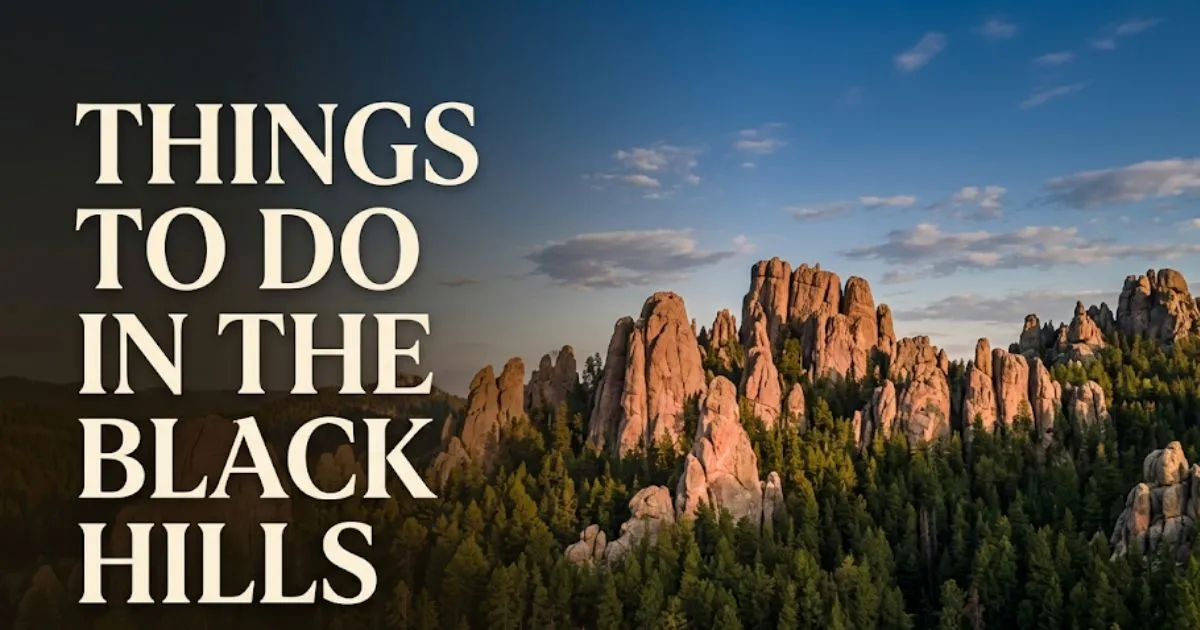
Things To Do in the Black Hills: 2026 Visitor’s Guide

The Black Hills of South Dakota pack more genuine variety into a single road trip than almost any other region in the American West.
Within a 60-by-110-mile area, you get presidential monuments, bison herds, granite spire trails, underground cave systems, and a real 19th-century mining town that never fully stopped being itself.
This guide covers every major experience in the region for 2026. It also covers what to skip, what requires advance planning, and who each experience genuinely suits.
Things to Do in the Black Hills: What Makes This Region Worth the Trip
Things to do in the Black Hills range from iconic national memorials to uncrowded canyon hikes most visitors never find.
The Black Hills cover a compact enough area that you can experience dramatically different terrain within a single day. Granite formations, pine forest, limestone caves, prairie, and historic Western towns all exist within an hour of each other.
What separates the Black Hills from comparable western destinations is the density of genuinely different experiences per mile. Unlike Yellowstone, where wildlife zones are separated by hours of driving, the Black Hills reward a focused three-day visit with real completeness.
The Black Hills and Badlands Tourism Association identifies the region as one of the most geographically concentrated multi-experience destinations in the Great Plains. That concentration is the region’s actual selling point.
The honest caveat: the Black Hills is not a luxury destination. There are no five-star resort properties in the mountains. Keystone, the town closest to Mount Rushmore, is unambiguously tourist infrastructure, not a destination in itself.
Plan around experiences, not around a base town. The region rewards travelers who drive.
Insider Tip:
- Pick a cabin or lodge in Custer or Hill City rather than Keystone. Both offer far better dining and genuine mountain character without the souvenir-shop density.
- Custer is 17 miles from Mount Rushmore. Keystone is 3 miles. The trade-off is worth it.
- Families with young children may prefer Rapid City as a base for its broader amenities and flatter terrain.
Best Things to Do in the Black Hills South Dakota
The best things to do in Black Hills South Dakota span four clearly distinct categories: presidential history, wildlife immersion, geologic wonder, and Western cultural heritage.
No two of these categories deliver the same kind of experience. Travelers who approach the Black Hills as a single “nature trip” or a single “history trip” consistently miss half of what the region offers.
| Experience | Best For | Cost Range (2026 est.) | Time Required |
|---|---|---|---|
| Mount Rushmore | All profiles | Free to ~$10 parking | 2 to 3 hours |
| Crazy Horse Memorial | History and culture travelers | ~$15 to $30 per adult | 2 to 4 hours |
| Custer State Park Wildlife Loop | Families, wildlife enthusiasts | ~$10 to $20 park entry | 2 to 4 hours |
| Needles Highway Drive | Couples, scenic drive fans | Included with park entry | 2 to 3 hours |
| Wind Cave National Park | All profiles | Tour fee: ~$15 to $25 | 1.5 to 2 hours |
| Cathedral Spires Trail | Hikers, solo travelers | Included with park entry | 3 to 4 hours |
| Deadwood Historic District | Couples, history travelers | Free to enter; varies for gaming | Half day |
| Spearfish Canyon Hike | Outdoor enthusiasts | Free | 2 to 5 hours |
Verify current pricing directly with the National Park Service and South Dakota Game Fish and Parks before your visit. Entry fees and parking costs change annually.
Budget travelers should note that an America the Beautiful Annual Pass (approximately $80 per vehicle as of recent years) covers entry to Mount Rushmore, Wind Cave, Jewel Cave, and Badlands National Park. It pays for itself within two to three stops.
The single most overrated stop for experienced travelers: Keystone itself. Drive through it to reach Mount Rushmore. Do not base a day around it.
Unique Things to Do in the Black Hills
The most unique things to do in the Black Hills are the experiences that appear on no other American road trip: feeding wild burros from your car window, descending into the world’s second-longest cave system, and driving a scenic highway engineered specifically for the view of a single mountain.
Bear Country USA outside Rapid City is a legitimate drive-through wildlife park, not a roadside novelty. You drive your own car through enclosures housing black bears, elk, bison, wolves, and mountain lions.
The 1880 Train (Black Hills Central Railroad) runs a 20-mile round trip between Hill City and Keystone on an authentic narrow-gauge steam railroad. The schedule varies seasonally — verify before planning a half-day around it.
The Cosmos Mystery Area near Keystone is a regional curiosity: a gravity-defying optical illusion attraction that has operated since 1952. It is genuinely odd, inexpensive, and takes about 45 minutes. It is not for skeptics. It is exactly right for travelers who enjoy roadside Americana.
Feeding the wild burros along Wildlife Loop Road in Custer State Park is a free experience unlike anything in the American West. The burros approach cars directly. Children respond to this with memorable enthusiasm.
Unique experiences by traveler profile:
- Solo travelers: Cathedral Spires Trail for solitude and technical terrain
- Couples: Evening laser show at Crazy Horse Memorial
- Families: Wild burros at Custer State Park wildlife loop
- Seniors: 1880 Train between Hill City and Keystone (no significant walking required)
- Budget travelers: Sunday Gulch Trail at Sylvan Lake (free with park entry)
Mount Rushmore: What to Know Before You Go
Mount Rushmore National Memorial is free to enter, but parking costs approximately $10 to $15 per vehicle and requires an advance reservation in summer 2026.
Book parking through recreation.gov well before your visit. By late June, peak time slots sell out days to weeks in advance. Arriving without a reservation on a July morning is genuinely risky.
The memorial is at its best between 5 a.m. and 8 a.m. The granite faces catch direct sunlight from the east in the morning. By midday, the memorial sits in flat light.
The Presidential Trail loop is 0.6 miles and paved. It brings you within 100 yards of the base of the mountain and is accessible to most mobility levels. The Sculptor’s Studio below the main viewing terrace adds genuine historical depth on the construction methods — most visitors walk past it.
The Evening Lighting Ceremony runs nightly in summer and includes a ranger program and patriotic ceremony. The ceremony is free with parking. It ends with the memorial illuminated against the night sky. Arrive by 8 p.m. for seating.
What most first-time visitors get wrong: they treat Mount Rushmore as a two-hour stop and then wonder why it felt underwhelming. The memorial rewards genuine engagement: read the Hall of Records history, walk the full Presidential Trail, and attend the evening program if possible.
The honest assessment: the scale is genuinely impressive in person. Every photograph undersells the size of the faces. The tourist infrastructure around the parking structure is heavy. Stay focused on the memorial itself.
Seniors and accessibility travelers: The main viewing terrace and Presidential Trail are paved and wheelchair-accessible. The Sculptor’s Studio involves stairs. Restrooms are accessible throughout the main complex.
Key Takeaway: Book Mount Rushmore parking on recreation.gov before late May. Summer slots fill weeks out, and arriving without a reservation in July will cost you hours.
Crazy Horse Memorial
Crazy Horse Memorial is privately funded, independently operated, and still under active construction after more than 75 years.
Admission runs approximately $15 to $30 per adult as of recent years, with pricing varying by group and vehicle. The fee includes access to the visitor complex, the Indian Museum of North America, and the view of the mountain carving from the main viewing deck.
The face of Crazy Horse was completed and dedicated in 1998. The full sculpture, when finished, will stand 563 feet tall and 641 feet long. The scale dwarfs Mount Rushmore.
For context: the entire Mount Rushmore monument could fit inside the head of the Crazy Horse sculpture as it is designed.
The evening laser light show at Crazy Horse runs on select summer nights. It projects the completed sculpture design onto the mountain face with narration. For couples and history travelers, this is one of the most genuinely distinctive experiences in the Black Hills. Check the Crazy Horse Memorial Foundation website for 2026 schedule dates.
Comparing Crazy Horse to Mount Rushmore:
| Factor | Mount Rushmore | Crazy Horse Memorial |
|---|---|---|
| Entry Fee | Free (parking fee) | Paid admission |
| Completion | Fully completed | Still in progress |
| Cultural significance | American presidential history | Lakota and Indigenous heritage |
| Viewing distance | 185 meters to faces | Farther viewing deck |
| Evening program | Lighting ceremony | Laser show (seasonal) |
| Crowds | Extremely high in summer | High but more manageable |
Many travelers find Crazy Horse the more emotionally resonant of the two. The active construction and the story of sculptor Korczak Ziolkowski’s family continuing his work across generations adds a living quality that Mount Rushmore’s completed state cannot match.
Custer State Park Things to Do
Custer State Park is the best single half-day or full-day decision you can make in the Black Hills for wildlife, scenery, and genuine outdoor experience.
The park covers 71,000 acres and contains one of the largest free-roaming bison herds in North America, with approximately 1,400 bison. You will see bison from your car on the Wildlife Loop Road, a 18-mile paved loop in the southeastern section of the park.
Entry fees are charged separately from National Park passes. As of recent years, expect approximately $10 to $20 per vehicle. Verify current pricing with South Dakota Game Fish and Parks before arriving.
Beyond bison, the park hosts pronghorn antelope, white-tailed deer, wild turkeys, bighorn sheep, mountain goats, prairie dogs, and the wild burros mentioned earlier. Morning and evening are best for wildlife activity.
Needles Highway (SD-87) runs through the park’s northern section. It is covered in its own section below, but note that the park entry fee covers your Needles Highway access. Drive it as part of a full Custer State Park day rather than as a standalone excursion.
Sylvan Lake in the park’s northwest corner is the most scenic swim and paddleboard spot in the Black Hills. The granite formations around the lake’s edge make it look implausibly beautiful. Kayak and paddleboard rentals are available seasonally at the Sylvan Lake Resort.
Families should prioritize the wildlife loop and wild burro interaction over hiking. The burro experience is free, requires no planning, and takes children between 5 and 15 years old from mildly interested to genuinely enthusiastic within two minutes.
Insider Tip:
- Drive the Wildlife Loop Road between 6 and 8 a.m. for the highest bison density and lowest vehicle traffic.
- Pull completely off the road and turn off your engine when approaching bison. They will pass within feet of your vehicle if you are still.
- The park’s Peter Norbeck Scenic Byway designation covers multiple connected routes. A full loop of all connected drives takes a full day.
Hiking in the Black Hills
The best hiking in the Black Hills ranges from the short and accessible to the genuinely technical, with the most rewarding trails concentrated in Custer State Park and Black Hills National Forest.
Cathedral Spires Trail is the definitive Black Hills hike for experienced walkers. The 1.8-mile round trip climbs through pink granite spires in the southern section of Custer State Park. The vertical gain is moderate but the rocky terrain requires attention. The payoff is views across pine forest to Harney Peak and the plains beyond.
Black Elk Peak (formerly Harney Peak) is the highest point in the Black Hills at 7,242 feet. It is the highest summit east of the Rocky Mountains. The most common route is a 7.2-mile round trip from the Sylvan Lake Trailhead. Allow 4 to 6 hours round trip. The stone fire lookout tower at the summit, built by the Civilian Conservation Corps in the 1930s, is in remarkable condition.
Sunday Gulch Trail at Sylvan Lake is 3.5 miles and requires scrambling through a boulder-filled canyon creek. It is genuinely fun for physically capable travelers but not suitable for young children or seniors with mobility considerations.
Spearfish Canyon trails (covered below) offer additional multi-mile hiking along creek-side terrain.
| Trail | Distance | Difficulty | Best For | Trailhead |
|---|---|---|---|---|
| Cathedral Spires | 1.8 mi RT | Moderate | Solo, couples | Custer SP, SD-87 |
| Black Elk Peak | 7.2 mi RT | Strenuous | Experienced hikers | Sylvan Lake Trailhead |
| Sunday Gulch | 3.5 mi loop | Moderate/hard | Active adults | Sylvan Lake |
| Little Devils Tower | 3.4 mi RT | Moderate | Families, couples | French Creek area |
| Spearfish Canyon | 2 to 8 mi | Easy to moderate | All profiles | US-14A trailheads |
Solo travelers should note that Black Hills trails in less-visited sections of the national forest have limited cell service. Download offline trail maps via AllTrails or Gaia GPS before you leave the highway.
Key Takeaway: For Black Hills hiking, Cathedral Spires Trail and the Black Elk Peak summit route are the two experiences that justify dedicated hiking shoes. Everything else can be done comfortably in trail runners.
Needles Highway and Iron Mountain Road Scenic Drives
Needles Highway (State Highway 87) and Iron Mountain Road (US-16A) are two of the most technically engineered and scenically precise scenic drives in the United States.
Needles Highway earned its name from the granite needle formations that rise vertically from the forest floor along SD-87 through Custer State Park. The road passes through tunnels blasted specifically to frame views of the needles. The Needles Eye Tunnel is 8.4 feet wide and 12 feet tall. Vehicles wider than standard passenger cars will not fit. RVs, large trucks, and many camper vans cannot drive it.
Iron Mountain Road connects Mount Rushmore to Custer State Park via a series of pigtail switchbacks, three one-lane tunnels, and three wooden bridges. The tunnels were aligned deliberately so that drivers exit each one framing a direct view of Mount Rushmore on the horizon. This is not accidental. Governor Peter Norbeck designed the road specifically to create this effect.
Driving logistics:
- Drive Needles Highway from south to north (Custer to Sylvan Lake) to keep the most dramatic formations on your right side.
- Begin Iron Mountain Road from the Custer State Park end in the morning to drive toward Mount Rushmore with the sun behind you.
- Stop at the Needles Eye formation for a short walk (10 minutes from the road shoulder).
- Use the Norbeck Overlook pullout on Iron Mountain Road for the clearest pigtail bridge view.
- Allow 2.5 to 3 hours total for both drives combined, not counting stops.
Couples consistently rate these drives among the best in the Black Hills. The tunnel framing shots are among the most photographed moments in the region.
Seniors and accessibility travelers: Both roads are fully paved. All overlooks are accessible from vehicle pullouts. No significant walking is required to experience the core views.
Spearfish Canyon and the Northern Black Hills
Spearfish Canyon Scenic Byway (US-14A) is the most underused major experience in the Black Hills among first-time visitors.
The 19-mile canyon drive runs between the town of Spearfish and the former mining town of Cheyenne Crossing. Limestone walls rise 1,000 feet above Spearfish Creek. The creek-side trail system provides some of the easiest accessible hiking in the region.
Bridal Veil Falls and Roughlock Falls are the two waterfall stops most worth the brief parking-lot walk. Roughlock Falls is approximately 0.5 miles from the trailhead on a flat, well-maintained path. It is genuinely accessible to seniors and families with young children in strollers.
The town of Spearfish itself is worth a half-hour stop for coffee and provisions. Spearfish Canyon Brewing Company on Canyon Street is the most locally recognized brewery in the northern Hills. It is a practical lunch stop before or after the canyon drive.
The northern Black Hills also contain Deadwood (covered below) and the former mining town of Lead (pronounced “Leed”). Lead was the site of the Homestake Gold Mine, one of the largest gold mines in Western Hemisphere history. The Sanford Underground Research Facility in Lead now converts the old mine shafts into physics laboratory space and offers public tours. Check availability and tour schedules in advance.
Seasonal note: Spearfish Canyon is at its best in late September and early October when the canyon walls turn gold and amber. Fall color here rivals Colorado’s leaf-peeping season. This is the least crowded and most photogenic season in the northern Black Hills.
The Local Alternative: Most visitors drive the canyon and turn around. Experienced visitors park at the Roughlock Falls trailhead and hike the full Spearfish Canyon Trail system north toward Savoy for 3 to 5 miles of creek-side terrain with near-zero crowds even in peak season.
Things to Do in Deadwood South Dakota
Deadwood is a legitimate 19th-century gold rush town, a National Historic Landmark district, and one of the few places in the American West where the atmosphere of the frontier era is architecturally intact rather than reconstructed.
The historic Main Street is lined with Victorian-era buildings that now house casinos, saloons, steakhouses, and museums. South Dakota legalized limited-stakes gaming in Deadwood in 1989. The gaming revenue funds historic preservation, which explains why the town looks more like 1876 than 1989.
The Adams Museum on Sherman Street is free to enter and contains the most credible collection of Black Hills history in the region. Its coverage of the gold rush era, Lakota history, and figures including Wild Bill Hickok and Calamity Jane provides genuine historical grounding.
Wild Bill Hickok was shot dead at a poker table in Saloon No. 10 on August 2, 1876. A marker inside the saloon identifies the table location. Mount Moriah Cemetery above the town holds the graves of Hickok, Calamity Jane, Seth Bullock, and other frontier figures. The walk up is steep. The view of the valley is significant.
Dining in Deadwood: Tatanka: Story of the Bison is Kevin Costner’s outdoor historical interpretive center on the north side of town. The connected dining experience serves buffalo-focused dishes. For a more purely local experience, Deadwood Social Club on Main Street has served consistent regional cuisine for decades and is the preferred local dinner choice over the hotel-casino restaurants.
Couples find Deadwood more charming than expected. The combination of genuine history, architectural character, and evening entertainment (gaming, live music, theater productions) makes it a natural overnight stop rather than a day trip.
Key Takeaway: Deadwood earns a half-day minimum, not a one-hour drive-through. The Adams Museum alone takes 90 minutes if you actually read the exhibits.
Hill City and Rapid City Local Experiences
Hill City is the Black Hills’ most underrated town and the best base of operations for travelers prioritizing dining quality and genuine mountain character over tourist convenience.
Main Street Hill City is three blocks long and contains the most concentrated collection of quality independent restaurants and galleries in the Black Hills. Creekside Restaurant serves elk and buffalo dishes with sourcing from regional ranches. Alpine Inn is a local institution: a simple German-influenced lunch spot in a former 19th-century brothel building that serves one of the better filet mignon lunches in western South Dakota at genuinely reasonable prices. It closes in the early afternoon. Arrive before 1 p.m.
Hill City is also the southern terminus of the Black Hills Central Railroad’s 1880 Train, making it a natural anchor for a morning before boarding the steam train to Keystone.
Rapid City is the region’s largest city and offers the broadest range of amenities. The Rapid City Art Alley between 6th and 7th Streets off Main Street is a legitimate outdoor gallery: an entire city block of murals, sculptures, and painted walls created by regional artists. It takes 30 to 45 minutes to walk and costs nothing.
Downtown Rapid City has developed a credible restaurant and brewery district in the blocks around Main Street and Saint Joseph Street. Tally’s Silver Spoon on Main Street is the most consistent local breakfast and lunch spot in the city. Firehouse Brewing Company on Saint Joseph Street is a regional craft beer institution operating since 1991 in a converted fire station.
The Journey Museum and Learning Center in Rapid City covers 2.5 billion years of Black Hills geology and Lakota Sioux cultural history in a single building. For families and culture travelers, this is a half-day of genuine depth.
Budget travelers should note that Rapid City offers the largest selection of mid-range hotels and chain accommodations in the region. Prices are meaningfully lower than Keystone or resort properties closer to the monuments.
Black Hills Family Activities and Kid-Friendly Picks
The Black Hills is one of the stronger family road trip destinations in the American West, specifically because the variety of experiences keeps children engaged across age ranges.
Bear Country USA, approximately 8 miles south of Rapid City on US-16, is a drive-through wildlife park where bears, elk, and wolves approach vehicles at close range. Young children respond to this experience with consistent enthusiasm. The walk-through section includes bear cubs and other smaller animals. Budget approximately 2 to 3 hours.
Reptile Gardens on US-16 south of Rapid City is the world’s largest reptile collection according to the Guinness World Records designation it holds. The facility includes tortoise feedings, alligator shows, and handling opportunities with non-venomous snakes. Children between ages 4 and 12 find this consistently engaging.
Fort Hays Chuckwagon Supper and Show near Rapid City offers a cowboy cookout experience with live Western music. It runs seasonally — verify 2026 dates and reservation requirements before planning around it. Families with children between 6 and 14 years old tend to engage most with this format.
Kid-friendly picks by age group:
- Ages 3 to 6: Wild burros at Custer State Park, Bear Country USA, Reptile Gardens
- Ages 7 to 12: 1880 Train, Mount Rushmore Presidential Trail, Custer State Park bison loop
- Ages 13 and up: Black Elk Peak hike, Wind Cave tour, Deadwood historic district
- All ages: Wildlife Loop Road, Iron Mountain Road drive, Spearfish Canyon
Stroller and mobility note: The Mount Rushmore Presidential Trail and Spearfish Canyon’s Roughlock Falls trail are both paved. The 1880 Train has steps to board. Wind Cave and Jewel Cave tours require stairs and are not suitable for strollers.
Key Takeaway: Bear Country USA and the wild burro loop in Custer State Park deliver more genuine child engagement than any monument or museum in the Black Hills. Build your family itinerary around wildlife first.
Black Hills for Couples and Romantic Experiences
The Black Hills offers a quieter, more character-rich alternative to conventional romantic destinations, particularly for couples who measure a good trip by scenery quality and genuine shared experience rather than resort amenities.
The most romantic single experience in the Black Hills: driving Needles Highway at sunrise with no other vehicles in sight, stopping at the Eye of the Needle granite formation with coffee from a Thermos. This costs the price of a Custer State Park entry fee.
Evening experiences for couples:
- Crazy Horse Memorial laser show (seasonal, check 2026 dates)
- Mount Rushmore Evening Lighting Ceremony (free with parking)
- Dinner at Deadwood Social Club followed by a walk through the historic Main Street at dusk
- Cabin stay along Spearfish Canyon with access to the creek-side trail system at dawn
Sylvan Lake at sunset is among the most photographically compelling locations in the region. Rent a paddleboard or kayak and spend an hour on the lake as the granite walls catch the evening light. The Sylvan Lake Lodge, a 1937 stone-and-timber structure inside Custer State Park, is the most atmospherically appropriate place to stay for couples in the entire Black Hills.
The Mickelson Trail is a 109-mile converted rail trail running from Deadwood to Edgemont along a former Burlington Northern Railroad route. Couples who cycle can ride sections of it over two to three days, camping at trail shelters along the route. The full trail is not a single-day experience.
Honest note for couples: The Black Hills has limited fine dining outside of Rapid City and a handful of Hill City restaurants. Travelers who measure romance by Michelin-star proximity should recalibrate expectations before arrival.
Best Time to Visit the Black Hills South Dakota
The best time to visit the Black Hills is late May through early June or September through mid-October.
Late May and early June bring wildflowers, green pine forest, comfortable daytime temperatures (typically 60 to 75 degrees Fahrenheit), and meaningfully lower crowd levels than the peak summer months. The wildlife loop bison herd is active. Most seasonal attractions are fully operational.
September into early October delivers fall foliage, particularly in Spearfish Canyon, where the canyon walls turn gold and amber. Crowds drop significantly after Labor Day. Temperatures remain comfortable for hiking. Many lodging properties drop prices by 20 to 40 percent compared to July rates.
The honest peak-season reality: July and the first week of August represent the worst planning choice for most travelers.
Peak July conditions in the Black Hills:
- Mount Rushmore parking books out by 8 to 9 a.m. daily
- The Sturgis Motorcycle Rally (first full week of August) brings 500,000-plus visitors to the region
- Regional accommodation prices spike by 50 to 150 percent during Sturgis week
- Needles Highway experiences traffic backups at tunnel approach points
- Custer State Park wildlife loop sees vehicle congestion between 9 a.m. and 3 p.m.
Winter visits (November through March) are feasible for travelers who want solitude and snowscape photography. Most cave tours run year-round. Many surface attractions close or run reduced hours. Verify directly before planning a winter trip.
According to the South Dakota Department of Tourism, visitation to the Black Hills region peaks in July and declines sharply after Labor Day, with September representing the best balance of access and comfort for most attraction types.
Black Hills Road Trip Itinerary
A three-day Black Hills itinerary should be structured by geographic zone, not by attraction type.
The single most common planning mistake: treating all attractions as equally accessible from a single base. Deadwood is 45 miles from Wind Cave. Planning both on the same day creates unnecessary backtracking.
Three-Day Black Hills Itinerary (Geographic Zone Structure):
Day 1: Southern Zone (Wind Cave, Custer State Park, Needles Highway)
- Arrive at Wind Cave National Park when it opens. Book a cave tour in advance (ranger-led tours fill quickly in summer). Allow 1.5 to 2 hours.
- Drive north on US-385 to Custer State Park. Enter from the southern Wildlife Loop Road entrance.
- Drive the Wildlife Loop Road from south to north (18 miles). Stop wherever bison are present.
- Take the Needles Highway (SD-87) north through the park to Sylvan Lake. Walk the lakeshore (30 minutes).
- Have dinner in Hill City at Creekside Restaurant or Alpine Inn (lunch hours only for the inn).
- Stay in Hill City or Custer.
Day 2: Central Zone (Mount Rushmore, Crazy Horse, Iron Mountain Road)
- Arrive at Mount Rushmore parking at 7 a.m. (pre-booked via recreation.gov). Morning light on the faces is strongest before 9 a.m.
- Walk the Presidential Trail and visit the Sculptor’s Studio. Allow 2 to 2.5 hours total.
- Drive to Crazy Horse Memorial (3 miles from Keystone). Allow 2 to 3 hours including the Indian Museum of North America.
- Drive Iron Mountain Road (US-16A) south toward Custer State Park. Stop at all three pigtail bridge overlooks.
- Return to Hill City or drive to Rapid City for a broader dining selection.
- Evening option: Mount Rushmore Lighting Ceremony (check seasonal timing).
Day 3: Northern Zone (Deadwood, Spearfish Canyon, Lead)
- Drive north on US-385 to Lead. Stop at the Sanford Underground Research Facility surface tour if pre-booked.
- Continue to Deadwood. Walk Main Street, visit the Adams Museum, and hike to Mount Moriah Cemetery.
- Drive Spearfish Canyon Scenic Byway (US-14A) west from Cheyenne Crossing. Stop at Roughlock Falls and Bridal Veil Falls.
- Lunch in Spearfish at Spearfish Canyon Brewing Company.
- Return east toward Rapid City via I-90 for a flight departure or hotel stay.
Badlands Day Trip from the Black Hills
Badlands National Park is 85 to 100 miles east of the Black Hills, making it a natural and genuinely worthwhile day trip from a Rapid City or Hill City base.
The drive from Rapid City to the Ben Reifel Visitor Center in Badlands National Park takes approximately 1.5 hours via I-90 East. The drive itself transitions dramatically from pine-forested mountain terrain to barren, striated prairie formations. The geological contrast with the Black Hills is complete and striking.
The Badlands Loop Road (SD-240) is a 30-mile scenic route through the park’s most dramatic formation zones. Allow 3 to 4 hours for the loop with stops at all major overlooks. Pinnacles Overlook and the Notch Trail (1.5 miles, includes a ladder section) deliver the best viewpoints in the park.
Wildlife in Badlands: The park contains prairie dog towns, bison herds, pronghorn antelope, and bighorn sheep. The Roberts Prairie Dog Town off SD-240 is one of the largest accessible prairie dog colony viewpoints in the United States.
Practical logistics for the day trip:
- Bring twice the water you think you need. The Badlands offers almost no shade and temperatures in July and August regularly exceed 100 degrees Fahrenheit.
- The America the Beautiful Pass covers Badlands entry.
- Cell service is limited inside the park. Download offline maps before arrival.
- The Wall Drug stop in Wall, South Dakota (20 miles east of the park entrance) is an enormous regional roadside institution. It is deliberately kitsch and proudly so. Budget travelers will find free coffee (a Wall Drug tradition) and inexpensive food.
Families should time the Badlands visit for morning. Afternoon heat in July and August makes trail walking genuinely uncomfortable for young children. The Fossil Exhibit Trail in the park is paved, flat, and takes 45 minutes. It is age-appropriate for children 5 and older.
Key Takeaway: The Badlands day trip requires genuine water planning in summer. One liter per person is not enough for a full day. Three liters minimum per adult in July heat is not overcaution.
Black Hills Budget Travel and Free Things to Do
The Black Hills is more budget-accessible than its concentration of national monuments suggests.
The America the Beautiful Annual Pass (approximately $80 per vehicle as of recent years) is the single most effective budget tool for a Black Hills trip. It covers entry to Mount Rushmore, Wind Cave, Jewel Cave, and Badlands National Park. If you visit any three of these, the pass pays for itself.
Free and low-cost experiences in the Black Hills:
- Mount Rushmore National Memorial: Free to enter. Parking fee applies (approximately $10 to $15). The Sculptor’s Studio, Presidential Trail, and Lighting Ceremony are all included.
- Iron Mountain Road and Needles Highway: Free to drive with Custer State Park entry. No additional charge for the scenic drives themselves.
- Rapid City Art Alley: Free. Always open. No reservations required.
- Spearfish Canyon Scenic Byway: Free to drive. Roughlock Falls and Bridal Veil Falls pullouts are free.
- Prairie dog towns in Badlands National Park: Free with park entry (covered by America the Beautiful Pass).
- Wildlife viewing on Wildlife Loop Road: Covered by Custer State Park entry fee.
Budget lodging strategy: Rapid City has the broadest selection of mid-range hotels and chain properties in the region. Rates in Rapid City run lower than in Keystone or resort areas. Dispersed camping in Black Hills National Forest is available at designated sites at minimal cost — verify site availability and permit requirements with the National Forest Service before arrival.
What budget travelers should not skip to save money: Custer State Park entry is worth the fee. The park is not replicated anywhere else in the region. Do not skip it to save $15.
Budget travelers spending under $100 per day can realistically cover the Mount Rushmore experience, Iron Mountain Road, Spearfish Canyon, and the Rapid City Art Alley with an America the Beautiful Pass and a packed cooler.
Safety and Practical Warnings for the Black Hills
The primary safety concern for Black Hills visitors is afternoon thunderstorms, which develop rapidly over the region between June and August and can move from clear sky to lightning in under 30 minutes.
Key safety and practical facts every visitor should know:
- Lightning risk on exposed ridges: Black Elk Peak and Cathedral Spires Trail are fully exposed above treeline. Begin summit hikes before 7 a.m. and plan to be below treeline by noon in summer.
- Wildlife distance requirements: Bison in Custer State Park are wild animals weighing up to 2,000 pounds. The National Park Service recommends a minimum distance of 25 yards. Bison charge without warning. Do not exit your vehicle on the Wildlife Loop Road when bison are nearby.
- Rattlesnakes: Present in rocky terrain throughout the Black Hills, particularly in lower-elevation areas near Deadwood and in the Badlands. Watch foot placement on rocky trail sections.
- Narrow roads and vehicle size: Needles Highway tunnels are impassable for most RVs, large trucks, and camper vans. Check your vehicle dimensions against the 8.4-foot tunnel width before routing through Needles Highway.
- Limited cell service: Trail areas in Black Hills National Forest have unreliable cell coverage. Download offline maps before hiking. Tell someone your planned route and expected return time.
- Heat in the Badlands: Surface temperatures in the Badlands can exceed 120 degrees Fahrenheit in July. Carry at least 3 liters of water per person for a full day visit.
- Sturgis Rally week (first full week of August): Motorcycle traffic on all major regional roads increases dramatically. Accommodation prices spike across the entire region. Book accommodation months in advance if visiting during rally week, or avoid the dates entirely.
- High-altitude consideration: Elevations range from 3,000 to over 7,200 feet. Visitors from sea-level cities should hydrate well and allow one day of acclimatization before attempting strenuous summit hikes.
The National Park Service maintains a visitor safety information line and staffed ranger stations at Mount Rushmore, Wind Cave, Jewel Cave, and Badlands. For wilderness emergencies, dial 911 and note that response times in remote Black Hills National Forest areas can be extended.
Frequently Asked Questions About Things to Do in the Black Hills
How many days do you need in the Black Hills?
Three full days is the practical minimum for the Black Hills if you want to cover Mount Rushmore, Custer State Park, Crazy Horse, at least one cave, Deadwood, and the major scenic drives.
Five days allows a Badlands day trip, a full Spearfish Canyon exploration, and a more relaxed pace across the major sites.
Travelers with only two days should prioritize the southern zone: Custer State Park, Mount Rushmore, Crazy Horse, and Iron Mountain Road.
Is the America the Beautiful Pass worth buying for the Black Hills?
Yes, the America the Beautiful Pass pays for itself within two to three stops in the Black Hills.
It covers entrance to Mount Rushmore, Wind Cave, Jewel Cave, and Badlands National Park.
The pass costs approximately $80 per vehicle as of recent years and is available at any National Park Service entrance station or through recreation.gov.
What is the best thing to do in the Black Hills besides Mount Rushmore?
The single best alternative to Mount Rushmore is the Custer State Park Wildlife Loop Road, where you can spend 2 to 3 hours watching bison herds from your vehicle at close range.
For hikers, Cathedral Spires Trail is a 1.8-mile round trip through some of the most visually dramatic granite terrain in the region.
For a cultural experience, Deadwood’s Adams Museum and Main Street historic district deliver authentic 19th-century frontier history with genuine architectural integrity.
When should you avoid visiting the Black Hills?
Avoid the Black Hills during the first full week of August, when the Sturgis Motorcycle Rally brings more than 500,000 visitors to the region.
Accommodation prices during rally week spike across the entire Black Hills and Rapid City area.
Mid-July through early August also brings peak summer crowd conditions at Mount Rushmore, with parking booking out by 8 to 9 a.m. daily.
Can you visit the Black Hills on a budget?
Yes. The Black Hills is genuinely accessible for budget travelers with an America the Beautiful Annual Pass and a packed cooler.
Mount Rushmore’s memorial and Lighting Ceremony are free to experience (parking fee applies). Spearfish Canyon, Iron Mountain Road, and the Rapid City Art Alley cost nothing beyond gas.
Camping in Black Hills National Forest is available at designated sites for minimal fees. Verify current availability with the US Forest Service before arrival.
Is the Black Hills worth visiting for families with young children?
The Black Hills is one of the stronger family road trip destinations in the American West for children between ages 4 and 14.
Bear Country USA, the wild burro interaction at Custer State Park, the 1880 Train, and the Reptile Gardens engage children across a wide age range without requiring long hikes or patience for historical narration.
Mount Rushmore’s Presidential Trail is paved, short, and manageable for children 3 and older, though the monument itself resonates more with children who have some historical context for the presidents depicted.
Plan Your Black Hills Trip with Confidence
The Black Hills rewards travelers who plan by zone and arrive with realistic expectations. This is not a luxury resort destination. It is one of the most geographically concentrated combinations of American history, wildlife immersion, and outdoor adventure in the country.
Book your Mount Rushmore parking on recreation.gov before late May for summer visits. Confirm cave tour availability at Wind Cave or Jewel Cave at the same time. Those two logistics steps determine the shape of your entire itinerary.
Travel conditions, operating hours, entry fees, and parking reservation systems change year to year. Verify all logistics directly with the National Park Service, South Dakota Game Fish and Parks, and individual venue websites before your departure date. The traveler who books those two things first and builds the rest of the trip around them will have a dramatically better experience than the one who figures it out on arrival.